

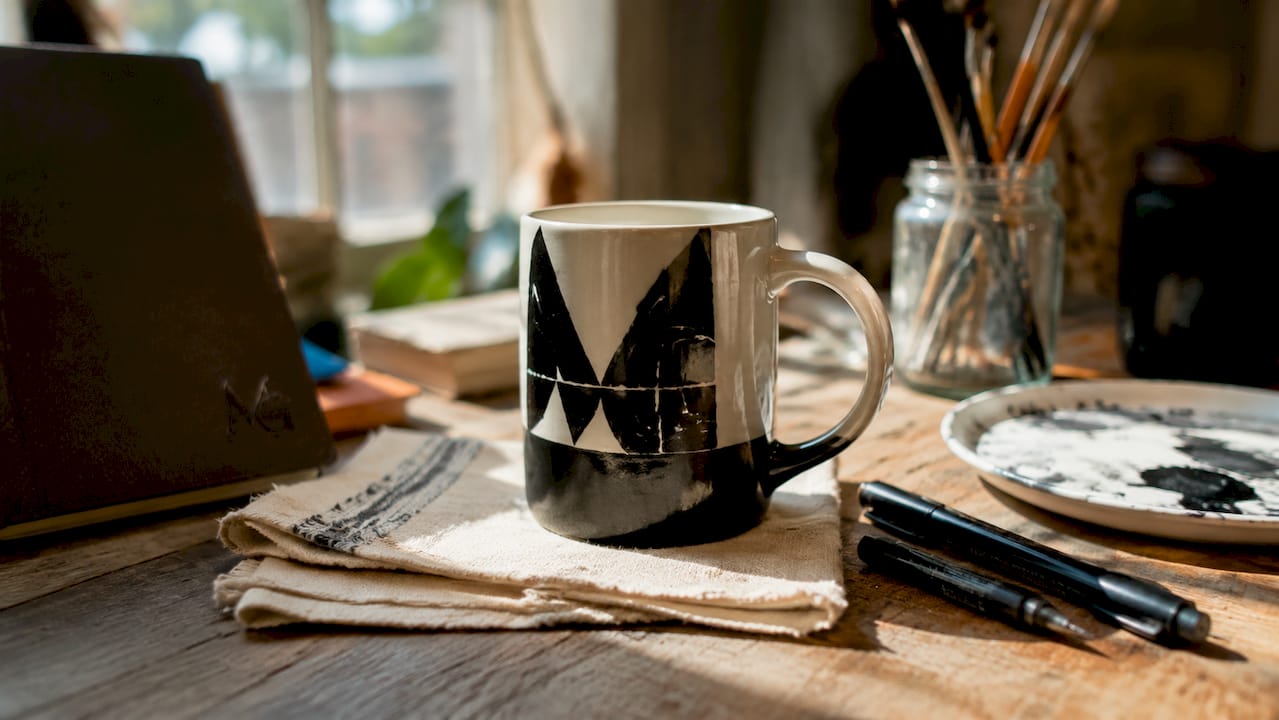
Black and white mug art is defined as the practice of applying high-contrast monochromatic designs to ceramic mugs, using minimalism, geometric patterns, or bold line work to transform a functional object into an expressive artistic statement. The term sits within the broader field of decorative ceramics, where the mug surface becomes a canvas governed by the discipline of working without colour. Artists like Julian Hayes and historic brands like Taylor & Ng have shaped what black and white mug art means today, from collectible curiosities to considered creative objects. Whether you are an art enthusiast, a gift-giver, or a maker, understanding this style opens a genuinely rewarding creative territory.
What is black and white mug art and why does it matter?
Black and white mug art is a recognised subset of decorative mug design in which the entire visual impact relies on contrast rather than colour. The high-contrast monochromatic approach forces the designer to work with composition, line weight, and negative space alone. That constraint is precisely what gives the style its power. A single well-placed brushstroke on a white ceramic surface can carry more visual weight than a full-colour illustration.
The style appeals to a wide audience because it reads as both timeless and personal. Minimalist line drawings of musical instruments, geometric tessellations, and Sumi-e inspired brush marks all fall under this umbrella. Each approach shares the same core discipline: every mark must earn its place because there is nowhere to hide.
How did black and white mug art evolve?
The roots of black and white mug art reach back further than most people expect. The Taylor & Ng collectible mugs of the 1970s established bold black ink on white ceramic as a serious design language. Their anthropomorphic animal designs were witty, graphic, and immediately recognisable. They proved that a mug could carry genuine artistic identity.
The evolution from that era to the present follows a clear trajectory:
- 1970s collectibles. Taylor & Ng used bold black ink line work on white ceramic to create mugs with strong character and collector appeal.
- 1980s and 1990s graphic design influence. Screen printing brought geometric and typographic black and white motifs to mass-market mugs, widening the aesthetic.
- 2000s craft revival. Independent ceramic artists began hand-painting mugs with fine-detail monochrome work, reclaiming the form as a studio art practice.
- Contemporary 'Visual Silence' philosophy. Artist Julian Hayes describes his approach as prioritising the void to create calm and focus. His 'Kinetic Silence' mug uses a single black ink stroke on white ceramic as a visual anchor rather than decoration.
The shift from decorative collectible to considered artistic statement reflects a broader cultural appetite for objects that feel deliberate. Black and white mug designs now appear in creative workspaces, recording studios, and design agencies precisely because they project focus without noise. That is a long way from a novelty gift shop shelf.
What are the key styles and techniques in black and white mug art?
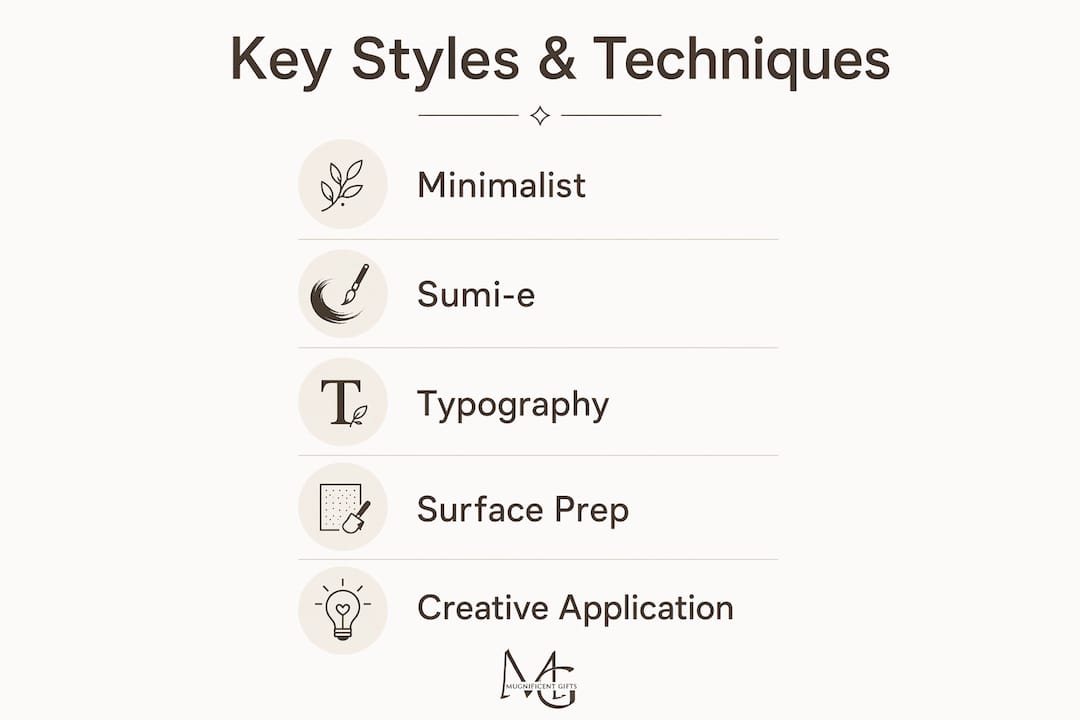
Several distinct visual styles define the genre. Understanding them helps you both appreciate existing work and make informed choices when creating your own.
Minimalist and geometric patterns
Minimalist mug design relies on reduction. A single geometric form, a sparse grid, or a repeated angular motif can fill a mug surface with visual interest while using very little ink. The discipline here is proportion. A circle placed slightly off-centre reads as intentional; placed carelessly, it reads as a mistake.
Sumi-e inspired brush work
Sumi-e is the Japanese art of ink wash painting, and its influence on mug art is direct. Artists apply diluted black ink with a wide brush to create gradients and texture on the ceramic surface. The result is organic and expressive, sitting at the opposite end of the spectrum from geometric precision.
Industrial and typographic motifs
Bold sans-serif lettering, technical diagrams, and architectural line drawings all translate well to black and white ceramics. These designs often appeal to professionals who want their everyday objects to reflect their discipline, whether that is music, architecture, or engineering.
Surface and finish considerations
Ceramic finishes like speckled or matte white glazes enhance the black contrast and make the design feel intentional rather than like a mass-produced decal. A speckled glaze adds texture that interacts with black ink, giving hand-applied designs a depth that printed transfers cannot replicate. Archival inks and permanent ceramic paints are the materials of choice for lasting results.
Pro Tip: Choose a matte or speckled white glaze over a high-gloss finish when hand-painting. Gloss surfaces repel ink more readily, making fine line work harder to control and less durable once cured.
Common pitfalls include applying paint to an unprepared surface. Invisible oils from handling leave a barrier that causes paint or vinyl to peel prematurely, regardless of how carefully the design is applied.
How do professional artists create black and white mug art?
The creation process for professional-quality black and white mug art follows a clear workflow. Skipping any stage produces visible results in the finished piece.
-
Select the right ceramic. Ceramic or porcelain mugs are preferred because their smooth surfaces hold paint well. Plastics and coated mugs do not accept ceramic paints reliably. White mugs offer the classic canvas, though high-contrast designs can work on coloured surfaces.
-
Clean the surface thoroughly. Wipe the entire mug with isopropyl alcohol before any design work begins. This removes oils deposited during manufacturing and handling. Skipping this step is the single most common cause of peeling.
-
Sketch and plan the design. Work out the composition on paper first. For wraparound designs, create a paper template that matches the mug's circumference and height. This reveals how the design will distort around the curve before any ink touches ceramic.
-
Transfer the design using a light-box or chalk outline. Light-box tracing and chalk-outline methods allow artists to map fine details and achieve near-perfect symmetry on a curved surface. Freehand symmetry on a mug is extremely difficult without this step.
-
Apply the design with ceramic paints or porcelain markers. Work from the lightest marks to the darkest. Porcelain markers give clean, consistent line weights. Ceramic paints applied with a fine brush allow for tonal variation and expressive texture.
-
Cure or bake the finished mug. Most ceramic paints require oven curing at a specific temperature to bond permanently with the glaze. Follow the paint manufacturer's instructions precisely. Under-curing leaves the design vulnerable to washing off.
Pro Tip: Test your design on a paper template wrapped around the mug before committing to ceramic. This reveals distortion in geometric patterns and lets you adjust spacing before the design is permanent.
The step-by-step mug design workflow used by professional designers mirrors this process closely. The difference between amateur and professional results almost always comes down to surface preparation and template testing, not artistic talent.
How to apply black and white mug art creatively in your own projects
Once you understand the fundamentals, the creative possibilities are genuinely broad. The following approaches suit both beginners and experienced makers.
- Start with a single motif. A lone musical note, a geometric triangle, or a single brushstroke is a complete design. Resist the urge to fill the surface. Negative space is not empty; it is part of the composition.
- Use text as a design element. A short phrase in a bold monospaced font, placed asymmetrically, creates strong visual interest. The personalised music mug approach used by Mugnificentdeals demonstrates how a name or inside joke becomes the focal point of the design.
- Integrate photography-inspired line work. Reduce a photograph to its essential contours using a tracing technique, then render those lines in black ink. The result is a portrait or landscape that reads as illustration rather than reproduction.
- Test before committing. Wrap a paper template around the mug and draw your design on the paper first. Failing to account for curvature leads to distorted geometry in the final piece, particularly with grids and parallel lines.
- Seal for longevity. After curing, a food-safe ceramic sealant adds a protective layer that extends the life of hand-applied designs significantly.
The table below compares three popular approaches to black and white mug art for different skill levels and intentions.
| Approach | Best for | Skill level | Key material |
|---|---|---|---|
| Geometric line work | Precise, graphic aesthetics | Beginner to intermediate | Porcelain marker |
| Sumi-e brush painting | Expressive, organic designs | Intermediate to advanced | Diluted black ceramic ink |
| Text and typographic design | Personal gifts and humour | Beginner | Porcelain marker or transfer |
Each approach produces a genuinely distinct result. The geometric route suits those drawn to minimalist and geometric black and white ceramics. The Sumi-e route rewards patience and practice. The typographic route is the fastest path to a mug that feels personal and considered.
Key takeaways
Black and white mug art succeeds because constraint forces intention: every mark, surface choice, and technique directly determines whether the finished piece reads as art or accident.
| Point | Details |
|---|---|
| Definition is precise | Black and white mug art uses high-contrast monochromatic design on ceramic to merge function with artistic expression. |
| History shapes the style | Taylor & Ng's 1970s line work and Julian Hayes' 'Visual Silence' philosophy are the two anchoring references for the genre. |
| Surface preparation is non-negotiable | Cleaning with isopropyl alcohol before painting prevents peeling and is the most overlooked step in the process. |
| Templates prevent distortion | Testing a wraparound design on a paper template before applying it to ceramic saves the finished piece from geometric errors. |
| Style choice drives the outcome | Geometric, Sumi-e, and typographic approaches each produce distinct results and suit different skill levels and intentions. |
Why black and white mug art resonates more deeply than it first appears
I have spent a good deal of time thinking about why black and white mug art holds attention in a way that colourful designs often do not. My honest view is that Julian Hayes identified something real when he described the approach as Visual Silence. The absence of colour is not a limitation. It is a decision to trust the viewer.
Most decorative objects compete for attention. A black and white mug does the opposite. It sits quietly on a desk and rewards the person who looks closely. That quality makes it particularly well-suited to musicians, writers, and designers who spend long hours in focused work. The mug becomes a small, reliable anchor in the visual environment.
Working on a curved surface is genuinely challenging, and I think that challenge is worth embracing rather than avoiding. The distortion that a flat design undergoes when wrapped around a cylinder forces you to think about composition in three dimensions. That is a skill that transfers directly to other areas of visual art. The mug is not a lesser canvas. It is a more demanding one.
My practical advice is to begin with a single, confident mark rather than a complex composition. The discipline of committing to one stroke or one geometric form teaches you more about contrast and negative space than filling a surface ever will. Start there, cure it properly, and see what you learn.
— Lasse
Discover personalised black and white mug designs at Mugnificentdeals

Mugnificentdeals specialises in personalised music mugs that apply the black and white aesthetic to musician-focused designs. Each mug is sketched, considered, and personal rather than mass-produced. Whether you want a mug featuring a specific instrument, a name, or a line that only a fellow musician would understand, the range covers it. For gift-givers looking for something that feels genuinely thoughtful, the best personalised music mugs for gifts collection brings together the strongest designs in one place. Quality ceramic surfaces, bold monochrome line work, and a clear sense of personality make these mugs worth exploring.
FAQ
What is black and white mug art exactly?
Black and white mug art is the practice of applying high-contrast monochromatic designs to ceramic mugs using minimalism, geometric patterns, or bold line work. The style treats the mug surface as a deliberate artistic canvas rather than a vehicle for decoration.
What styles are most common in black and white mug designs?
The three most common styles are minimalist geometric patterns, Sumi-e inspired brush work, and typographic or text-based designs. Each produces a distinct visual result and suits a different skill level.
How do I prepare a mug before painting it?
Clean the entire surface with isopropyl alcohol before applying any paint or vinyl. This removes invisible oils that cause premature peeling, regardless of how carefully the design is applied.
How do I stop my design from distorting around the mug?
Wrap a paper template around the mug and draw your design on the paper first. This reveals how geometric patterns distort around the curve before any ink touches the ceramic surface.
What materials do professional artists use for mug art?
Professional artists use porcelain markers for clean line work and ceramic paints for tonal variation. Ceramic and porcelain mugs are the preferred surfaces because their smooth glazes hold paint reliably, unlike plastic or coated alternatives.