

Musical instrument motifs define the role of instruments in mug art as one of the most expressive intersections between music culture and ceramic design. A violin silhouette, a row of piano keys, or a minimalist guitar outline transforms a plain mug into a personal statement. Artists and musicians increasingly treat mugs as three-dimensional canvases, applying techniques from waterslide decals and ceramic paints to Arduino-powered interactive designs. Brands like Mugnificentdeals have built entire collections around this idea, proving that a well-placed instrument drawing carries more personality than any generic print ever could.
How do musical instruments inspire mug art designs?
Instrument motifs in mug art go far beyond decoration. They carry cultural weight, personal identity, and a shared language that musicians instantly recognise. A drummer sees a snare on a mug and feels seen. A violinist spots a bow-hold sketch and smiles before the coffee is even poured.
The most common motifs include:
- Violins and cellos rendered in fine black line art, often wrapping around the mug body
- Guitar silhouettes using negative space to create contrast against a solid background
- Piano keys running horizontally across the mug's widest circumference
- Treble clefs and musical notation layered with instrument outlines for depth
- Drumstick crosses and percussion symbols for rhythm-focused designs
Colour choices matter as much as the motif itself. High-contrast, minimalist line art translates best onto curved ceramic surfaces, keeping designs legible at a glance. Dark ink on a white or cream base remains the most reliable combination for instrument-themed work.
Shape and handle design also echo instrument aesthetics. Treating the mug as a three-dimensional canvas with attention to handle form, texture, and silhouette produces designs that feel considered rather than printed. A handle shaped with the gentle curve of a cello's waist, for instance, adds a layer of meaning that a flat print cannot achieve.

Pro Tip: Test your instrument design in greyscale before committing to colour. If the motif reads clearly without colour, it will survive any background and any lighting condition.
What are the key mug art techniques for instrument themes?
The mug art creation process spans a wide range of methods, from professional ceramic firing to home-based marker techniques. Each approach suits a different level of commitment, budget, and desired permanence.
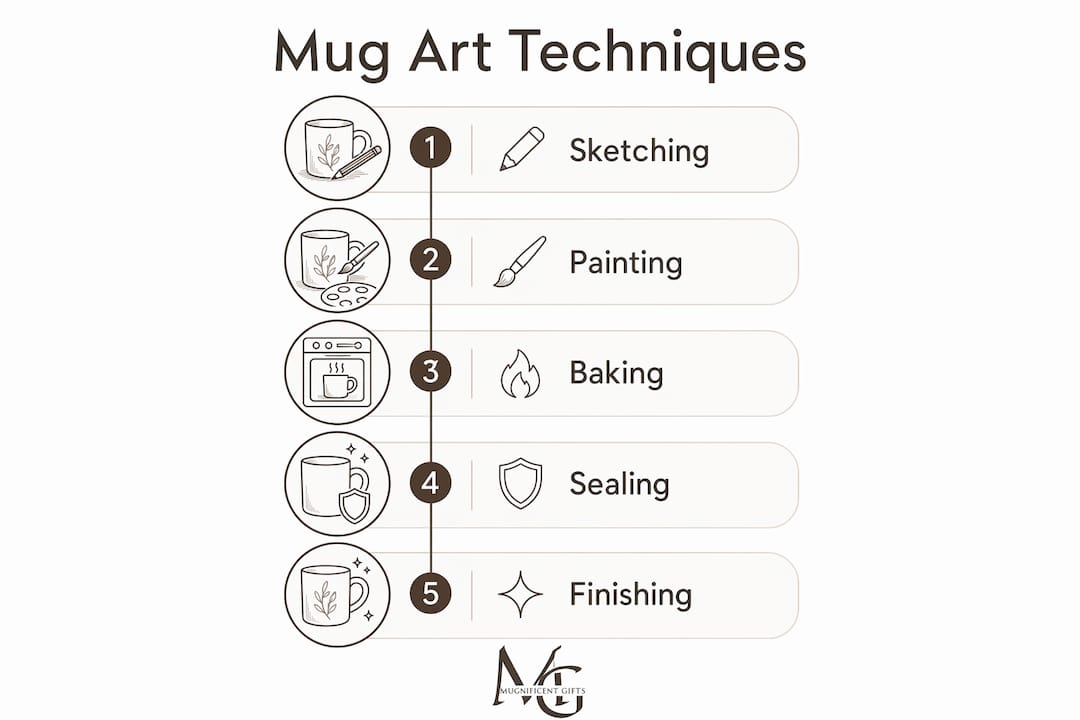
Professional ceramic firing
Professional studios fire instrument-themed designs at 700–750°C to fix them permanently. This temperature range vitrifies the glaze and locks pigment into the ceramic body. The result is a dishwasher-safe, fade-resistant finish that home methods cannot fully replicate.
Home-based baking and sealing
Home decorators bake mugs at approximately 120°C for 15–20 minutes to cure ceramic paints and marker-based designs. This lower temperature sets the medium without firing the clay itself.
The step-by-step process for home decoration runs as follows:
- Clean the mug surface with isopropyl alcohol to remove oils and residue.
- Sketch the instrument motif lightly with a pencil or chalk marker.
- Apply ceramic paint or a permanent marker following the instrument outline.
- Allow the design to dry fully before baking.
- Bake at 120°C for 15–20 minutes, then cool in the oven with the door ajar.
- Apply a food-safe clear sealer once fully cooled.
- Allow up to 28 days of curing time before the first dishwasher cycle.
Materials comparison
| Material | Best use | Durability |
|---|---|---|
| Ceramic paint | Detailed instrument illustrations | High with baking and sealing |
| Permanent markers | Quick sketches and line art | Moderate, requires sealing |
| Waterslide decals | Complex photographic motifs | High with professional firing |
| Underglaze | Studio pottery with kiln access | Very high, permanent |
Pro Tip: Waterslide decals work particularly well for intricate instrument drawings like violin scroll details or guitar headstock tuning pegs. They transfer cleanly and hold fine lines that hand-painting often blurs.
For those interested in the full hand-drawn approach, the hand-drawn mug art guide covers curing and sealing steps in practical detail.
How do artists balance functionality and artistry in instrument-inspired mugs?
Aesthetic ambition and practical use pull in opposite directions when designing instrument-themed mugs. The most successful pieces resolve this tension through deliberate placement and material choices.
Key design considerations include:
- Wrap intent: Critical design elements should sit at least 1–2 inches away from the handle to prevent distortion and preserve full visibility when the mug is held. A guitar neck that disappears behind the handle defeats the entire composition.
- Rim clearance: Keep paint and marker designs 1–2 inches below the rim to protect artwork from wear and to prevent non-food-safe sealants from contacting the mouth. This rule applies to every instrument motif regardless of technique.
- Thermal shock prevention: Place ceramic mugs in a cold oven before preheating rather than inserting them into a hot oven. Sudden temperature changes crack ceramic bodies, destroying hours of decorative work.
- Texture and grip: Raised texture inspired by instrument surfaces, such as the ridged body of a guitar or the ribbed keys of an accordion, adds tactile interest but must not compromise the grip or comfort of the handle.
- Ergonomic silhouette: Mugs shaped to echo instrument forms, like a body narrowed at the waist to suggest a violin, must still hold a standard volume and sit stably on a flat surface.
The tension between art and function is not a problem to eliminate. It is the creative constraint that makes instrument-inspired mug design genuinely interesting. Working within it produces pieces that are both beautiful and useful, which is precisely what makes them worth owning.
What creative innovations are emerging in musical instrument mug art?
The most surprising development in instrument-inspired mug art is not visual. It is sonic. Using a Disney Touché sensor and an Arduino microcontroller, hobbyists can convert a water-filled ceramic mug into a touch-sensitive musical instrument for approximately £1 in additional components beyond a standard kit. The software ChucK processes the capacitive signal from the water surface and triggers musical tones on contact. A mug becomes a playable instrument, not just a picture of one.
This kind of project sits at the edge of what most people consider mug art. Yet it captures something the best instrument-themed designs already do: they make the object feel alive with musical intention.
On the conceptual side, exhibitions like Ffiona Lewis's Slung Mugs show how instrument history and performance culture can anchor mug art in genuine meaning. Lewis uses the mug as a vehicle for exploring the relationship between musicians and their instruments, treating the object as a cultural artefact rather than a souvenir.
"Musical instrument motifs in mug art serve as profound conceptual anchors, linking object history and musical performance culture, offering depth beyond decoration."
Minimalist approaches are gaining ground alongside these more complex projects. AI-assisted design workflows now help artists generate clean instrument outlines optimised for curved surfaces, testing legibility before a single drop of paint is applied. The result is a new generation of mug designs that feel hand-sketched but are technically precise.
| Approach | Creative focus | Technical complexity |
|---|---|---|
| Hand-drawn line art | Personal, expressive instrument sketches | Low to moderate |
| Waterslide decal printing | Photographic or detailed instrument imagery | Moderate |
| Arduino touch-sensor integration | Interactive, playable mug instruments | High |
| AI-assisted design generation | Optimised, legible instrument motifs | Low with the right tools |
The music-themed mug art guide explores several of these approaches in practical terms for artists ready to experiment.
Key takeaways
Instrument-inspired mug art succeeds when artists treat the mug as a three-dimensional canvas, apply the right technique for the desired durability, and respect the functional constraints that make a mug worth using every day.
| Point | Details |
|---|---|
| Motif placement matters | Keep designs 1–2 inches from the handle and below the rim for visibility and safety. |
| Technique determines durability | Professional firing at 700–750°C outlasts home baking, but sealing extends marker-based work significantly. |
| Minimalist line art performs best | High-contrast instrument outlines read clearly on curved surfaces where complex imagery blurs. |
| Functionality shapes artistry | Wrap intent, thermal shock prevention, and ergonomic silhouette are design constraints, not limitations. |
| Innovation is expanding the form | Arduino-powered mugs and AI-assisted design are pushing instrument-themed mug art into genuinely new territory. |
Why this intersection rewards more attention than it gets
I have spent a fair amount of time looking at how musicians respond to objects made in their honour, and the pattern is consistent. A mug with a generic music note printed on it gets a polite nod. A mug with a carefully drawn violin scroll, placed with intention, gets picked up and examined. That difference is entirely about craft.
What strikes me most about instrument-themed mug art is how rarely artists think about the handle as part of the composition. The handle is the first thing a musician's hand reaches for. Designing around it, rather than ignoring it, is the single change that separates a thoughtful piece from a forgettable one.
The Arduino water-instrument project also deserves more attention from the art community. Most people dismiss it as a novelty. I think it points toward something genuinely interesting: the idea that a mug can perform music rather than simply depict it. That is a conceptual leap worth taking seriously.
For musicians who want to go deeper into personal expression through mugs, the creative possibilities extend well beyond what most gift-shop designs suggest. The form is underexplored. That is an opportunity, not a limitation.
— Lasse
Mugnificentdeals: instrument-inspired mugs worth owning
Mugnificentdeals designs mugs the way musicians think about their instruments: with care, specificity, and a sense of humour that earns its place. Each piece in the personalised music mugs collection reflects a genuine understanding of what musicians want to see on their morning coffee ritual.

The designs range from clean black-and-white instrument sketches to personalised pieces carrying a name, an instrument, and the kind of inside joke that only makes sense to the person holding it. If you are looking for a gift that feels commissioned rather than grabbed off a shelf, the best personalised music mugs for gifts collection is the place to start. These are mugs that musicians actually want to use.
FAQ
What is the role of instruments in mug art?
Musical instruments serve as the primary visual and conceptual inspiration in mug art, providing motifs, silhouettes, and cultural meaning that transform a functional object into a personal artistic statement.
What techniques work best for instrument-themed mug designs?
Minimalist line art applied with ceramic paint or permanent markers, then sealed and baked at 120°C, produces clear and durable instrument designs for home decorators. Professional firing at 700–750°C offers the highest permanence.
How do I keep a mug design from distorting near the handle?
Leave at least 1–2 inches of clear space around the handle when placing any instrument motif. This preserves the full composition when the mug is held and prevents key visual elements from disappearing behind the grip.
Can a mug actually be turned into a musical instrument?
Yes. Using an Arduino kit and a Disney Touché sensor, a water-filled ceramic mug can be converted into a touch-sensitive instrument for approximately £1 in additional parts, with the software ChucK generating musical tones on contact.
How long does a hand-decorated mug take to become dishwasher-safe?
After applying a food-safe sealer, hand-decorated mugs require up to 28 days of curing time before they are reliably dishwasher-safe.