

There is a mug sitting on someone's desk right now that says more about them than their LinkedIn profile ever could. That is precisely what makes it worth understanding when you want to explain personal expression mugs to someone searching for a meaningful gift. A personalised mug is not just a vessel for coffee or tea. For musicians and creatives, it is a quiet declaration of identity, humour, and belonging, wrapped around something they reach for every single day. This article unpacks how these mugs work, what makes them effective, and how to design or choose one that truly resonates.
Table of Contents
- Key takeaways
- Understanding personal expression mugs
- Design elements that make mugs expressive
- Types of personalised music-themed mugs
- How to design personal mugs step by step
- My perspective on expressive mugs for musicians
- Find your perfect music mug at Mugnificentdeals
- FAQ
Key takeaways
| Point | Details |
|---|---|
| Mugs as identity signals | Personalised mugs act as low-risk, daily expressions of personality and musical identity. |
| Design principles matter | Bold typography, high contrast, and handle placement are critical for legible, attractive mug designs. |
| Humour and niche references connect | Music-specific jokes and inside references make mugs feel personal rather than generic. |
| Material and style affect outcomes | Ceramic, travel, and wraparound designs each offer distinct creative and practical advantages. |
| Ordering is more accessible than ever | Modern tools allow non-designers to create expressive, print-ready mug designs with ease. |
Understanding personal expression mugs
To properly explain personal expression mugs, it helps to start with why they work psychologically. Unlike a T-shirt or a poster, a mug is an object of daily ritual. You fill it, hold it, carry it, and set it in plain view of colleagues, bandmates, or guests. That constant visibility turns it into a silent statement about who you are.
Novelty mugs serve as a low-risk form of identity expression and communication, especially for musicians and creatives who want to signal niche interests without broadcasting them. The key word here is "low-risk." A mug does not demand attention the way a loud patch on a jacket might. It simply sits there, being itself, and lets the right people notice.
"Many people feel mugs express their personalities and life stories better than their curated online profiles, providing a more authentic nonverbal communication channel."
This rings particularly true for musicians. A violinist who keeps a mug printed with a delicate bow illustration is not shouting about their passion. They are weaving it into the fabric of their morning. That subtlety is what makes customized mugs for expression so appealing within creative communities. They build connection without demanding it.
Novelty mugs also spark conversations and help build community connections based on shared humour and interests. A drummer spotting a "I don't make mistakes, I improvise" mug on a colleague's desk is going to smile. Possibly start a conversation. Possibly feel a little less alone in the world. That is the cultural power of a well-chosen, personalised mug. Households now represent 45% of global ceramic mug demand, driven precisely by this appetite for premium, design-led pieces that reflect personal style rather than just fill a cupboard.
Design elements that make mugs expressive
Choosing a concept is one thing. Getting it to land visually on a curved ceramic surface is another challenge entirely. Understanding the mechanics behind expressive mug designs is what separates a gift that gets used every day from one that quietly migrates to the back of the shelf.
Here are the core design elements to get right:
- Typography size and weight. Font sizes appropriate for flat graphics are simply not sufficient for curved mug surfaces. Bold weights and high-contrast pairings are required to maintain legibility when the text wraps around the body of the mug. Thin decorative scripts, while lovely on screen, often become illegible once printed.
- Colour contrast. Dark text on a light background or vice versa reads clearly from across a room. Pastel on pastel, however charming in theory, tends to disappear. For music-themed mugs especially, contrast also adds energy.
- Handle placement. This is the element most first-time designers overlook entirely. The handle interrupts the front view of a mug and must be accounted for in the layout. A beautifully composed central design that falls directly behind the handle when held will never be seen properly. Positioning text or imagery slightly to the right of centre (for right-handed users) or choosing a wraparound layout solves this cleanly.
- Humour and niche references. Humour and nostalgia are core motivators in mug popularity. For musicians specifically, dry wit and music-specific inside jokes create an immediate sense of recognition. "I survived another rehearsal" lands differently for an orchestra member than a generic inspirational quote ever could.
- Avoiding overcrowding. Expressive does not mean cluttered. The most memorable unique expression coffee cups tend to carry a single clear idea, executed with confidence.
Pro Tip: When reviewing your mug design, rotate the digital preview and simulate the handle position with your finger covering roughly 20% of the left or right edge. If your core message is still visible and centred on the remaining surface, the layout works.
The home aesthetic movement has further raised the bar. Consumers now treat drinkware as lifestyle accessories, which means a mug that looks striking on a kitchen shelf or in an Instagram flat lay carries extra appeal as a gift. Balancing aesthetics with practicality is not a compromise. It is a design goal in itself. Explore how thoughtful mug design matters more than most buyers initially expect.
Types of personalised music-themed mugs
Not all expressive mug designs are created the same way. Understanding the range of options helps you match the right format to the right recipient, occasion, and budget.
| Mug type | Best for | Key consideration |
|---|---|---|
| Single-sided ceramic | Clean, focused messages or illustrations | Design must avoid handle zone |
| Wraparound ceramic | Storytelling layouts, detailed artwork | Greater print area; higher design complexity |
| Travel mug (stainless steel) | Gigging musicians, commuters | Limited print area; metallic finishes affect colour |
| Colour-changing (heat-reveal) | Novelty gift occasions | Design only visible when hot; choose high-contrast reveals |
| Artisanal / hand-illustrated style | Premium gifts, collectors | Reflects premiumisation trend; higher perceived value |
Single-sided designs work well for a single bold statement, such as a clean instrument illustration paired with a name. Wraparound designs suit more narrative concepts, like a timeline of a musician's life in musical notes or a panoramic scene of a concert. Travel mugs are practical for musicians who are frequently on the move, though the cylindrical shape and often-matte finishes require simplified artwork to retain clarity.
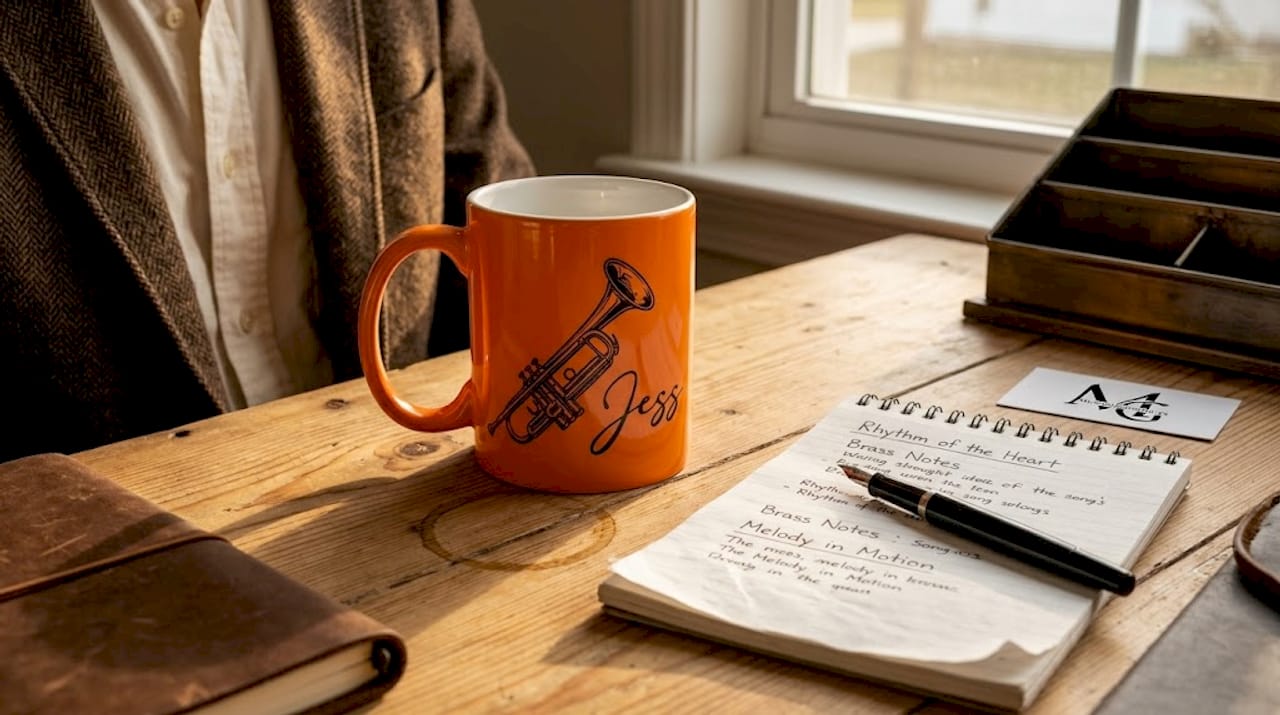
The premiumisation trend in ceramic mugs has also elevated artisanal, hand-illustrated styles as a distinct category. These feel less like merchandise and more like keepsakes, which makes them particularly strong as meaningful mug designs for milestone occasions such as recitals, graduations, or retirements from a musical career. For a full breakdown of which style suits different recipients, the gift buyer's guide to music mugs covers the landscape thoroughly.
How to design personal mugs step by step
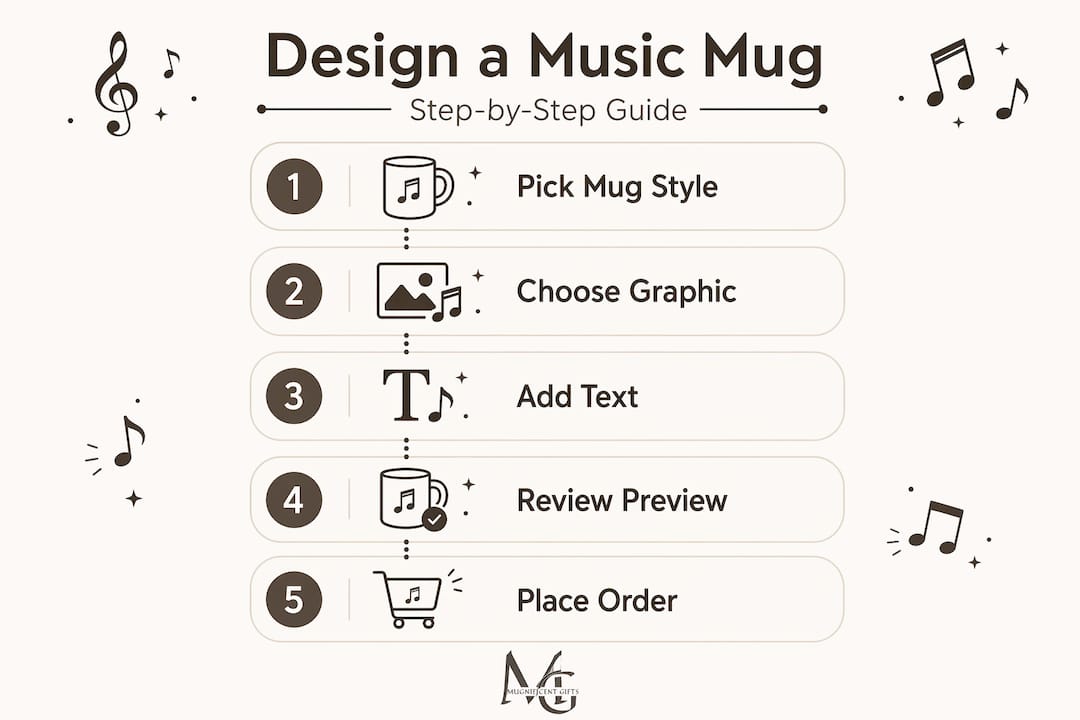
Creative mug personalisation ideas are only useful if you know how to turn them into a finished, print-ready product. The good news is that modern drag-and-drop tools have made this accessible to anyone, regardless of design experience. Here is a practical approach that works:
- Define the core concept. Before opening any design tool, decide what the mug is primarily about. Is it a witty one-liner? A portrait of a specific instrument? A reference to a shared musical memory? One clear concept is always more powerful than three competing ideas.
- Choose your mug format. Based on the comparison table above, select the mug type that suits your concept and the recipient's lifestyle. A touring guitarist likely uses a travel mug daily. A classical pianist at home may treasure a quality ceramic piece.
- Account for the handle zone. Mapping your design relative to the handle before finalising placement prevents the most common printing disappointment. Leave clear margins around both edges of the printable area, and verify the focal point of your design sits on the dominant "viewing side."
- Scale your typography. Increase your font size well beyond what you would use for a poster or social media graphic. Bold, clean typefaces at a generous size read beautifully on ceramic. Ornate or light-weight fonts tend to break up when printed on a curved surface.
- Use high-contrast colour combinations. Black on white, white on navy, deep red on cream. These pairings work on almost every screen and printing system without colour-shift surprises.
- Preview in context. Most online mug design platforms show a 3D mockup of the finished product. Check it carefully. Rotate the view. Ask yourself whether the design reads clearly from a metre away, because that is often how it will be seen in the real world.
- Check resolution and file format. Images should be at least 300 DPI at print size. Logos or illustrations saved from the web at 72 DPI will appear blurry once printed at mug scale.
Pro Tip: If you are designing a mug as a gift and want to include the recipient's name, place the name on the secondary "private" side of the mug. This way, the expressive illustration or joke faces outward publicly, while the personal detail feels like a hidden signature discovered on first use.
How to design personal mugs does not require professional software or a graphic design background. What it requires is clarity of concept, respect for the physical constraints of the mug surface, and a genuine understanding of what will make the recipient smile.
My perspective on expressive mugs for musicians
I have seen a lot of personalised gifts come and go, but personalised mugs for musicians occupy a genuinely unusual space. They are used every day, displayed in homes, rehearsal rooms, and green rooms, and they carry meaning without ever announcing it loudly.
What I find most interesting is how often the design restraint is what makes a mug feel personal. The mugs that land best are not the ones crammed with text and imagery. They are the ones that say one true thing clearly. A hand-drawn piano sketch with a single musician's name says more than a collage of musical facts ever could.
I also think people underestimate how much the humour register matters. Music-specific wit, the kind that only makes sense if you have sat through a four-hour orchestra rehearsal or debated chord voicings at midnight, creates a sense of recognition that generic humour simply cannot replicate. When someone opens a gift and thinks "this was made for me," that moment is entirely created by specificity.
The mistake I see most often is choosing a design that tries to appeal to everyone who likes music generally, rather than one that speaks precisely to the specific musician receiving it. A mug for a cellist should feel different from one for a jazz drummer. The more specific, the more meaningful.
Expressive mugs are small canvases, and the best ones are painted with intention.
— Lasse
Find your perfect music mug at Mugnificentdeals
If everything in this article has clarified what you are looking for, Mugnificentdeals makes the next step straightforward. The brand specialises in personalised music mugs designed specifically for musicians and the people who want to celebrate them. Every design reflects the kind of thoughtful specificity discussed throughout this article: clean illustration work, music-specific humour, and personal touches that make each mug feel commissioned rather than mass-produced.
Whether you are searching for a gift for a violinist, a drummer, or a devoted music teacher, the curated range of best gifts for musicians includes options across every style discussed here. From single-sided ceramic pieces to wraparound designs, the collection brings expressive mug designs to life for real musicians and the people who know them well.
FAQ
What are personal expression mugs?
Personal expression mugs are customised drinkware designed to reflect the owner's identity, humour, or interests. They act as everyday objects that communicate personality without words, particularly popular among musicians and creatives.
Why are personalised mugs good gifts for musicians?
Personalised mugs combine daily practicality with emotional resonance. Music-specific references, instrument illustrations, and inside jokes make them far more meaningful than generic gifts, and they are used often enough to remain visible long after the occasion.
What makes an expressive mug design work well?
Effective expressive mug designs use bold typography, high-contrast colours, and clear focal points positioned away from the handle zone. A single strong concept executed cleanly outperforms complex, cluttered layouts every time.
How do I avoid common mistakes when designing a custom mug?
Account for the handle interruption, increase font sizes beyond normal digital standards, and avoid placing key design elements too close to the edges. Always preview a 3D mockup before ordering to check how the design reads from different angles.
Are personalised mugs suitable for professional musicians?
Absolutely. Whether as a rehearsal room staple or a home studio companion, a well-designed personalised mug suits any musician's environment. Artisanal and hand-illustrated styles carry particularly strong appeal for professional or serious musicians seeking a refined, meaningful gift.