
Few objects sit closer to daily identity than a mug. The history of personalized mugs is far older and more socially rich than most people realise, stretching back well before digital printing or e-commerce made customisation easy. If you are a musician, music teacher, or someone searching for a gift that actually means something, understanding where personalised mugs came from changes how you think about giving one.
Table of Contents
- Origins of mugs and the rise of personalised drinkware
- Early social traditions and practical uses of personalised mugs
- How modern organisations use personalised mugs for identity and brand loyalty
- Understanding personalised mugs as musical identity and humour gifts
- The hidden social power of personalised mugs in musical communities
- Explore personalised music mugs at Mugnificent Deals
- Frequently asked questions
Key Takeaways
| Point | Details |
|---|---|
| Personalisation origins | Mugs evolved technologically and socially, enabling early personalised traditions in communities and institutions. |
| Social bonding tool | Personalised mugs foster repeated interaction and identity signalling within groups like musicians and educators. |
| Effective gift strategy | Their practical use and sentimental value make personalised mugs memorable, humorous gifts that deepen connections. |
| Pre-digital customisation | Personalisation predates digital printing and included logistics practices fostering community belonging. |
| Business impact | Branded mugs influence customer loyalty and brand impressions owing to high retention and daily visibility. |
Origins of mugs and the rise of personalised drinkware
The story of the personalised mug begins with the mug itself, and that story starts earlier than you might expect. Mug designs evolved from bone and wood in the Stone Age to clay, metal, and porcelain over thousands of years, with each material shift making decoration and personalisation increasingly feasible.
Here is a simplified personalised mug history timeline showing the key material breakthroughs:
- Neolithic era (circa 10,000 BCE): Early drinking vessels were carved from bone and wood, durable but impossible to decorate meaningfully or repeatedly.
- Ancient civilisations (circa 6,000 BCE onwards): Clay pottery allowed basic shaping and rudimentary surface markings, which were early precursors to personalised decoration.
- Roman and Medieval periods: Metal mugs, particularly pewter and silver, carried engraved names and crests, making personalisation a privilege of the wealthy.
- Tang Dynasty China (circa 618 CE): Porcelain was refined to a point where thin, handle-equipped vessels could safely hold hot liquids without burning the hand, a practical revolution.
- 18th and 19th centuries: European ceramic production industrialised, making decorated and inscribed mugs accessible to ordinary households for the first time.
- 20th century onwards: Screen printing, sublimation, and eventually digital printing turned designing personal musician mugs into something anyone could commission affordably.
The critical insight here is that personalisation did not arrive with the internet. Each material advance opened a new door: porcelain could be painted, ceramics could be fired with text, and industrialisation meant a name on a mug was no longer reserved for aristocrats. The custom mug evolution is really a story about accessibility catching up with desire.
Early social traditions and practical uses of personalised mugs
With that foundation in hand, we can explore how social practices shaped personalisation beyond materials.
Some of the most compelling evidence for when did personalised mugs become popular comes not from commercial history but from community life. Consider this remarkable example from small-town America:
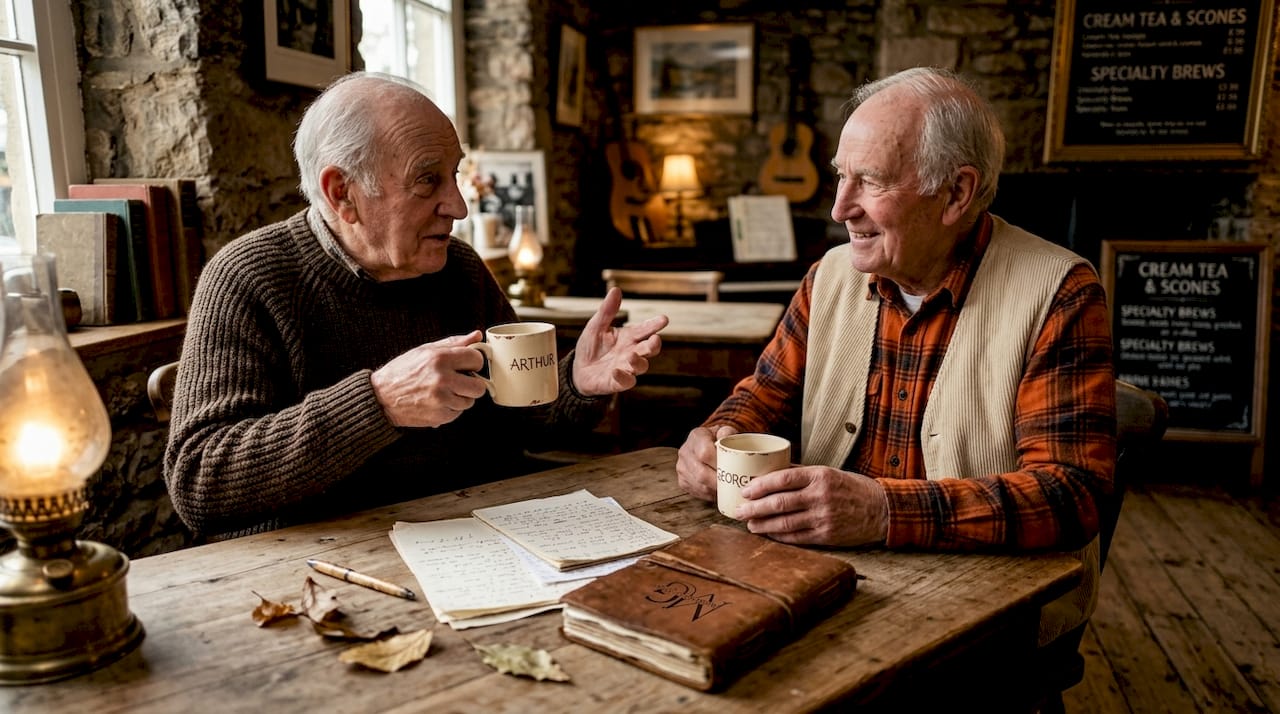
In Arcola, Illinois, a local coffee club required customers to drink 100 cups of coffee to earn a name-labelled mug kept on a dedicated shelf, creating an ongoing ritual of belonging that drew people back week after week.
That was 1948. No digital printing. No online customisation tool. Just a proprietor with a marker, a shelf, and an understanding that a name on an object changes its meaning entirely. The mug was not a product. It was membership.
This community logic appears in educational settings too. Elon University's Art History programme introduced a senior mug tradition roughly a decade ago, inviting graduating students to participate in what they call a "muggening" celebration. Each mug reflects individual student input, creating an object that carries genuine sentimental and collectible value long after graduation.
What these traditions share is instructive for musicians and educators:
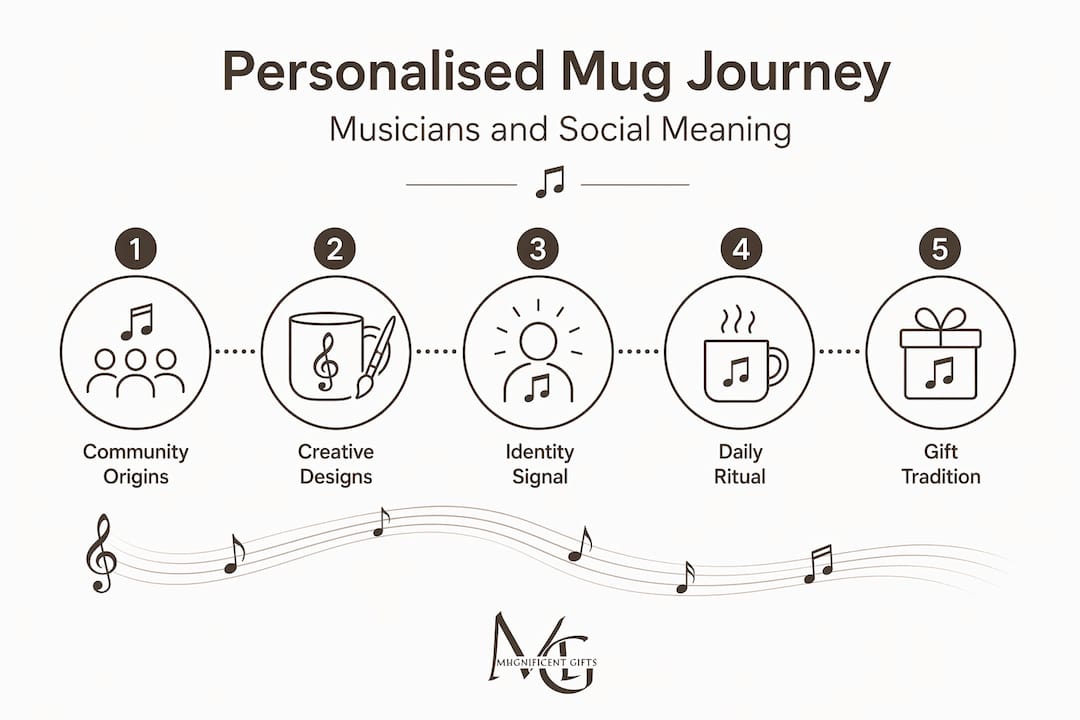
- Personalisation builds continuity. A mug with your name or a private joke does not get abandoned on a kitchen shelf. It becomes part of a daily routine.
- Humour and identity increase attachment. The Arcola mugs included individual quirks and preferences. Elon students shaped their own designs. Both approaches deepened the emotional connection to the object.
- Community rituals amplify meaning. A mug earned through shared experience carries more weight than one simply purchased. This is exactly why personalised music mugs resonate so strongly in ensemble settings, staff rooms, and music schools.
- Educators and musicians already operate within ritual structures, from the first day of term to the end-of-year concert. A well-chosen mug slots naturally into those rhythms.
These community-driven origins contrast with modern corporate uses, which we will explore next.
How modern organisations use personalised mugs for identity and brand loyalty
Understanding why organisations invest in personalised drinkware helps clarify why these objects work so well as gifts, particularly for professionals with strong group identities like orchestras, bands, and music departments.
The data is persuasive. 30% of customers who receive drinkware as a promotional or gifted item are more likely to do business again with the person who gave it to them. That is a retention figure most marketing channels would envy.
| Mug use case | Primary benefit | Relevant for musicians/educators? |
|---|---|---|
| Corporate branded mug | Brand visibility, daily impressions | Moderately, for music schools |
| Community name-labelled mug | Belonging, ritual participation | Strongly, for ensembles and choirs |
| Humorous identity mug | Morale, shared laughter | Strongly, for teaching staff and bands |
| Commemorative event mug | Memory, collectible value | Strongly, for concerts and graduations |
| Personalised gift mug | Emotional connection, individual recognition | Strongly, for all musicians and educators |
The most important column in that table is the last one. Musicians and educators do not just want a mug that looks nice. They want one that signals something true about who they are, whether that is a treble clef sketch, a line about surviving Grade 5 theory, or a quiet joke only their section understands.
Pro Tip: When giving a personalised mug to a musician or music teacher, think about their role rather than just their instrument. A choir director's identity is different from a soloist's. A peripatetic music teacher covering twelve schools has a different sense of humour from a conservatoire professor. The most memorable coffee mug gifts for music lovers are the ones that acknowledge that nuance.
Understanding these uses helps clarify why personalised mugs resonate so strongly with musicians and educators.
Understanding personalised mugs as musical identity and humour gifts
The history of custom ceramics shows that the best personalised objects have always combined function with social signal. For musicians, that social signal is rich territory. Music is already a language of identity: what instrument you play, what genre you favour, how you talk about theory or rhythm or rehearsal all mark you out within a community. A well-designed mug can carry all of that in a glance.
Here is a comparison of the main design approaches, each with distinct strengths:
| Design style | What it communicates | Best for |
|---|---|---|
| Illustrative (instrument drawings, sketches) | Craft, identity, aesthetic appreciation | Instrumentalists, music educators with display space |
| Text-based (quotes, jokes, musical puns) | Humour, shared language, wit | Staff rooms, ensemble gifts, secret Santa |
| Photo-based (portrait, sheet music, event) | Personal memory, sentimentality | Milestone gifts, retirements, graduations |
| Minimalist (single clef, note, or symbol) | Quiet identity, everyday elegance | Professionals who prefer understatement |
The most shareable unique mug designs in musical communities tend to be text-based or illustrative, because they invite conversation. A mug that reads "I don't make mistakes, I improvise" gets picked up, read, and passed around during a rehearsal break in a way that a plain instrument photo simply does not.
When considering best personalised music mugs for gifts, it also helps to think about longevity. Humour dates well when it is built on universal musician experiences: the endless tuning, the fortissimo that surprises everyone, the student who always forgets their music. Those jokes will still land in five years.
Pro Tip: If you are unsure between illustrative and text-based, lean towards text for group gifts and illustrative for individual ones. A personal sketch of someone's instrument feels singular and considered. A shared joke works as a unifying object when you are gifting a whole section or department. You can explore custom mug design tips to find the approach that fits best.
Having seen why personalised mugs work, let's reflect on lesser-known truths and lessons from their social history.
The hidden social power of personalised mugs in musical communities
Most articles about the history of personalized mugs focus on materials, printing technology, and commercial adoption. That is the obvious thread. But the more interesting story is the one about social infrastructure: how personalised mugs function as ritual objects that hold communities together across time.
Think about what actually happens in a music school or an orchestra pit. Relationships are maintained through repeated, low-stakes interactions: the pre-rehearsal chat, the interval coffee, the shared groan after a difficult passage. A personalised mug is present for all of those moments. It does not merely represent identity. It participates in building it, cup by cup.
Personalisation is more than printing; it is a logistics and social practice that embeds continuity and belonging within communities. The Arcola coffee club understood this instinctively. The proprietor tracked which mug belonged to which customer, maintained a physical shelf, and managed that system across years. That effort was not incidental. It was the point. The labour of keeping track of someone's mug is itself an act of recognition.
Musicians and music educators can apply this insight deliberately. Consider a department that commissions new mugs each academic year with a small design tweak, building a series that staff and students collect over time. Or an ensemble that gifts a unique mug to each member at the start of a tour, creating an object that carries the memory of those performances for decades. These are not grand gestures. They are small, repeated acts of recognition that accumulate into genuine community.
The conventional wisdom says personalised mugs are gifts. The deeper truth is that they are social technology. When you understand that, you make better choices about what to put on them, when to give them, and to whom. You can start thinking about designing minimal personal musician mugs with that social dimension in mind, not just the visual one.
With this deeper understanding, you can now confidently choose or create personalised mugs that truly resonate.
Explore personalised music mugs at Mugnificent Deals
If this history has sparked an idea for your next gift, you are in the right place. Mugnificent Deals exists precisely for musicians and music educators who want a mug that says something real rather than something generic.
Browse the personalised music mugs collection for designs that balance humour, identity, and visual appeal, from instrument sketches to clever musical puns. If you already know what you are looking for, the best personalised music mugs gifts section curates the most popular choices for gifting occasions. Prefer something with a distinctive ceramic character? Explore the unique ceramic mugs popular styles range for options that feel considered rather than mass-produced.
Frequently asked questions
When did personalised mugs first become popular in communities?
Personalised mugs gained popularity in specific communities around the mid-20th century. The Arcola, Illinois coffee club mug tradition from 1948 is a clear example of name-labelled mugs used to foster belonging well before digital customisation existed.
How do personalised mugs benefit musicians and educators as gifts?
They provide daily practical use while celebrating the recipient's musical identity and humour, strengthening social bonds within ensembles and teaching communities. Their practicality and personal relevance make them memorable long after other gifts are forgotten.
What makes personalised mugs an effective promotional or gift item?
Their high visibility and daily use create lasting impressions over time. Research shows 30% of recipients are more likely to return to the giver, making them one of the most cost-effective and emotionally resonant gift categories available.
Are personalised mugs a recent digital printing phenomenon?
Not at all. Personalisation predates digital printing by decades, with earlier methods relying on physical inventory management and hand-labelling in community settings. Digital printing simply made the process faster and more accessible to everyone.