

A mug is the first thing many people reach for in the morning, yet most receive almost no design thought at all. That gap is exactly why thoughtful mug design has become such a powerful concept. The right design transforms a functional object into something that carries personality, triggers memories, and signals belonging. For music lovers in particular, a mug that whispers "you get it" is worth more than a dozen generic gifts. This article unpacks the psychology, the craft, and the genuine human value behind mugs that are designed with real intention.
Table of Contents
- Key takeaways
- The psychology behind why thoughtful mug design matters
- Core design principles that make a mug thoughtful
- Thoughtful design in gifting and personal expression
- Generic vs thoughtful mugs: a direct comparison
- My honest take on why this all matters
- Discover music mugs made with real intention
- FAQ
Key takeaways
| Point | Details |
|---|---|
| Design shapes emotion | Thoughtful mug design creates genuine emotional bonds that generic products cannot replicate. |
| Placement matters as much as the image | Keeping key artwork in the visible zone away from the rim protects both aesthetics and user comfort. |
| Personalisation outperforms generic gifts | Personalised mugs generate vicarious pride and feel irreplaceable to recipients. |
| Mugs are experiential, not just objects | Each use is a repeat emotional moment that deepens attachment over time. |
| Design quality signals overall quality | Strong visual design changes how recipients perceive the entire product and the giver behind it. |
The psychology behind why thoughtful mug design matters
Most people would struggle to recall the design on their office mug from five years ago. Ask them about the one a close friend gave them, though, and details surface immediately. That contrast is not a coincidence. It reflects a genuine psychological principle: objects tied to identity and personal meaning are encoded differently in memory than purely functional items.
A well-designed mug does several things at once. It communicates something about the person using it, whether that is a love of jazz, a dry sense of humour, or a particular instrument. It also sends a social signal in shared spaces. Think about the colleague who walks into a meeting with a mug that reads "I improvise, not mistakes." That person has already told you something about themselves before saying a word.
Research backs this up in interesting ways. Personalised gifts create stronger emotional bonds than generic equivalents because they generate what researchers call vicarious pride. The giver has thought specifically about you, and the object becomes a stand-in for that attention. Recipients do not just use it. They keep it.
The emotional weight also compounds over time. Experiential gifts strengthen relationships more through emotional intensity during consumption rather than at the moment of unwrapping. A mug is used daily, sometimes several times. Each use is a small emotional moment, and those moments accumulate. This is why meaningful gifts create repeat emotional experiences that build durable bonds far beyond the initial occasion.
"The value of a product lies in what it means to the user, not just its function or features." — Matthew Holloway on meaningful design
Consider what this means for musicians and music enthusiasts. Music already carries deep emotional resonance. A mug that speaks directly to that passion does not just hold coffee. It holds a small piece of identity. Learning how to personalise music mugs to match a specific musician's personality is part craft, part emotional intelligence.
Key psychological factors worth understanding:
- Identity alignment: A mug reflecting someone's actual interests feels like recognition, not just a purchase.
- Memory encoding: Objects tied to strong positive emotions are recalled with greater clarity and affection.
- Daily ritual reinforcement: Each morning coffee becomes a micro-moment of identity affirmation.
- Social signalling: In shared spaces, a thoughtful mug communicates personality without a word.
Core design principles that make a mug thoughtful
Knowing that design matters is one thing. Understanding how to make a mug design thoughtful is where most people get stuck. There are practical, tested principles that separate a mug people treasure from one they leave at the back of the cupboard.
Placement and the visible zone
The most overlooked detail in mug design is where the artwork actually sits. When someone holds a mug, the handle faces them or sits to the side. This means a significant portion of the mug's surface faces outward, towards other people. Positioning design elements in visible zones considers this natural holding behaviour, placing key artwork where it can be seen whether the mug is on a desk, being held, or sitting in a kitchen.

Equally important is the rim. Printing or designing too close to the lip of a mug is both a comfort issue and an aesthetic one. Leaving a clean border near the top avoids ink contact with the mouth and keeps the design looking intentional rather than crowded.
Colour, font, and layout choices
Colour communicates mood before the eye even processes text. Dark, moody tones suit introspective or classical music aesthetics. Bright, contrasting palettes work well for playful or jazz-inspired designs. The font choice carries its own meaning too. A hand-drawn, slightly imperfect font signals warmth and personality. A sharp, sans-serif font reads as confident and modern.
Design clarity and semantic meaning increase the probability of selection by 44% compared to purely aesthetic designs. This matters enormously for gift buyers. A mug with a clear, legible message tied to a specific identity will outperform a visually impressive but ambiguous design almost every time.
Pro Tip: If you are designing a mug for a specific musician, prioritise one clear visual anchor, whether that is an instrument illustration, a short phrase, or a name. Trying to include too many elements dilutes the impact and the emotional message.
The halo effect in action
Design quality does not just affect how people feel about the artwork. Design quality signals product quality through the halo effect, influencing perceptions of reliability, care, and overall value. A thoughtfully designed mug signals that the giver or creator paid genuine attention. That perception flows into how the whole gift is received.
This is why durable, well-designed drinkware makes 70% of consumers feel positive about the associated brand. The same principle applies to personal gifting. Quality design tells the recipient: you were worth the thought.
- Avoid overcrowding the print area with too many design elements.
- Keep fonts legible at actual mug size, not just on screen.
- Test how the design looks in real conditions, not just in a digital mockup.
- Consider whether the design still works in a single colour, a useful test for visual clarity.
Thoughtful design in gifting and personal expression
Gifting a mug sounds simple. It rarely is, at least not when done well. The difference between a mug that lives on the shelf and one that gets used every single day comes down to specificity. Gifts tied to specific memories or personal references create stronger emotional responses than generic or broadly themed alternatives.
For music lovers, this specificity is a genuine advantage. The range of possible references is enormous. A mug that features a hand-drawn violin with the player's name, a phrase that only another clarinettist would recognise, or a subtle nod to a beloved composer. These details do not feel over-the-top. They feel seen.
Here are four ways thoughtful mug design transforms the gifting experience:
- It signals genuine attention. Choosing a design that reflects the recipient's specific passion tells them you noticed what they love, not just that you needed to buy something.
- It creates conversation. A mug with an interesting or witty music-related design invites questions and comments in social settings, extending its value beyond the coffee inside.
- It becomes a daily ritual object. Unlike flowers or chocolates, a well-chosen mug is used repeatedly. Each use is a small, positive reminder of the person who gave it. Research confirms that repeated emotional experiences with a gift accumulate ongoing relationship strength.
- It supports personal expression. Beyond gifting, people curate their mug collection the way they curate their bookshelves. A music-themed mug on a desk communicates identity even when the owner is not in the room.
Exploring how to create standout music mugs reveals just how much nuance exists in this space. The difference between a clever design and a forgettable one is often a single specific detail.
Generic vs thoughtful mugs: a direct comparison
Not all mugs are created equal, and the gap between a generic mug and a thoughtfully designed one is wider than most people expect.
| Feature | Generic mug | Thoughtful mug |
|---|---|---|
| Emotional impact | Low; forgettable after use | High; associated with a specific person or memory |
| Usability | Functional but unremarkable | Designed with holding position and comfort in mind |
| Perceived value | Reflects the price paid | Reflects the thought invested |
| Longevity | Often replaced or discarded | Recipients keep drinkware for 1+ years, generating sustained value |
| Social function | None | Conversation starter and identity signal |
| Gifting suitability | Acceptable but safe | Memorable and specific |
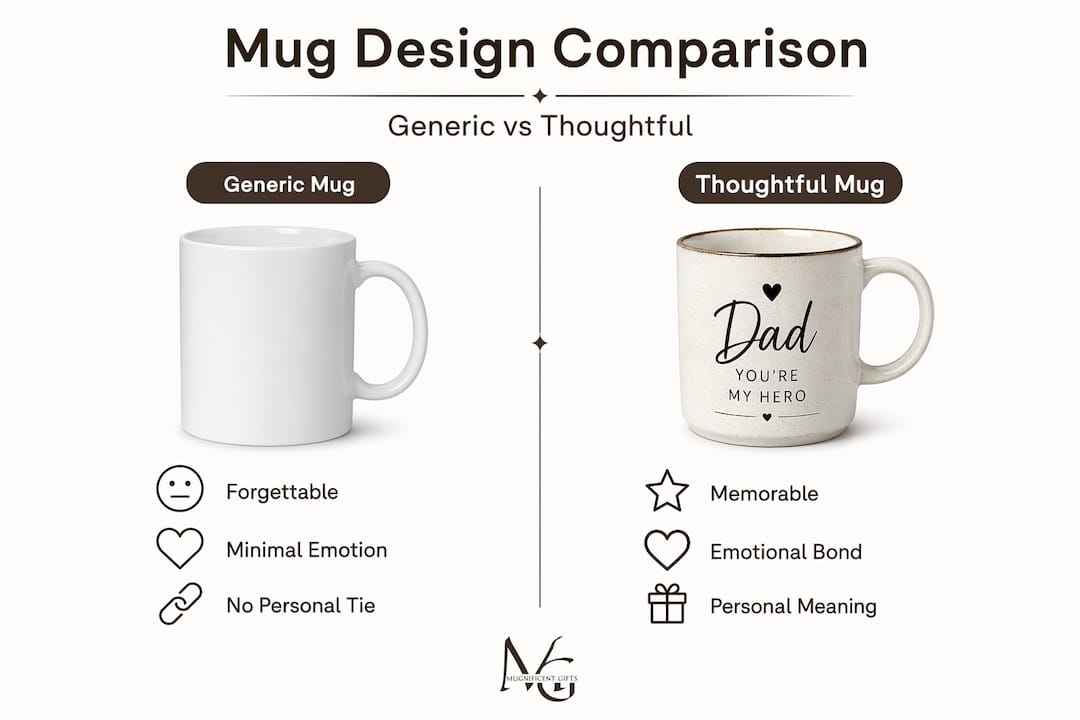
The perceived value gap is particularly striking. A thoughtful mug does not necessarily cost more to produce. The investment is in the design decision, not the materials. Yet recipients consistently rate personalised, specific gifts as more valuable and more meaningful than higher-priced generic alternatives.
Pro Tip: When choosing between two designs, ask yourself whether a stranger could identify the recipient from the mug alone. If the answer is yes, the design has real specificity. If the answer is no, it is probably still generic.
Real-world examples make this vivid. A mug printed with a clean line drawing of a cello and a single well-chosen phrase communicates more about the recipient than a premium-branded mug from an expensive retailer. The cello mug says "I know you." The branded mug says "I had a budget."
My honest take on why this all matters
I have seen a lot of mugs, and I have thought more about mug design than most people would consider reasonable. Here is what I have genuinely come to believe: most people underestimate how much a bad design communicates.
When a mug looks rushed, overcrowded, or generic, it does not just fail to impress. It actively signals that no real thought went in. And in a gifting context, that is the opposite of what you want. The recipient may never articulate it, but they feel it.
What I find genuinely exciting about designing minimal musician mugs is how much can be conveyed with very little. A single instrument outline. A short, dry phrase about practising scales. A name placed just right. These small choices, made with intention, turn an everyday object into something that sits on a desk for years because the owner cannot quite imagine getting rid of it.
The risk of neglecting emotional connection in design is not just a lost sale. It is a lost opportunity to create something that matters to someone. Meaningfulness requires embedding emotional value from the very beginning of the design process, not as an afterthought once the visual is already done. That is the principle I would carry into any mug design, whether it is for a professional drummer, a piano teacher, or someone who just loves humming in the shower.
The mugs that endure are the ones that feel like they were made for one specific person. That is not a coincidence. It is the direct result of design choices made with genuine care.
— Lasse
Discover music mugs made with real intention
Mugnificentdeals was built on exactly the principle this article has been exploring. Every mug in the range is designed to feel like it was made for someone specific, because it was. From hand-drawn instrument illustrations to playful phrases that only a fellow musician would appreciate, the designs carry personality without shouting for it. Whether you are shopping for a violinist, a drummer, a piano teacher, or yourself after a long rehearsal, the personalised music mugs collection offers designs that connect rather than merely decorate. For occasions where the gift needs to land perfectly, the best personalised music mugs for gifts collection is curated with exactly that in mind. Browse the full range and find the one that says what words cannot quite manage.
FAQ
Why does thoughtful mug design create stronger emotional bonds?
Thoughtful mug design creates emotional bonds because it reflects specific identity and personal meaning, triggering what researchers call vicarious pride in recipients. Each daily use reinforces the connection, accumulating emotional value over time.
What makes a good mug design for gifting?
A good mug design for gifting is specific to the recipient's interests, keeps key artwork in the visible holding zone, and balances a clear visual message with functional comfort. Specificity consistently outperforms broad or generic themes.
How does mug design affect mood?
Mug design affects mood by reinforcing personal identity and triggering positive associations during daily rituals like morning coffee. Research confirms that repeated positive emotional experiences during use build lasting attachment and wellbeing.
Are personalised music mugs better gifts than generic alternatives?
Yes. Personalised mugs signal genuine attention and create irreplaceable emotional value that generic gifts cannot match. Recipients keep and use personalised drinkware significantly longer than branded or generic alternatives.
What are the most common mistakes in mug design?
The most common mistakes are placing artwork too close to the rim, overcrowding the print area, and choosing designs that are too generic to communicate anything personal. Good mug design keeps artwork visible when held and centres on one clear, meaningful message.