
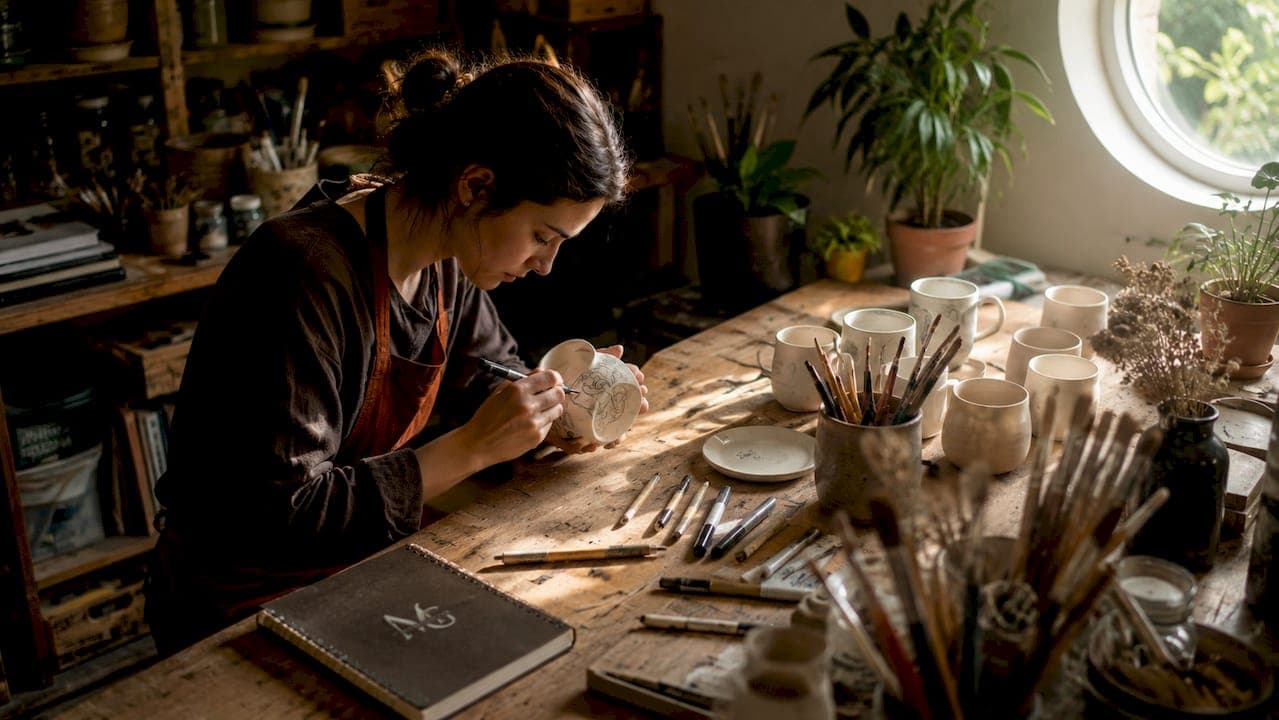
Hand-drawn mug art is the practice of applying personalised, hand-sketched designs directly onto ceramic mugs using specialist paints, oil-based markers, or porcelain pens. Each piece carries the natural imperfections of the human hand, which is precisely what makes it worth owning. Unlike mass-produced tableware, a hand-drawn mug carries a story. In 2026, doodle-style aesthetics are among the most sought-after design trends across homeware and gifting, driven by a growing consumer desire for objects that feel personal rather than generic.
What is hand-drawn mug art and why does it matter?
Hand-drawn mug art is a form of ceramic art in which an artist or crafter applies original illustrations, lettering, or patterns to a mug surface by hand. The industry term for the broader practice is ceramic surface decoration, but hand-drawn mug art specifically refers to freehand work rather than transfers or screen printing. The result is a functional object that doubles as a small, wearable piece of illustration.
The appeal is straightforward. No two hand-drawn mugs are identical. A slightly wobbly line or an uneven fill of colour signals authenticity in a way that a factory-printed design never can. Charm lies in imperfection, and that imperfection is the point. For musicians, artists, and anyone who values personality over polish, a hand-drawn mug communicates something a supermarket shelf cannot.

Brands like Mugnificentdeals have built their entire identity around this principle. Their mugs feature sketched instrument illustrations and witty lettering that feel thought-out rather than templated. That approach resonates because it treats the mug as a canvas, not a commodity.
What materials and tools do you need for mug art?
The right materials determine whether your artwork survives its first wash or fades within a week. Choosing specialist supplies is not optional.
Paints, markers, and pens
- Ceramic paints: Formulated specifically for glass and ceramic surfaces, these paints bond to the mug during heat-curing. Specialist ceramic paints outperform regular acrylic craft paints, which are neither food-safe nor durable after washing.
- Oil-based markers: Brands such as Posca and Molotow produce oil-based and paint markers that adhere well to smooth ceramic surfaces and produce clean, consistent lines.
- Porcelain pens: Fine-tipped porcelain pens are ideal for detailed line work, lettering, and intricate doodle-style patterns.
- Brushes and sponges: Flat brushes suit broad colour fills, while fine-tipped brushes handle detail. Sponges create textured effects, particularly useful for galaxy or watercolour-style motifs.
- Stencils: Adhesive stencils help beginners achieve clean geometric shapes and consistent lettering without freehand confidence.
Surface preparation
Wiping with rubbing alcohol before painting is the single most overlooked step in mug art. Invisible oils from your hands transfer to the mug surface during handling and prevent paint from adhering properly. A lint-free cloth dampened with rubbing alcohol removes these oils completely. Skip this step and your paint will peel, regardless of how good the paint itself is.
Pro Tip: Always handle a prepared mug by its handle only, and work on a clean surface. Touching the painting area after cleaning reintroduces the oils you just removed.
Which styles and techniques define hand-drawn mug designs?
Hand-drawn mug designs span a wide range of visual styles, from spare minimalism to densely patterned folk art. Understanding the most popular approaches helps you choose one that suits your skill level and aesthetic.
Popular styles at a glance
| Style | Visual character | Ease for beginners |
|---|---|---|
| Minimalist line art | Single-colour outlines, lots of white space | High |
| Doodle and pattern fill | Repetitive small motifs covering the surface | Medium |
| Botanical illustration | Leaves, stems, and flowers in natural tones | Medium |
| Galaxy and texture effects | Sponged colour gradients with dot details | Medium |
| Hand lettering | Quotes and words as the primary design element | Medium to high |
| Folk art and florals | Bold colours, symmetrical patterns | Lower |
Simple designs with clean lines produce the most professional-looking results for beginners. Experts consistently advise against overcomplicating your first attempts. A single well-drawn motif, such as a cactus, a musical note, or a geometric shape, reads more confidently than a crowded composition that loses definition on a curved surface.
Doodle-style aesthetics deserve particular attention. This approach celebrates repetition and imperfection. Small stars, tiny hearts, simple animals, and abstract squiggles fill the mug surface in a way that feels playful and deliberate at once. The style suits musicians and creatives especially well because it mirrors the spontaneous quality of a sketchbook page.
Layering colours adds depth to any style. Apply a base colour first, allow it to dry fully, then add detail layers on top. Sponging creates soft gradients for galaxy motifs by dabbing two or three colours onto the surface before they dry, blending them naturally at the edges.
How to create lasting mug art: process and best practices
Creating a mug that holds up to daily use requires more than artistic skill. The process from blank mug to finished piece follows a clear sequence, and skipping any stage compromises the result.
-
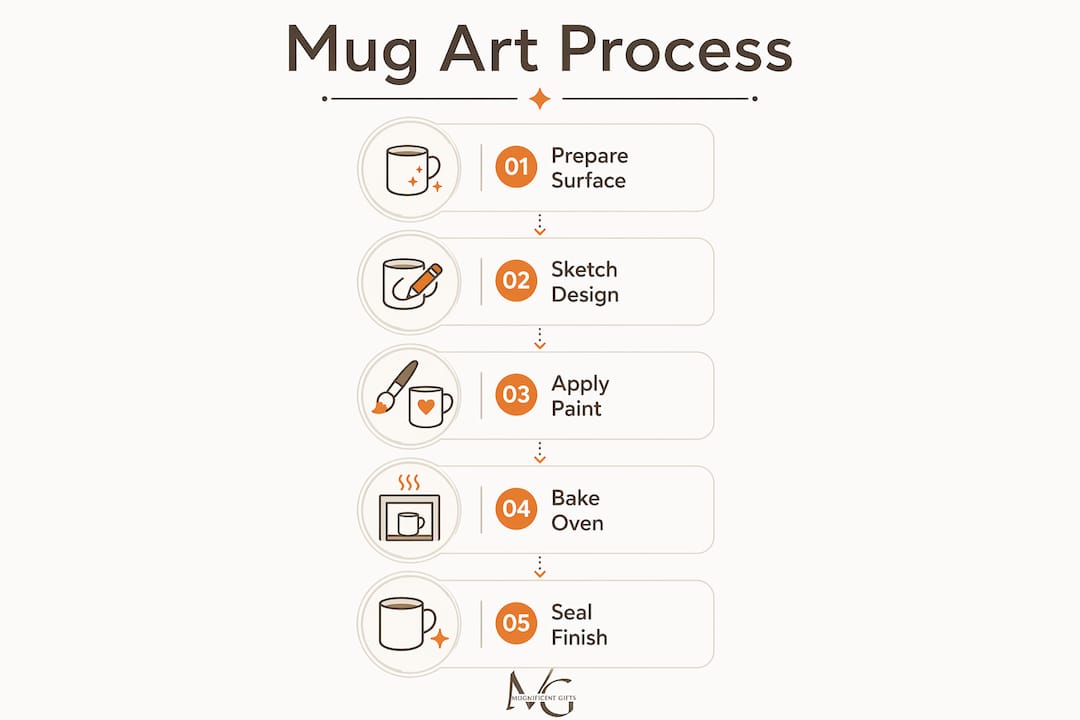
Plan your design first. Sketch your idea on paper before touching the mug. Consider the curve of the surface and how your design will wrap around it. Simple, bold shapes translate better to ceramic than fine, complex illustrations.
-
Prepare the surface. Wipe the mug thoroughly with rubbing alcohol and a lint-free cloth. Allow it to dry for two to three minutes before picking up any paint or marker.
-
Sketch lightly if needed. Use a chalk pencil or a very light pencil mark to outline your design on the mug. These marks disappear during baking or can be wiped away before heat-setting.
-
Apply your first layer. Work with thin, even coats of ceramic paint or use your oil-based marker with consistent pressure. Thin layers dry faster and adhere more reliably than thick applications.
-
Allow proper drying time. Air-dry for 15–20 minutes between layers to prevent smudging. Rushing this stage is the most common cause of ruined artwork.
-
Add detail layers. Once your base is dry, add outlines, shading, or lettering on top. This layering approach gives hand-drawn mug art its characteristic depth and richness.
-
Heat-set in the oven. Place the finished mug in a cold oven, then set the temperature to the paint manufacturer's recommendation (typically around 160–180°C). Heat mugs gradually and allow them to cool inside the oven once the cycle is complete. Sudden temperature changes cause ceramic to crack.
-
Apply a food-safe sealant. A clear food-safe glaze applied over the cured design protects it from dishwasher wear. This step is frequently skipped and is the primary reason hand-painted mugs fade prematurely.
Pro Tip: Never place a freshly painted mug directly into a preheated oven. The thermal shock can crack the ceramic before your artwork even gets the chance to cure.
What are the creative applications and emotional benefits of mug art?
Hand-drawn mugs function as more than decorative objects. They carry meaning in a way that printed merchandise rarely achieves.
-
Personalised gifting: A mug decorated with someone's name, instrument, or inside joke communicates effort and attention. It is the difference between a gift that is bought and one that is made. For musicians especially, a mug featuring a hand-sketched violin or a drumkit with a witty caption becomes a daily reminder that someone truly knows them. Mugnificentdeals has built its gifting range around exactly this principle, with personalised music mugs that feel commissioned rather than mass-produced.
-
Meditative creative practice: The act of drawing on a mug is genuinely calming. The focus required to apply clean lines on a curved surface quiets the mind in the same way that colouring or sketching does. Expressiveness over precision defines the practice, which means there is no pressure to achieve technical perfection.
-
Home décor and personal identity: A collection of hand-drawn mugs on a kitchen shelf reads as a gallery of small artworks. Each one reflects the owner's taste, humour, or passions. For musicians, a shelf of instrument-themed mugs is a quiet declaration of identity.
-
Small business and branding: Cafés, music schools, and independent studios use custom handcrafted mug illustrations as branded merchandise. A hand-drawn aesthetic signals craft and care in a way that generic printed mugs do not.
-
Occasion-specific art: Birthdays, graduations, recitals, and band anniversaries all become more memorable with a mug designed for the moment. Incorporating quotes, dates, or personal messages transforms a functional object into a keepsake.
For anyone curious about how professional illustrators approach this kind of work, the sketching instrument mugs guide from Mugnificentdeals offers a detailed look at the creative process behind music-themed mug illustrations.
Key takeaways
Hand-drawn mug art produces its most lasting results when the right materials, proper surface preparation, and controlled heat-setting are combined from the start.
| Point | Details |
|---|---|
| Use specialist materials | Ceramic paints and oil-based markers outperform standard acrylics for safety and durability. |
| Prepare the surface properly | Wipe with rubbing alcohol before painting to remove oils that prevent adhesion. |
| Keep designs simple | Clean line art and basic shapes produce more professional results than complex compositions. |
| Heat-set with care | Place mugs in a cold oven and cool slowly to avoid cracking the ceramic. |
| Seal the finished piece | A food-safe glaze protects artwork from dishwasher wear and extends the mug's life. |
Why imperfection is the whole point
I have spent years looking at hand-drawn mugs, from rough beginner attempts to beautifully refined artist pieces, and the ones that stay with me are never the technically perfect ones. They are the ones where you can see the hand that made them. A slightly uneven letter. A line that curves a little more than intended. These are not flaws. They are signatures.
The conventional wisdom in craft circles is that you should practise until your lines are straight and your fills are even. I disagree. The moment a hand-drawn mug looks too polished, it starts to resemble something a machine could have made. The whole point of choosing a hand-drawn piece, whether you make it yourself or buy it from a brand like Mugnificentdeals, is that it carries a human quality that no print run can replicate.
My advice to anyone starting out is to resist the urge to compare your work to digital illustrations. Your mug is not competing with a screen-printed design. It is doing something entirely different. It is telling the person who drinks from it that a real person cared enough to put something of themselves into it. That is worth more than a perfectly straight line.
The giftable mug concept captures this well. A mug becomes a gift when it carries meaning. Hand-drawn art is one of the most direct ways to put that meaning there.
— Lasse
Discover hand-drawn inspired mugs from Mugnificentdeals
If this guide has sparked an idea for your next creative project or your next gift, Mugnificentdeals brings the hand-drawn aesthetic to life across a curated collection of music-themed mugs. Each design feels sketched and personal, from detailed instrument illustrations to clever musical humour that earns a smile rather than demanding one.

Whether you are shopping for a violinist, a drummer, or someone who simply lives for music, the best personalised music mugs collection offers designs that feel genuinely thoughtful. You can also browse the full range of unique ceramic mugs to find styles that reflect current trends in handcrafted mug illustrations. Every mug is designed to feel like it was made with someone specific in mind.
FAQ
What is hand-drawn mug art exactly?
Hand-drawn mug art is the practice of decorating ceramic mugs with original freehand designs using specialist ceramic paints, oil-based markers, or porcelain pens. Each piece is unique because it is created by hand rather than printed by machine.
What paints are safe to use on mugs?
Specialist ceramic paints and oil-based markers designed for glass and ceramic surfaces are the correct choice. Standard acrylic craft paints are not food-safe and do not withstand repeated washing.
Do hand-drawn mugs need to be baked?
Yes. Heat-setting in an oven cures the paint and bonds it to the ceramic surface. Place the mug in a cold oven, heat gradually to the paint manufacturer's recommended temperature, then allow it to cool inside the oven to prevent cracking.
How do you make hand-drawn mug art last longer?
Apply a clear food-safe glaze or sealant over the cured design. This protects the artwork from dishwasher wear and significantly extends the life of the decoration.
Can beginners create good-looking hand-drawn mug designs?
Absolutely. Simple designs with clean lines and basic shapes produce the most appealing results for beginners. Starting with a single motif, such as a musical note or a small botanical shape, builds confidence before attempting more complex compositions.