

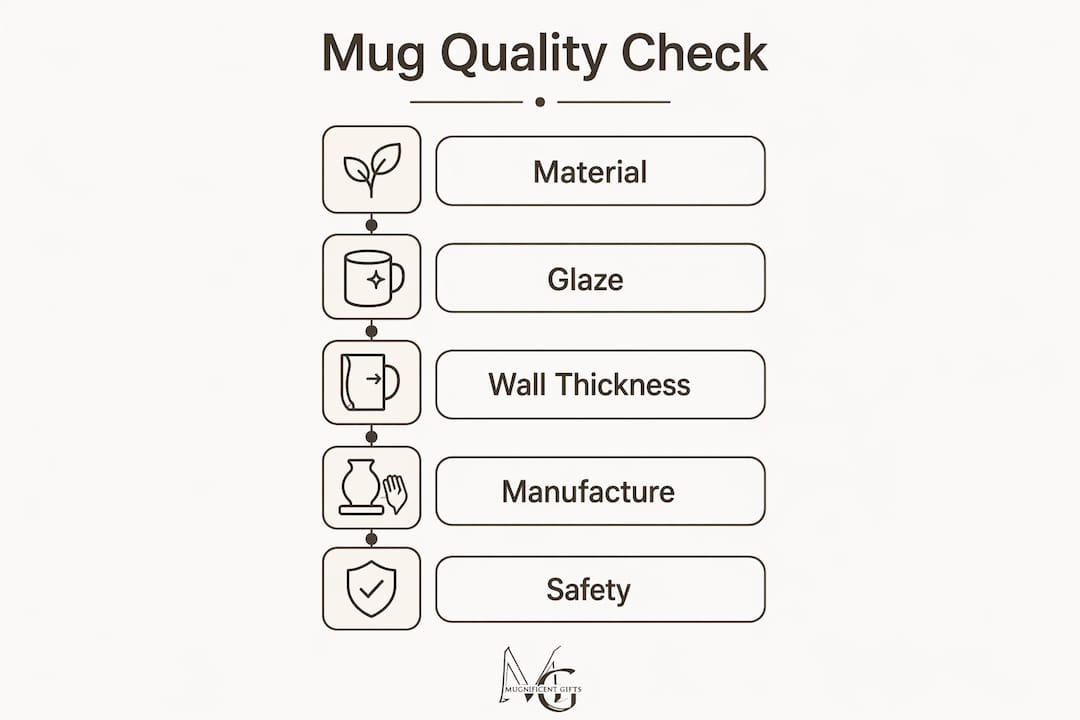
Mug quality is defined by four measurable factors: material composition, glaze safety, wall thickness, and manufacturing consistency. Knowing how to check mug quality before buying protects you from chipped rims, leaching glazes, and mugs that fade after a handful of washes. The industry term for this process is pre-purchase quality inspection, and it applies whether you are buying a single gift mug or a dozen for a café. Key benchmarks include FDA food-safety compliance, California Proposition 65 certification, and LFGB standards from Germany, all of which give you an objective basis for comparison rather than relying on guesswork from product photos alone.
What are the essential materials used in mugs?
The material a mug is made from determines almost everything about its long-term performance. Porcelain, stoneware, earthenware, and enamel each behave differently under heat, impact, and repeated washing.
- Porcelain is fired above 2,200°F, which creates interlocking mullite crystals inside the clay body. This high-fired porcelain is more resistant to chipping than thicker, low-fired earthenware, despite having thinner walls. Thin walls also make porcelain feel refined and balanced in the hand.
- Stoneware is fired at mid-range temperatures and produces a denser, heavier body than earthenware. It holds heat well and resists minor impacts, making it a reliable choice for daily use.
- Earthenware is the softest of the three. It fires at lower temperatures, leaving a more porous body that absorbs moisture if the glaze cracks. Chips on earthenware expose that porous core, which can harbour bacteria over time.
- Enamel mugs use a steel or iron core coated in vitreous enamel. They are lightweight and durable for outdoor use, but the coating can chip if struck sharply, exposing bare metal underneath.
Wall thickness matters, but it does not tell the whole story. A thin porcelain wall fired correctly outperforms a thick earthenware wall fired at a lower temperature. Weight alone is not a reliable quality signal. A mug that feels heavy is not automatically better built.
Pro Tip: Hold the mug up to a light source. High-quality porcelain shows a slight translucence through the walls. Stoneware and earthenware remain opaque. This quick test confirms the material type before you commit to a purchase.

For a broader look at what makes certain ceramic mug styles worth choosing, the material properties above are the starting point every informed buyer needs.
How to inspect mugs for durability before purchase
Physical inspection is the most direct mug quality inspection method available to you before buying. Run through these checks systematically.
- Glaze coverage: Check glaze coverage extending fully to the foot ring. An unglazed foot ring on an otherwise fully glazed mug is a sign of manufacturing precision, not a flaw. Patchy glaze on the body or interior signals inconsistent production.
- Rim smoothness: Run your finger along the rim. Any roughness, unevenness, or sharp edge indicates poor finishing. A smooth, even rim resists chipping and feels comfortable against your lips.
- The tap test: Tap the rim gently with a fingernail. A clear ringing sound indicates well-fired porcelain. A dull thud suggests a porous, lower-quality ceramic body. This single test takes three seconds and reveals firing quality immediately.
- Base stability: Place the mug on a flat surface and check for wobble. A wobbling base means the foot ring is uneven, which points to poor kiln control during production.
- Handle attachment: Grip the handle and apply light lateral pressure. The join between handle and body should feel solid with no flex or movement. Weak handle joins are a common failure point after repeated thermal cycling.
- Print and decoration: Scratch a fingernail lightly across any printed design. Quality prints sit under the glaze and cannot be scratched off. Prints on top of the glaze will wear away quickly in the dishwasher.
Manufacturers who apply rigorous standards use in-line quality checks during production, including raw material magnetic separation and kiln temperature monitoring. These controls prevent internal air bubbles or contaminants that are invisible once the mug is glazed and fired. You cannot see these defects from the outside, which is why sourcing from verified suppliers matters.
| Inspection point | What to look for | Red flag |
|---|---|---|
| Glaze coverage | Even coat to foot ring | Bare patches or drips |
| Rim | Smooth and uniform | Rough or sharp edges |
| Tap test | Clear ring | Dull thud |
| Base | No wobble on flat surface | Rocking or uneven foot |
| Handle | Solid join, no flex | Movement under pressure |
| Under glaze, scratch-resistant | Peels or scratches easily |
Pro Tip: When buying online, request a close-up photo of the foot ring and the interior base. Sellers who cannot provide these images are often working with lower-grade stock.
How to verify safety standards and lead-free certification
A mug's safety depends on its glaze chemistry, not its appearance. Verifying third-party food-safety documentation such as California Proposition 65 or FDA reports is the most reliable way to confirm a mug is lead-free. This documentation check takes under five minutes and protects against heavy metal exposure from glazes.
The three certifications worth knowing are:
- FDA compliance (USA): Confirms lead and cadmium levels in the glaze fall within safe limits for food contact surfaces.
- California Proposition 65: A stricter standard than federal FDA rules, requiring manufacturers to disclose any chemicals above defined thresholds.
- LFGB (Germany): One of the most stringent food-contact material standards globally. A mug carrying LFGB certification has passed rigorous migration testing for heavy metals.
Bright interior glazes in red, orange, or yellow often use cadmium-based pigments that carry leaching risks without proper certification. When no safety documentation is available, choose plain white or neutral interior glazes to reduce exposure risk.
Home lead test swabs are available from hardware retailers and provide a basic screening tool. They detect the presence of lead on a surface, but they do not measure concentration levels. A negative result from a swab does not equal certified food safety. Use swabs as a first filter, not a final answer.
Sourcing transparency is the clearest signal of a trustworthy supplier. Brands that publish their certification documents, name their manufacturing partners, and list the materials used in each product have nothing to hide. Brands that provide only vague "food safe" claims without documentation are asking you to take their word for it.
Pro Tip: Ask the seller directly for a copy of their FDA or LFGB test report. A reputable supplier will send it within 24 hours. Hesitation or a generic response is a clear signal to look elsewhere.
The Coral & Clay Ethan mug is one example of a product where material transparency is part of the brand's standard communication, which makes safety verification straightforward for buyers.
What practical durability tests can you run after buying a sample?
Buying a single sample mug before committing to a larger order is the most reliable durability test available. A practical method to confirm durability is to subject that sample to multiple dishwasher cycles and inspect it at intervals.
- Run 50 dishwasher cycles using your standard household detergent and the hottest cycle available. Inspect the mug after cycles 10, 25, and 50. Look for glaze dulling, colour shift, or any cracking along the base or handle join.
- Check print integrity after each inspection point. Quality under-glaze prints show no fading or lifting after 50 cycles. Surface prints begin to degrade noticeably within 10 to 20 cycles.
- Assess thermal shock resilience by moving the mug directly from a cold rinse to a hot liquid fill. Repeat this five times. Low-quality ceramics develop hairline cracks called crazing under repeated thermal stress. Crazing compromises the glaze barrier and allows moisture into the clay body.
- Test handle strength by filling the mug to capacity and lifting it by the handle only. Do this repeatedly over the test period. A well-attached handle shows no movement or cracking at the join after sustained use.
- Evaluate rim resilience by placing the mug rim-down on a hard surface with light pressure. Quality mugs resist minor impacts without chipping. This simulates the kind of contact a mug experiences daily in a kitchen or café setting.
High-quality mugs maintain at least 90% gloss retention after 250 dishwasher cycles under commercial-grade testing conditions. That benchmark gives you a reference point when assessing your sample results at home.
Pro Tip: Photograph the mug before and after the test cycle. Side-by-side comparison reveals glaze changes that are easy to miss when you are looking at the mug every day.
Key takeaways
Mug quality is best assessed by combining material knowledge, physical inspection, certified safety documentation, and practical durability testing before committing to a purchase.
| Point | Details |
|---|---|
| Material determines durability | High-fired porcelain outperforms thicker earthenware due to mullite crystal bonds formed above 2,200°F. |
| Tap test reveals firing quality | A clear ring confirms well-fired ceramic; a dull thud signals a porous, weaker body. |
| Certification beats visual checks | FDA, Proposition 65, or LFGB documentation confirms glaze safety far more reliably than appearance alone. |
| Avoid bright interior glazes without proof | Red, orange, and yellow interior glazes may use cadmium pigments; request certification before buying. |
| Sample testing confirms batch quality | Run 50 dishwasher cycles on a sample and inspect at intervals to verify print and glaze durability. |
What I have learned from years of looking closely at mugs
Most people judge a mug by how it looks on a shelf or in a product photo. That is the wrong starting point. I have handled hundreds of mugs over the years, and the ones that photograph beautifully are not always the ones that survive six months of daily use. Surface aesthetics and structural quality are separate things entirely.
The detail that separates a genuinely well-made mug from a convincing imitation is batch consistency. One perfect sample tells you what a manufacturer is capable of on a good day. It does not tell you what you will receive in the tenth shipment. Brands that invest in kiln temperature monitoring and in-line production checks are the ones whose quality holds across every order.
My honest advice is to treat safety certification as non-negotiable. A mug without documented FDA or LFGB compliance is a risk you are taking with every hot drink. That risk is unnecessary when certified alternatives exist at comparable price points. The role mugs play in daily rituals means you are using them repeatedly, every single day. That frequency makes quality worth prioritising from the start.
— Lasse
Mugnificentdeals: quality and personality in every mug
Mugnificentdeals builds mugs for people who want both safety and character in the same product.

Every mug in the collection is made from food-safe materials with documented certifications, so you are not left guessing about glaze chemistry. The designs are made for musicians and music lovers, with personalised details that make each mug feel genuinely considered rather than mass-produced. Whether you are buying for yourself or choosing a gift for someone who lives and breathes music, the personalised music mug collection covers a range of instruments, styles, and inside jokes that land without trying too hard. For gift-ready options with quality assurance built in, the best personalised music mugs for gifts collection is a reliable place to start.
FAQ
What is the best material for a durable everyday mug?
High-fired porcelain is the most durable option for daily use. Its mullite crystal structure provides chip resistance despite thin walls, outperforming thicker earthenware fired at lower temperatures.
How do I know if a mug is food safe?
Request FDA compliance documentation, a California Proposition 65 report, or an LFGB test certificate from the seller. Visual inspection alone cannot confirm glaze safety.
What does a dull sound mean when I tap a mug?
A dull thud when tapping the rim indicates a porous, lower-quality ceramic body. A clear ringing sound confirms the mug is well-fired and structurally sound.
How many dishwasher cycles should a quality mug survive?
Quality mugs maintain at least 90% gloss retention after 250 commercial dishwasher cycles. For home testing, run 50 cycles and inspect for glaze dulling, cracking, and print fading.
Are bright interior glazes safe to use?
Bright red, orange, and yellow interior glazes may contain cadmium-based pigments that carry leaching risks. Only use mugs with these colours if the seller provides certified safety documentation confirming safe heavy metal levels.