

A signature mug is defined as a personalised or uniquely designed drinking vessel that carries individual identity, daily ritual significance, and emotional meaning beyond its function as a cup. Unlike a standard mug pulled from a cupboard at random, a signature mug typically holds 250–350 ml and is distinguished by design choices that reflect the owner's personality, story, or taste. Think of the hand-painted stoneware from Emerson Creek Pottery, or the sublimation-printed ceramic bearing a musician's name and favourite instrument. These are not mass-produced afterthoughts. They are objects chosen, or made, with intention.
What is a signature mug and what defines it?
A signature mug is a personalised coffee mug that goes beyond decoration to become a daily companion. The term "signature" signals ownership and identity, much like a written signature marks something as distinctly yours. In the drinkware industry, the recognised category is often called a personalised or custom mug, but the phrase "signature mug" adds a layer of meaning: this is the one you reach for every morning without thinking.
What separates a signature mug from any other cup is the combination of deliberate design and consistent use. Customised signature mugs earn their role through daily ritual and owned meaning, not merely through a printed name or logo. A corporate branded mug given at a conference is technically customised. A signature mug is the one you would notice missing.

Named entities matter here. Brands like Emerson Creek Pottery, Nespresso, and Mugnificentdeals each approach the concept differently, but all share one principle: the mug must feel like it belongs to someone specific. That specificity is what makes it a signature piece.
Which design elements and materials define a signature mug?
The physical character of a signature mug comes from its material, decoration method, and ergonomic form. Each choice affects how the mug feels in your hand, how long it keeps your drink warm, and how well it holds its design over time.
Materials: from ceramic to bone china
| Material | Heat Retention | Tactile Feel | Best For |
|---|---|---|---|
| Ceramic | Good | Smooth, solid | Everyday use, sublimation printing |
| Stoneware | Excellent | Rustic, weighty | Artisan and hand-painted designs |
| Bone china | Moderate | Delicate, refined | Gifting, fine detail printing |
| Glass | Poor | Cool, transparent | Visual display, cold drinks |
Ceramic remains the most common material for signature mug production, and for good reason. It accepts sublimation printing cleanly, holds heat well, and survives daily dishwasher cycles. Stoneware offers superior heat retention and a tactile weight that many people find grounding. Bone china suits gifting occasions where visual elegance matters more than rugged daily use.
Decoration methods that create a signature look
Sublimation printing transfers full-colour designs onto ceramic at high temperature, producing sharp, permanent images. Engraving cuts directly into the surface, creating a tactile, monochrome effect that suits minimalist or professional aesthetics. Hand-painting, as practised by artisan potteries like Emerson Creek Pottery, produces one-of-a-kind pieces where slight variations are features, not flaws. For premium ceramic features, the glaze quality and firing temperature also determine colour vibrancy and surface durability.
Ergonomics matter too. A signature mug often has a handle shaped for a comfortable morning grip, a base weighted enough to feel stable, and a rim diameter suited to the drinker's preference. These details are rarely accidental in well-made personalised drinkware.
Pro Tip: When assessing a mug's quality before buying, run your thumb along the inside of the handle joint. A smooth, fully sealed join indicates quality construction. A rough or uneven join suggests the mug may crack with repeated heating.
Why do people form emotional attachments to signature mugs?
Signature mugs function as psychological anchors that offer stability and comfort during early morning hours or uncertain moments. This is not sentiment for its own sake. It reflects how routine objects shape mood and identity in measurable ways.
The morning ritual is the key mechanism. The mug you reach for first sets a tone for the day. It signals to your brain that a familiar, comfortable sequence has begun. Over time, that association deepens. The mug becomes less about coffee and more about the feeling of starting well.
Colour plays a documented role in this attachment. Mug colour choices reflect personality traits subconsciously: blue suggests calmness, yellow projects optimism, and red signals energy. People rarely choose their signature mug colour by accident. They choose what they want to feel.
The emotional factors that make a mug "signature" include several distinct elements:
- Personal story: The mug was a gift from someone meaningful, or marks a specific memory or milestone.
- Identity expression: The design reflects a hobby, profession, or value the owner holds privately.
- Ritual anchoring: The mug is used at the same time, in the same place, every day, creating a conditioned comfort response.
- Endowment effect: Once an object is owned and used regularly, its perceived value rises significantly beyond its purchase price.
- Aesthetic resonance: The design simply pleases the owner every time they look at it, reinforcing positive association.
Mugs also carry stories and memories in ways that perfect aesthetics cannot replicate. A chipped handcrafted mug from a pottery class often holds more emotional weight than an expensive piece bought on impulse. The imperfection becomes part of the narrative. For musicians, a mug bearing their instrument or a lyric they love operates the same way. It is a small, private declaration of who they are.
You can read more about mugs in daily rituals to understand how deeply these objects embed themselves in personal routine.
How do signature mugs differ from personalised or custom mugs?
The terms overlap, but they are not identical. Understanding the distinction helps when choosing or gifting with intention.
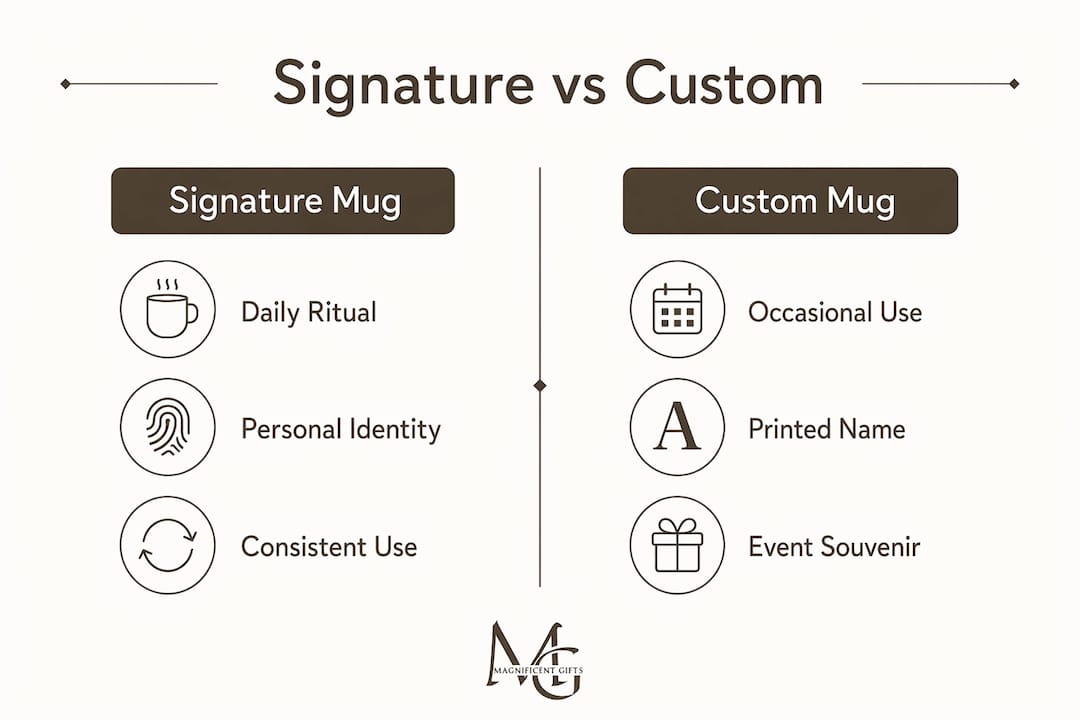
| Feature | Signature Mug | Custom or Personalised Mug |
|---|---|---|
| Primary purpose | Daily ritual and identity expression | Decoration, event, or brand promotion |
| Design driver | Personal story or ongoing identity | One-time occasion or external brief |
| Frequency of use | Used consistently, often daily | May be displayed or used occasionally |
| Emotional weight | High, built over time through use | Variable, often lower |
| Typical context | Personal ownership | Gifting, corporate, or event use |
A personalised coffee mug with someone's name printed on it is a custom mug. It becomes a signature mug only when that person adopts it as their daily vessel of choice. The distinction lies in daily ritual and owned meaning rather than the printing process or the personalisation itself.
Corporate branded mugs, promotional giveaways, and event souvenirs all qualify as customised drinkware. Very few become signature mugs. The ones that do tend to carry a design that resonates personally, not just logistically. A mug printed with a musician's name and a sketch of their instrument has a far higher chance of becoming someone's daily companion than one bearing a company logo.
What to consider when choosing or gifting a signature mug
Selecting the right mug, whether for yourself or someone else, comes down to five practical criteria. Get these right and the mug has a strong chance of becoming genuinely signature.
- Capacity: A typical signature mug holds 250–350 ml, which suits a standard coffee or tea serving without going cold too quickly. Larger mugs (400 ml and above) suit those who prefer long, slow morning drinks.
- Material durability: Ceramic and stoneware withstand daily dishwasher use. Bone china requires more care. Match the material to the recipient's actual habits, not their aspirational ones.
- Design meaning: The design should reflect something the recipient genuinely identifies with. A violinist's mug should feel like it was made for violinists, not for anyone who vaguely likes music.
- Heat retention: Thicker walls retain heat longer. If the recipient tends to get distracted mid-drink, a stoneware mug will serve them better than a thin ceramic one.
- Gifting occasion: Birthdays, milestones, and "just because" moments all suit signature mugs well. Pair the mug with a matching coaster or a small bag of quality coffee to complete the gift without overcomplicating it.
Choosing a signature mug is a subtle act of self-definition. When you choose for someone else, you are making a statement about how well you know them. That is what makes a well-chosen mug such a powerful gift.
Pro Tip: To identify whether a mug will become truly "signature" for someone, ask yourself: does this design reflect something they mention unprompted? If a friend talks about their violin every time you see them, a mug that speaks that language will land every time.
For inspiration on clever mug design trends and what makes personalised drinkware stand out in 2026, the Mugnificentdeals blog covers current approaches in depth.
Artisan retailers like Emerson Creek Pottery price quality ceramic signature mugs between $11 and $33. That range reflects the difference between a simple sublimation print and a hand-finished stoneware piece. For music-themed personalised mugs, Mugnificentdeals sits in a similar range, with the added dimension of niche design that speaks directly to musicians and music lovers.
The mug that stays on the shelf versus the one you always reach for
I have owned dozens of mugs over the years. Most of them have ended up at the back of a cupboard, used only when everything else is in the dishwasher. But there have been two or three that I reached for every single morning without thinking. That instinct is exactly what makes a mug "signature."
What those mugs had in common was not price or brand. One was a slightly uneven stoneware piece from a local market. Another was a ceramic mug with a line drawing of a double bass on it, bought as a gift by someone who knew I had played one badly for three years in my twenties. The design made me smile every morning. That is the whole point.
The ceramic body of a signature mug symbolises something quietly profound: resilience and vulnerability in the same object. It can chip. It can break. But until it does, it holds something warm for you every day. That is not a bad metaphor for the objects we choose to keep close.
My honest observation, after years of thinking about this, is that people underestimate how much a well-chosen mug contributes to the quality of an ordinary morning. It is a small thing. But small things, repeated daily, shape how we feel about our lives. If you have not found your signature mug yet, I would encourage you to look with a little more intention. You will know it when you find it.
— Lasse
Find your signature mug at Mugnificentdeals

Mugnificentdeals specialises in exactly the kind of personalised drinkware that earns the "signature" title. Every design is built around musicians and music lovers, from hand-drawn instrument illustrations to clever, wry phrases that resonate with anyone who has ever lost themselves in a piece of music. These are not generic prints. They are personalised music mugs made to feel like they were designed for one specific person. Whether you are treating yourself or finding a gift that genuinely reflects who someone is, Mugnificentdeals offers quality ceramic mugs that combine personality, humour, and craft. Browse the full collection and find the one that makes you reach for it every morning.
FAQ
What is the standard size of a signature mug?
A signature mug typically holds 250–350 ml, which suits a standard coffee or tea serving. Larger capacities are available but less common for daily signature use.
What materials are signature mugs made from?
Ceramic and stoneware are the most common materials, offering good heat retention and durability for daily use. Bone china is used for more delicate, gift-focused designs.
How does a signature mug differ from a personalised mug?
A personalised mug carries a custom design or name. A signature mug goes further: it becomes the one a person uses consistently every day, building emotional attachment through ritual and identity.
Can a signature mug make a good gift?
A signature mug makes an excellent gift when the design reflects something the recipient genuinely identifies with. The more specific the design, the more likely it is to become their daily choice.
Why do people feel attached to a particular mug?
Signature mugs act as psychological anchors in morning routines, providing comfort and routine stability. Colour, design, and personal story all deepen that attachment over time.
Key takeaways
A signature mug earns its name through daily ritual and personal identity, not simply through a printed name or custom design.
| Point | Details |
|---|---|
| Definition matters | A signature mug is defined by consistent daily use and identity connection, not decoration alone. |
| Material shapes experience | Ceramic and stoneware offer the best heat retention and durability for a true daily-use mug. |
| Emotional value builds over time | Routine use, personal story, and design resonance combine to create lasting attachment to a mug. |
| Gifting requires specificity | The best signature mug gift reflects something the recipient mentions or values unprompted. |
| Design drives adoption | A design that speaks to a specific identity, such as a musician's instrument, dramatically increases the chance of daily use. |