

Puns are used in gift design because they create immediate, shareable reactions that strengthen social bonds and make modest items feel thoughtful. A pun works like a tiny puzzle: the recipient's brain spots two meanings, resolves the tension between them, and rewards itself with a smile. That resolution is the whole trick, and it's why "why puns in gift design" is a question worth answering properly rather than dismissing as novelty-shop fluff.
Four mechanisms explain the effect:
- Surprise and resolution: the brain enjoys solving a small incongruity, which produces genuine pleasure rather than forced laughter.
- Smile-seeking: givers often choose gifts that guarantee a visible reaction over gifts that are merely useful.
- Social signalling: a well-aimed pun tells the recipient "I know you," which builds connection faster than a generic gift.
- Memorability: jokes stick in memory longer than plain statements, so the gift keeps working long after the wrapping paper is gone.
The rest of this guide covers when puns help, how to design them properly, and where they can misfire.
Key Takeaways
Puns succeed as gifts because they combine riddle-solving pleasure with social signalling, and they only work when the joke resolves in a single glance.
| Point | Details |
|---|---|
| Puns reward quick resolution | Choose wordplay that resolves within a glance; jokes requiring explanation rarely land. |
| Match visuals to the joke | Pair imagery with the punchline so the brain resolves both together, strengthening the reaction. |
| Fit the occasion and relationship | Save puns for casual, close-relationship contexts; skip them for formal or unfamiliar situations. |
| Test before committing | Read the pun aloud, check for unintended meanings, and get a neutral opinion first. |
| Mugnificentdeals builds pun mugs to these rules | Personalised musician mugs pair instrument art with tested wordplay for a joke that lands immediately. |
Table of Contents
- Why puns in gift design create such a strong emotional payoff
- When puns work best, and when to leave them out
- Design rules that help a pun actually land
- How to write a pun that rewards the reader instead of frustrating them
- Where puns go wrong, and how to avoid a misfire
- Pun styles matched to the right product
- How Mugnificentdeals puts these rules into practice
- A quick note on getting the balance right
- Order a personalised pun mug that actually lands
- Frequently asked questions
- Sources
Why puns in gift design create such a strong emotional payoff
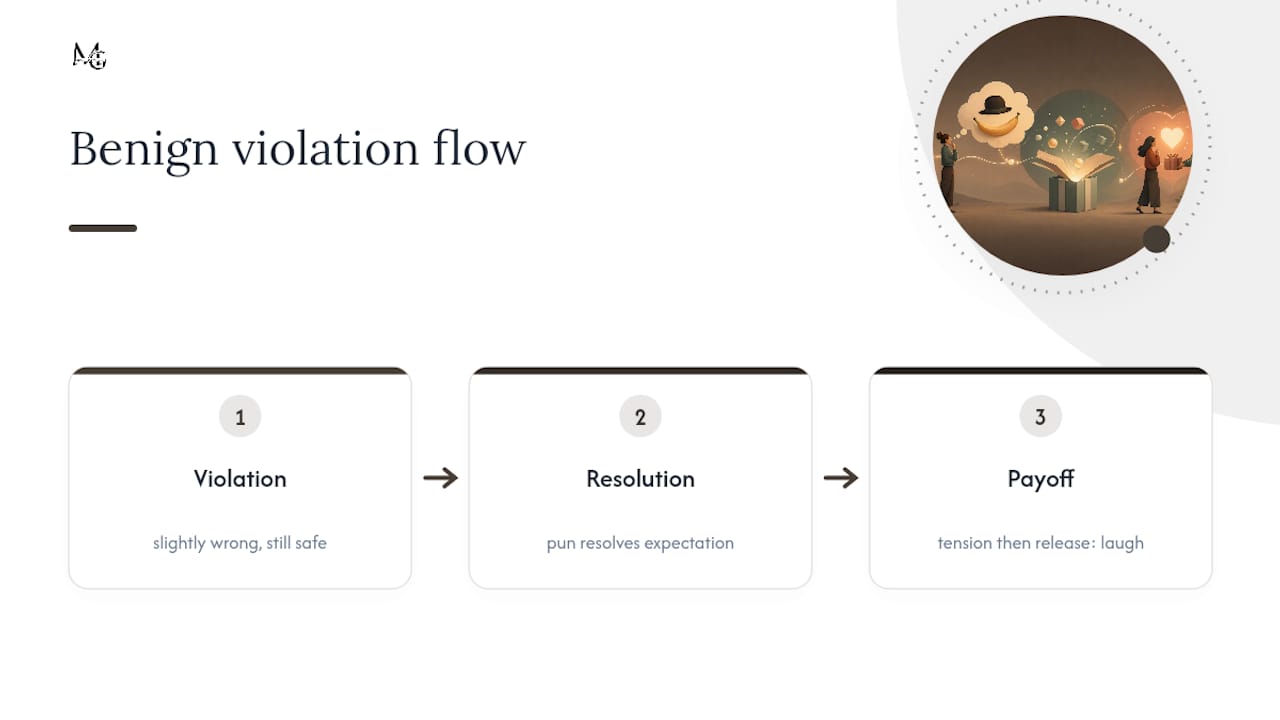
Humour researchers explain most successful jokes, including gift puns, using benign violation theory: something needs to feel slightly "wrong" (an unexpected second meaning) while still feeling safe enough not to cause real offence. A mug that reads "I'm a cellist and I approve this message" violates the expectation of a plain object, then resolves it instantly with the pun. That two-step process, tension followed by release, is what produces the laugh or the smile rather than confusion.
Puns also work because they behave like tiny riddles. Presenting someone with a wordplay gift flatters them slightly: they get to "solve" it, and solving something correctly feels good. Experimental work on advertising slogans found that puns are appreciated more than plain wording, and puns where both meanings genuinely apply to the message score even higher for felicity than puns that force the reader to discard one interpretation.
There's a giver-side psychology at work too. Research on the smile-seeking hypothesis found that people often pick gifts likely to produce an immediate positive reaction, even when a more "sensible" gift would serve the recipient better long-term. A punny mug rarely wins on practicality. It wins because the giver can picture the laugh happening in real time.
One consistent finding across the research: puns only pay off when the effort of understanding them is small. If a recipient has to work hard to get the joke, the reward rarely matches the effort, and the gift lands flat instead of landing funny.
Gag gifts, the broader category puns usually sit inside, carry a similar duality. They can increase affection and signal closeness, but the same mechanism that makes them bond-building can tip into an unwanted "poke" if the joke is aimed at a sensitive spot. The pleasure and the risk come from the same source: puns ask something of the recipient, and that request only feels good when it's easy to answer.
When puns work best, and when to leave them out
Not every occasion rewards a joke, and matching the pun to the moment matters as much as writing a good one. Some quick rules:
- Birthdays, farewells, and casual celebrations are ideal territory. The mood already invites levity, so a pun adds to the atmosphere rather than fighting it.
- Close relationships perform better than distant ones. Friends, teammates, and niche communities (musicians joking about key changes or tempo, for instance) share the reference points a pun depends on.
- Presence amplifies the effect. Watching someone read the joke and react is central to the smile-seeking motive, so in-person handovers get more value from a pun than a parcel opened alone. For distant relationships, pun gifts appear to help maintain a sense of playfulness even across physical separation, provided the reveal is recreated somehow, a video call, a note timed to the unboxing.
- Avoid puns for formal occasions, bereavement, or unfamiliar recipients. A promotion gift for a client you've met twice, or a sympathy gesture, is not the place to test wordplay. The stakes for misreading the room are simply too high.
Design rules that help a pun actually land
A clever line of text can still fail if the product around it fights the joke instead of supporting it. Visual and verbal elements need to work together, not compete.
- Pair the image with the punchline. Research on visual–verbal interplay shows that a strong link between a picture and a pun helps the brain resolve the joke faster, which strengthens the reaction. A violin illustration next to "I'm always in tune with you" resolves in half a second; the same line with no visual cue takes longer to click, if it clicks at all.
- Make the punchline legible immediately. Small type, low-contrast colours, or a joke buried in a paragraph of decoration all slow down comprehension, and a delayed joke is a dead joke.
- Choose products that match the joke's context. A coffee-based pun belongs on a mug that gets used every morning, not a sticker seen once. A calendar suits a recurring joke that reveals itself month by month.
- Check accessibility before finalising. Pale script fonts on cream backgrounds look elegant on a screen and become unreadable on a real ceramic surface under kitchen lighting.
Pro Tip: Print a mockup at true size and read it from across a room. If you have to walk closer to catch the joke, the type or contrast needs work.
How to write a pun that rewards the reader instead of frustrating them
Good gift puns follow a workflow, not a flash of inspiration. Start with the recipient's world (their instrument, their job, their daily ritual) and work backwards to a phrase that has two legitimate meanings inside that world.
- Favour two-relevant-meanings puns. Studies on advertising puns found that wordplay rated highest when both interpretations actually apply to the message, rather than one meaning existing purely to enable the joke.
- Keep references accessible. A private joke that only three people understand belongs in a card between those three people, not on a product meant to be read by anyone standing in the kitchen.
- Test it before committing. Read it aloud. Send it to someone outside the joke's context and see if they laugh, frown, or ask what it means. Check for any unintended second reading, wordplay is exactly where accidental innuendo sneaks in.
Three reliable templates:
- Substitution puns: swap one word for a homophone tied to the recipient's world ("Sax and the City" for a saxophonist).
- Homophone plays: lean on sound-alike words ("Bach to Bach" for a classical music fan).
- Double-meaning lines: a phrase that reads straight and funny at once ("I've got the beat, and the mug to prove it").
Where puns go wrong, and how to avoid a misfire
The same ambiguity that makes a pun clever can make it land as an insult if you're not careful. A joke about someone's "tempo" being slow reads as playful among bandmates and unkind from a stranger. Testing for cultural and identity sensitivities before printing anything matters more than testing for cleverness.
- Watch for double entendres that carry an unintended second insult, not just an unintended second meaning.
- Check the joke against the recipient's specific identity markers (age, profession, appearance) rather than assuming general good humour.
- Soften a slightly risky pun by pairing it with a sincere handwritten message or a genuinely useful item, humour lands better when it isn't the whole gift.
- If you're unsure the recipient will get the reference, or the relationship isn't close enough to absorb a miss, choose a straightforward, heartfelt gift instead.
Pro Tip: If you have to explain the joke, don't send it. A pun that needs a footnote has already failed the "resolves in a glance" test.
Pun styles matched to the right product
Certain formats amplify certain jokes, and mismatching the two wastes a good line.
- Mugs: pair an instrument illustration with a short line built for daily repetition, "Trebled in brass" next to a trumpet works because the recipient rereads it every morning, and a personalised name slot adds the specific-knowledge layer that makes a pun feel bespoke rather than generic.
- Greeting cards: a one-line riddle pun rewards a five-second read, perfect for a format the recipient only glances at once before moving on.
- Stickers: bite-sized homophone jokes suit phones and laptops, where the joke needs to work at a glance and survive being seen dozens of times a day.
- Calendars and corporate gifts: a recurring joke, a different musical pun each month, keeps delivering new smiles rather than exhausting itself after one viewing.
Presentation still matters regardless of format. Research on gift wrapping and attitudes found that neat presentation improves how a gift, and by extension its joke, gets received. A brilliant pun on a crumpled parcel loses some of its shine before the recipient even reads it.
How Mugnificentdeals puts these rules into practice
Mugnificentdeals builds each musician mug around the same principle covered above: the illustration and the wordplay have to resolve together, not separately. A hand-drawn cello paired with "Strings attached, feelings included" works because the image answers the question the joke raises before the reader has to think twice.
Two examples that hold up well in practice:
- A drummer's mug reading "I've got the beat covered" alongside a simple drum-kit sketch, tested against the "read from across the room" rule, gets recognised instantly by other musicians.
- A personalised violin mug with a student's name and "Fiddling around since [year]" turns a generic pun into something that reads as genuinely made for one person.
Readers who want templates for their own designs can browse the guide on adding humour to music-themed mugs or the writing guide for musician mug sayings.
A quick note on getting the balance right
Testing a musician pun mug in the workshop taught a simple lesson: the design that got the biggest reaction wasn't the cleverest line, it was the one a cellist actually recognised from her own rehearsal in-jokes. Specificity beat wit every time.
If there's one rule worth carrying forward, it's this: write the joke for the person, not for the room. Kindness first, cleverness second.
Order a personalised pun mug that actually lands
Mugnificentdeals turns the design rules above into finished products instead of leaving you to brief a printer yourself, matching instrument illustrations to wordplay, checking legibility, and building in the personalised name slot that makes a pun feel written for one specific person rather than pulled off a shelf.

Every design in the Personalised Music Mugs collection follows the same visual–verbal pairing covered in this guide: the artwork resolves the joke, the type stays legible on a real ceramic surface, and the phrase is built to reward a glance rather than demand a second read. If you'd rather browse finished examples first, the best personalised music mugs for gifts collection shows how the pairing works across different instruments and relationships. Pick the recipient's instrument, add their name, and check out, most orders are ready to personalise and dispatch within days.
Frequently asked questions
Why do puns work so well in gift design? Puns work because they ask the recipient to briefly resolve a small mental puzzle, and that resolution produces genuine pleasure. Paired with a relevant image, the joke resolves even faster, which strengthens the positive reaction and makes the gift more memorable than a plain message would.
Are pun-based gifts appropriate for every occasion? No. Puns suit birthdays, farewells, and casual celebrations, particularly among close friends or niche communities that share the same reference points. Formal events, bereavement, and gifts for people you barely know call for a straightforward, sincere gift instead.
What makes a pun feel personal rather than generic? Personalisation, names, specific instruments, inside references, raises how thoughtful a pun feels, but it also raises the stakes: the details need to be accurate, or the joke stops feeling considered and starts feeling careless.
Can a pun accidentally offend someone? Yes. The same ambiguity that makes a pun clever can create an unintended second meaning that reads as an insult. Testing the line with a neutral reader before committing to a product is the simplest safeguard.
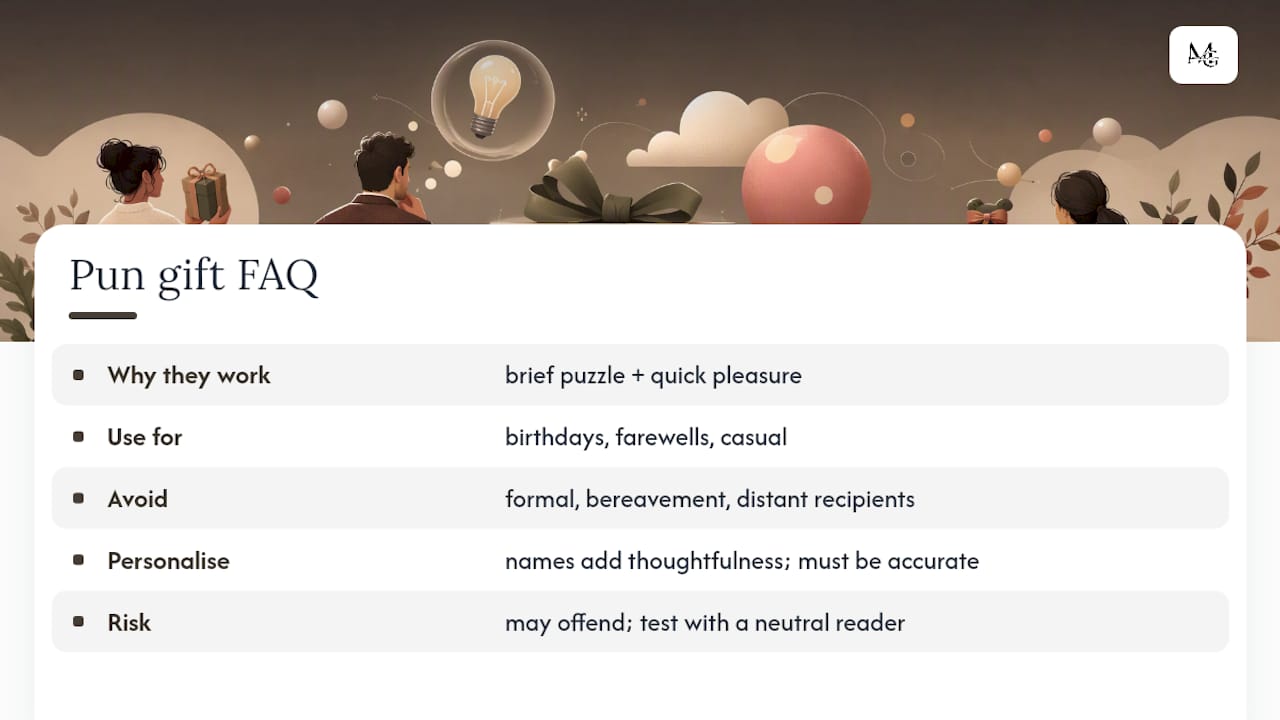
What products work best for pun-based gifts? Mugs and calendars suit puns designed for repeated daily use, cards suit one-line riddles read once, and stickers suit bite-sized jokes seen at a glance. Match the joke's length and payoff to how often the recipient will actually see it.
Sources
- The smile-seeking hypothesis: how immediate affective reactions motivate and reward gift giving
- Puns, relevance and appreciation in advertisements
- Visual–verbal interplay strengthens humour and consumer response
- Gag gifting: the joke and the poke