

A great musician mug saying does three things at once: it makes the reader smile, it signals that the giver truly gets them, and it fits on a curved ceramic surface without squinting. The formula is simple: audience + wordplay + brevity. Pick one person, find one musical double meaning, and cut every word that does not earn its place. Here are ten starter lines you can use right now, grouped by recipient:
For bandmates:
- "I've got 99 problems, but the pitch ain't one"
- "Resting bass face"
- "I play well with others (occasionally)"
For music teachers:
- "Teaching the world, one scale at a time"
- "I have the patience of a saint and the ears of a hawk"
- "Treble-maker in the classroom"
For music students:
- "Still practising. Still caffeinated."
- "Fuelled by coffee and crotchets"
For any musician:
- "I don't make mistakes — I improvise"
- "Life is short. Play loud."
These lines work because they sit where the reader expects a normal phrase and deliver a musical twist instead. That moment of recognition is exactly what makes music puns land: musical vocabulary is packed with homophones and near-homophones, so a single word swap can carry the whole joke.
Key takeaways
Clever musician mug sayings work when they combine one musical double meaning, a specific recipient, and enough brevity to read clearly on a curved ceramic surface.
| Point | Details |
|---|---|
| Use the three-part formula | Audience + wordplay + brevity produces sayings that land every time. |
| One pun per line | Stacking multiple wordplays causes confusion; a single twist lands harder. |
| Design for the curve | Keep lines to 25–35 characters; use 18pt minimum font; put the punchline last. |
| Choose your print method carefully | Sublimation suits gifts and small runs; DIY Sharpie/POSCA suits prototypes and personal keepsakes. |
| Mugnificentdeals handles it for you | Custom music mugs with free mockups and UK delivery, ready in 3–5 working days. |
Table of Contents
- How do you plan a mug saying that actually lands?
- Which wordplay techniques work best on a small mug surface?
- 60+ musician mug sayings ready to use or adapt
- What design rules make mug text print clearly?
- What are your printing options in the UK?
- What copyright pitfalls should you avoid on musician mugs?
- How do you proof a mug design before ordering?
- How do you personalise a mug without cluttering the design?
- Final checklist before you print
- Why simple and slightly nerdy wins with musicians
- Personalised music mugs, made for you by Mugnificentdeals
- Sources
How do you plan a mug saying that actually lands?
Before you write a single word, ask four questions: Who is this mug for? What do they love most about music? What reaction do you want (a laugh, a warm smile, or a knowing nod)? And how far away will someone read it — across a desk or up close over breakfast?
Narrow targeting raises emotional impact considerably. A mug that says "Resting bass face" means something specific to a bassist; a mug that says "Music lover" means nothing to anyone in particular. The same principle applies to teachers versus performers, classical players versus jazz improvisers, and beginners versus seasoned professionals. The most memorable music-related gifts reflect specific knowledge about the recipient rather than broad, genre-level choices.
Tone is the second decision. Four broad registers cover most musician mugs:
- Nerdy/insider: references that only the recipient's circle will catch ("Parallel fifths? Never heard of them")
- Affectionate: warm, slightly sentimental lines that celebrate dedication ("Every note you teach stays forever")
- Sarcastic/ironic: self-aware humour that musicians use on themselves ("Professional musician: will play for coffee")
- Inspirational: short, earnest lines that feel motivating rather than cheesy ("The music is worth the early mornings")
Choosing the wrong tone is the most common mistake. A sarcastic line sent to a sensitive student can sting; an earnest line sent to a sardonic jazz player will feel out of place. When in doubt, affectionate beats sarcastic for gifts, and insider beats generic every time.
Pro Tip: Before committing to a line, read it aloud to one or two people who know the recipient. If they smile without explanation, the line works. If they need context, it probably needs a rewrite.
Which wordplay techniques work best on a small mug surface?
Mugs give you roughly 30–40 characters per line on a standard 11oz design before text starts to wrap awkwardly. That constraint is actually a gift: it forces precision. Short, well-timed puns outperform multi-pun sentences because stacking too many wordplays in one line produces confusion rather than laughter. One pun per line is the working rule.
Four reliable techniques
1. Lexical ambiguity and homophones Musical vocabulary is unusually rich in double meanings. Words like sharp, flat, rest, key, beat, note, bar, scale, and pitch all carry everyday meanings alongside their musical ones. The technique is to write a sentence that reads naturally in both registers simultaneously:
- "Stay sharp" (advice + musical notation)
- "Life is full of rests" (pauses + musical rest)
- "You're my key" (importance + musical key)
2. Contrast and reversal Set up a familiar expectation, then flip it in the final word. The reader's brain completes the expected phrase and then catches the twist:
- "I followed my heart — it led me to the orchestra pit"
- "Practice makes perfect. I'll let you know when I get there."
3. Compression and ellipsis Cut every word that does not change the meaning. Contractions, symbols, and implied subjects all help. "I am a musician who needs coffee" becomes "Musician. Needs coffee." The shorter version reads faster and lands harder on a curved surface.
4. Mini templates to remix
Use these as starting frames:
- [Instrument] + verb pun: "Drummers do it with sticks"
- I [verb] my [noun] — musical twist: "I lost my keys. All twelve of them."
- Occupation + honest confession: "Professional musician: will play for coffee"
- Reversal of common wisdom: "Practice doesn't make perfect. It makes permanent."
The double-meaning anchor list
These musical terms are your most reliable pun anchors. Each carries a strong everyday meaning alongside its technical one:
- Sharp (alert / raised semitone)
- Flat (deflated / lowered semitone)
- Rest (relaxation / musical pause)
- Key (important / musical key)
- Beat (rhythm / to defeat)
- Note (written message / musical note)
- Bar (pub / musical bar)
- Scale (proportion / musical scale)
- Pitch (sales talk / musical pitch)
60+ musician mug sayings ready to use or adapt
Browse by category and pick the line that fits. Brief usage notes follow each group. For personalised commissions, drawing on a recipient's favourite song or artist produces lines that feel specific and memorable rather than off-the-shelf.
Puns and wordplay
- "Stay sharp"
- "Resting bass face"
- "Life is full of rests — take them"
- "I've got the key to happiness (all twelve of them)"
- "Feeling a little flat today"
- "You're in treble now"
- "I'm on a roll — a drum roll"
- "Keep calm and carry on (the beat)"
- "Pitch, please"
- "No rest for the wicked (or the musician)"
Best for: bandmates, music friends, self-gifting. These work well in retail settings because the humour is universal enough to land without context.
Short quips and ironic lines
- "Professional musician: will play for coffee"
- "I don't make mistakes — I improvise"
- "Practising since then. Still caffeinated."
- "Music is my second language. Coffee is my first."
- "Technically, I'm always in tune with myself"
- "I play well with others (occasionally)"
- "Rests are just coffee breaks in disguise"
- "My other instrument is also in need of tuning"
Best for: self-aware musicians, jazz players, anyone who appreciates dry wit. Avoid these for younger students or sensitive recipients.
Motivational and earnest lines
- "Every note matters"
- "The music is worth the early mornings"
- "Play like nobody's watching. Record like everybody is."
- "Still practising. Still believing."
- "Music doesn't ask why. It just plays."
- "One more run-through"
- "The stage is wherever you are"
Best for: music students, performers before a big event, or anyone who needs encouragement. These suit personal commissions more than mass retail.
Music teacher gifts
For teacher-focused designs, see the music teacher mug design workflow for layout ideas alongside these lines:
- "Teaching the world, one scale at a time"
- "Treble-maker in the classroom"
- "I have the patience of a saint and the ears of a hawk"
- "Every note you teach stays forever"
- "The best teachers play it forward"
- "Shaping musicians, one lesson at a time"
- "Part teacher, part conductor, mostly caffeinated"
- "Music teacher: turning chaos into harmony"
Best for: end-of-term gifts from students or parents. Adding the teacher's name and instrument beneath the punchline lifts these from generic to genuinely personal.
Instrument-specific lines
- Pianists: "88 keys, infinite possibilities"
- Guitarists: "Six strings, one obsession"
- Drummers: "I keep the beat so everyone else can pretend they're in charge"
- Violinists: "Strings attached"
- Cellists: "Low and slow"
- Flautists: "Breath is everything"
- Trumpeters: "Loud and proud"
- Bassists: "Holding it down since [year]"
Best for: instrument-specific gifts. These are strongest as personalised commissions where the instrument illustration matches the text.
Inside-joke and personalised formats
These are frames rather than finished lines. Fill in the brackets with real details:
- "[Name] plays [instrument] like nobody's business (because it is)"
- "Fuelled by coffee and [genre]"
- "Official [band name] mug — handle with care"
- "[Name]: still practising, still caffeinated"
Specificity increases emotional impact far more than any clever turn of phrase alone. A name, a date, or a private reference turns a good line into a great gift.
A note on copyright: Never quote song lyrics directly on a mug you intend to sell or gift widely. Even a short fragment can infringe copyright. Paraphrase the sentiment, use the feeling, not the words.
What design rules make mug text print clearly?
A saying that reads beautifully on screen can become a squinting exercise on a curved ceramic surface. These rules prevent that.
Line length and safe-wrap area
On a standard 11oz mug, the printable wrap area is roughly 20cm wide and 9cm tall. A comfortable line holds 25–35 characters at a legible font size (18pt minimum for body text, 24pt for a punchline). On a 15oz mug, you gain roughly 2–3cm of width, which allows slightly longer lines. For minimal musician mug designs, two short lines almost always outperform one long one.
Font hierarchy
Use two fonts at most: a display or script font for the punchline and a clean sans-serif for any supporting text (name, instrument, tagline). Mixing three or more fonts makes a small surface feel cluttered. Script fonts look elegant but reduce legibility at small sizes, so keep them for lines of 20 characters or fewer.
Contrast and colour
Dark text on a light background is the safest choice for ceramic printing. Light text on a dark background works well with sublimation printing but can fade faster with dishwasher use. Avoid mid-tone text on mid-tone backgrounds — the contrast disappears after a few washes.
Safe area and placement
| Element | Recommended placement | Notes |
|---|---|---|
| Main punchline | Centre of wrap, vertically centred | Largest font; this is the first thing the eye finds |
| Tagline or instrument | Below punchline, same horizontal axis | Smaller font, 60–70% of punchline size |
| Recipient's name | Opposite the handle or beneath punchline | Keep it subtle; it should complement, not compete |
| Instrument illustration | Left or right of text block | Leave at least 1cm breathing room around text |
Line breaks are editorial decisions. The final line of a two-line saying carries the most visual weight, so put the punchline or the twist there. "Fuelled by coffee / and crotchets" lands better than "Fuelled by crotchets / and coffee" because the unexpected word arrives last.
What are your printing options in the UK?
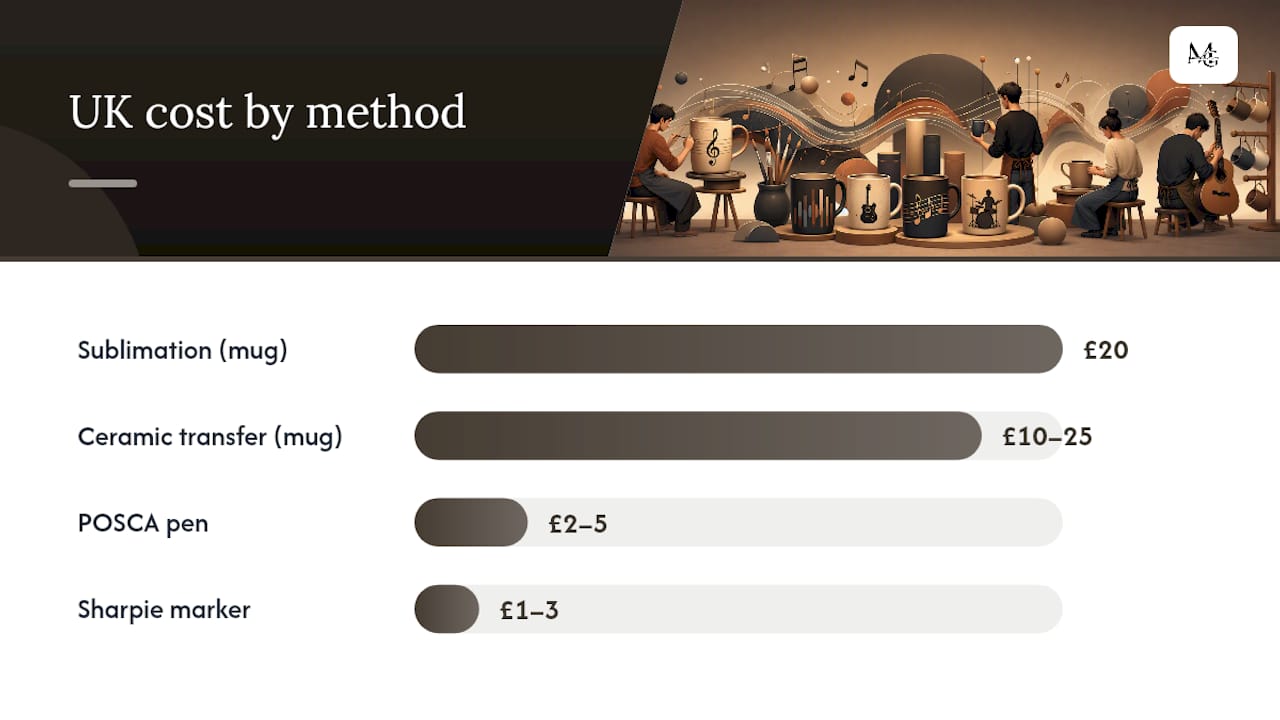
Three main routes exist for turning a saying into a finished mug: professional sublimation printing, ceramic transfer printing, and DIY hand-lettering. Each suits a different budget, quantity, and skill level.
Professional printing methods
Sublimation printing bonds dye directly into the ceramic coating under heat. The result is vivid, dishwasher-safe, and precise. Most UK online print services accept a PDF or PNG file at 300dpi. Minimum orders vary, but single-unit runs are widely available. This is the right choice for gifts, small runs, and any design with fine detail or photographic elements.
Ceramic transfer printing (also called decal printing) applies a printed film to the mug surface, which is then kiln-fired. It produces sharp, durable results and suits text-heavy designs well. Turnaround is typically 5–10 working days for small UK runs.
Pad printing suits simple, single-colour designs and is common for branded merchandise. It is less suited to detailed illustrations or multi-colour text.
DIY methods: Sharpie and POSCA
POSCA and ceramic paint pens produce clearer, longer-lasting lettering than standard permanent markers when sealed correctly. For a hand-lettered finish, POSCA pens are the stronger choice.
The Sharpie method is widely circulated in craft tutorials: draw on a clean, grease-free mug with Sharpie paint markers, then bake at 180°C for 30 minutes to improve durability. The result is charming but not fully dishwasher-proof. Hand-washing extends the life considerably. For a beginner starting out with lettering practice, simple marks and short text are a good entry point before committing to a full design.
Can you use Sharpie markers on mugs? Yes, with caveats. Standard Sharpie permanent markers fade quickly. Sharpie paint markers hold better after baking or sealing, but neither method matches the durability of professional sublimation. For a personal keepsake, the DIY approach is fine. For a gift intended to last years, professional printing is worth the cost.
| Method | Durability | Cost (UK) | Skill needed | Best for |
|---|---|---|---|---|
| Sublimation (professional) | Excellent | £20 per mug | None (file prep only) | Gifts, small runs, detailed designs |
| Ceramic transfer | Very good | £10–£25 per mug | None (file prep only) | Text-heavy, kiln-fired finish |
| POSCA paint pens (DIY) | Good (hand-wash) | £2–£5 per pen | Moderate | Personal projects, hand-lettered look |
| Sharpie paint markers (DIY) | Fair (hand-wash) | £1–£3 per marker | Low | Quick prototypes, practice pieces |
What copyright pitfalls should you avoid on musician mugs?
Song lyrics are protected by copyright from the moment they are written, and that protection typically lasts for the author's lifetime plus 70 years under UK law. Quoting even a short fragment on a mug you sell or distribute widely can constitute infringement. The "it's only a few words" argument does not hold legally: courts have found infringement in lines as short as a single distinctive phrase.
Rules of thumb to follow:
- Avoid quoting any recognisable lyric verbatim, even if you change one word.
- Do not use a band name or artist name as the centrepiece of a design without permission, particularly for commercial sale. A band name is often a registered trademark.
- Public domain songs (generally those written before 1928 in the UK, though the exact threshold depends on the author's death date) are safer, but verify before printing.
- Paraphrase the feeling of a lyric rather than its words. "She loves rock and roll" becomes "Loves the music, lives the life" — the sentiment survives, the infringement does not.
- Use generic musical descriptors ("jazz lover", "classical at heart") rather than artist or album names.
Pro Tip: If you plan to sell mugs commercially and want to use a lyric or artist reference, contact the relevant music publisher or use a licensing service such as the MCPS (Mechanical-Copyright Protection Society) in the UK. For personal, non-commercial gifts, the risk is lower, but the safest route is always an original line.
How do you proof a mug design before ordering?
Catching an error before printing saves money and disappointment. Work through these steps in order:
- Export a curved mockup. Most professional printers and design tools (Canva, Adobe Express, Printful's mockup generator) offer a 3D mug preview. View the design wrapped around the curve, not flat on screen.
- Check the wrap direction. The text should read left-to-right when the handle faces right. Confirm this on the mockup, not the flat file.
- Print at 1:1 scale. Print the flat artwork at actual size on paper and hold it against a mug. This reveals whether the font is genuinely readable at the size you have chosen.
- Check contrast on the actual background colour. If your mug is cream rather than white, the contrast will differ from what you see on a bright screen. Adjust accordingly.
- Proofread twice, in different sittings. Read the text forwards, then backwards word by word. Spell-check does not catch correctly spelled wrong words ("their" vs "there", "note" vs "not").
- Request a hard proof or sample. Most UK professional printers offer a single printed sample for a small fee before a run. For any order above five mugs, a physical sample is worth the cost and the extra 3–5 working days it adds.
- Confirm the file format. UK printers typically request a PDF or PNG at 300dpi with a 3mm bleed. Check the printer's specification sheet before submitting.
For small runs of one to three mugs, a single sample is the whole order. For runs of ten or more, order one sample first, approve it, then place the full order. This approach costs slightly more per unit but eliminates the risk of a batch error.
How do you personalise a mug without cluttering the design?
The most thoughtful personalisation is also the most restrained. A name, an instrument, and a well-chosen saying is usually enough. Adding a date, a band nickname, or a short paraphrase of a shared memory lifts the design from clever to genuinely meaningful, without crowding the surface.
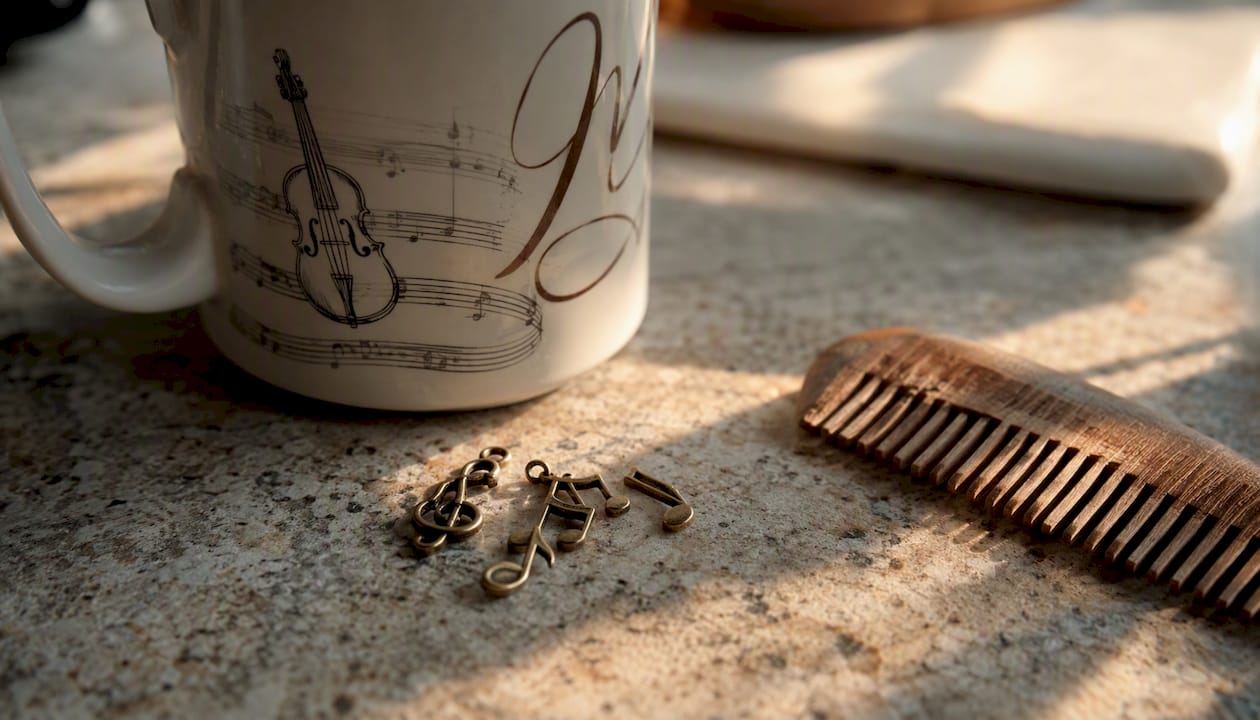
Specificity in personalised gifts increases emotional resonance far more than adding extra elements. Two or three concrete details outperform a design that tries to say everything.
Placement guidance:
- Recipient's name: place it opposite the handle (the side that faces outward when the mug sits on a desk) or directly beneath the punchline in a smaller font. Never let it compete with the main saying in size.
- Instrument name or illustration: position to the left of the text block, or centred above it. Leave at least 1cm of clear space between the illustration and the nearest letter.
- Date or occasion: small, beneath the main text, in a neutral font. Treat it like a caption, not a headline.
- Initials or monogram: work best on the handle side or as a subtle watermark beneath the design.
When to use a photo or icon instead of text: a clean line-drawing of the recipient's instrument often communicates more warmly than a photograph on a mug, particularly for ceramic printing where photo reproduction can look flat. Reserve photographs for sublimation-printed mugs where colour fidelity is high.
For teachers, a simple "Thank you, [Name]" beneath the punchline is enough. For bandmates, a band nickname or an inside reference to a shared gig date adds the private layer that makes a gift feel commissioned rather than bought.
Final checklist before you print
Run through these before hitting "order":
- Text proofread twice, in different sittings, including punctuation and apostrophes
- Recipient's name spelled correctly (confirm with the person who placed the order)
- Preferred pronouns or honorifics included where relevant
- Design viewed on a curved 3D mockup, not just a flat file
- Wrap direction confirmed (text reads left-to-right with handle facing right)
- Font size checked at 1:1 printed scale (minimum 18pt for body, 24pt for punchline)
- Contrast checked against the actual mug colour, not a white screen background
- No copyrighted lyrics or trademarked names in the design
- File saved in the printer's requested format (typically PDF or PNG at 300dpi with 3mm bleed)
- Bleed and safe-area guides included in the exported file
Why simple and slightly nerdy wins with musicians
There is a temptation, when designing for musicians, to go big: bold fonts, dramatic statements, sweeping declarations about the power of music. Resist it. Musicians, as a group, tend to be quietly self-aware. They have heard every grand claim about their art and they are more moved by the line that sounds like something they would actually say to themselves at 7am before a rehearsal.
The sayings that perform best in this space are the ones that feel like an inside joke between the mug and its owner. Not a joke that needs explaining, but one that lands the moment the reader picks up their coffee. "Resting bass face" works because it is precise, self-deprecating, and completely specific to one instrument. "Music is life" works for nobody, because it belongs to everyone and therefore to no one.
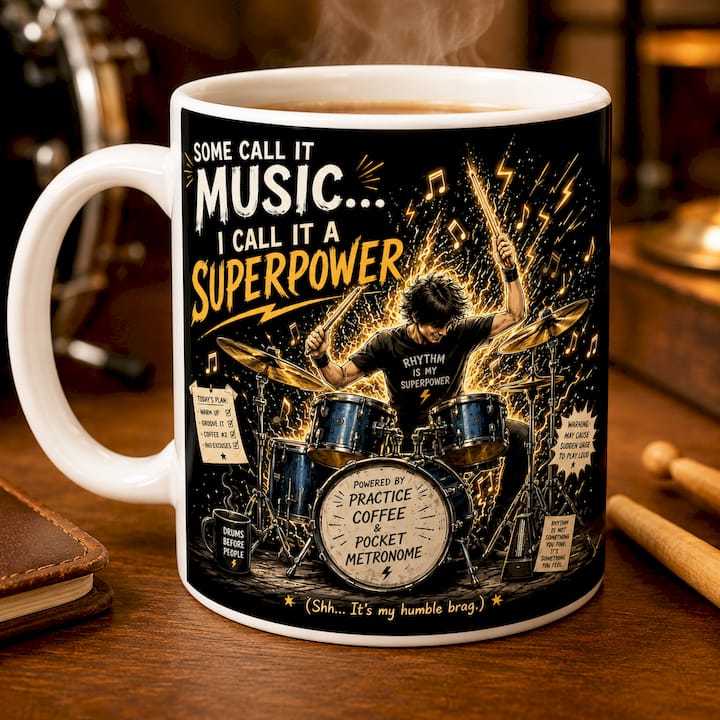
Mugnificentdeals was built on exactly this instinct: that a musician mug should feel sketched and thought-out, not mass-produced. The brand's approach, pairing clean instrument illustrations with short, clever copy, reflects the same principle this article argues for. Restraint is not a limitation. For this audience, it is the whole point.
Personalised music mugs, made for you by Mugnificentdeals
Writing your own saying is genuinely satisfying. But if you would rather hand the whole thing to people who do this every day, Mugnificentdeals's personalised music mugs collection is the direct route.

Every mug is custom-printed with your choice of saying, instrument illustration, name, and font style. The team handles layout, contrast, and wrap positioning so the design reads cleanly on the curve. A free digital mockup comes with every order, so you see exactly what you are getting before it goes to print. Turnaround for standard UK orders usually takes a few working days. Browse the best personalised music mugs for gifts to find a starting point, or bring your own line and let the team build around it.
Sources
These sources are worth bookmarking for technique, inspiration, and legal guidance:
- 170+ best Music Puns That Actually Land
- Crafting Heartfelt Messages: How Music Inspires Gift Card Greetings
- DIY Sharpie Mugs
- DIY: Paint your own mugs - Vaessen Creative
- How to Give Music as a Gift Without It Feeling Generic