

A clever music pun deserves better than a mug that swallows it whole. Too many musicians and music lovers have experienced that sinking moment: you spot what should be the perfect joke on a mug, but the text is squashed, the font too small, and the punchline vanishes around the curve before you can even finish reading it. Knowing how to add humor to mug designs is the difference between a gift that earns a genuine laugh every morning and one that collects dust at the back of a cupboard. This guide walks you through every step, from idea to finished ceramic, so your joke lands exactly as intended.
Table of Contents
- Getting started: What makes a funny music mug work?
- Prepare your idea: Planning for clarity and impact
- Execution: Bringing your music pun mug to life
- Common mistakes and how to troubleshoot them
- Enjoy your results: Sharing and gifting musical humour
- Why less is more: The surprising power of simple music mug humour
- Ready to create or gift the perfect humorous music mug?
- Frequently asked questions
Key Takeaways
| Point | Details |
|---|---|
| Instantly recognisable jokes | Musical puns and references must read at a glance to land well on mugs. |
| Simple design wins | One bold image and a short punchline beat cluttered, complex layouts. |
| Test before printing | Mock up your design on paper and check for readability around the mug’s curve. |
| Avoid fine details | Steer clear of small text or subtle gradients that get lost on curved surfaces. |
Getting started: What makes a funny music mug work?
Now that we've set expectations, let's break down what makes a musical mug joke actually work before you put ink to ceramic.
The single most important rule in humorous mug design is instant recognition. A joke that requires ten seconds of reading to understand is a joke that has already failed. The best funny mug design ideas work the moment your eyes land on them, the same way a well-timed rim shot lands before the audience has time to think. Musical references are particularly powerful here because they carry decades of shared knowledge. A pun like "BACH! Humbug!!" works because it layers two recognisable references — the composer and the Dickens phrase — into a single, satisfying collision.
What separates a mug joke that earns a smile from one that earns a polite nod? Four traits:
- Universal musical reference: The joke should connect to something most musicians or music fans already know, whether it's a famous composer, a genre cliché, or a shared rehearsal experience.
- A clear punchline: One joke per mug. Always.
- A strong musical connection: The humour should feel specific to music culture, not just a generic pun with a treble clef slapped on top.
- Readability at a glance: Bold typography, high contrast, and enough white space to let the words breathe.
For inspiration, consider how unique music mug designs balance wit with visual clarity. The best ones feel like they were written by a musician, not a marketing team.
| Humorous reference | Musical connection | Best audience |
|---|---|---|
| "BACH! Humbug!!" | Classical composer pun | Classical musicians and fans |
| "More Cowbell" | Famous SNL sketch reference | Rock musicians, general music lovers |
| "I improvise, not mistakes" | Jazz philosophy reframed | Jazz players and improvisers |
| "Treble maker" | Treble clef wordplay | Choral singers, general musicians |
| "Rest in peace" (with a musical rest symbol) | Music notation pun | Music teachers, theory students |
Notice that every entry in that table works without explanation. That is not a coincidence. It is the goal.
Prepare your idea: Planning for clarity and impact
Once you know what a successful humour mug involves, you need to prepare your own concept with the technical realities in mind.
The physical shape of a mug is not a neutral canvas. The curve of the ceramic means that text placed too close to the edges will appear to tilt, compress, or simply disappear from view depending on the angle. This is a constraint that catches many first-time designers off guard. Avoiding fine details or low-contrast gradients is essential because curvature and viewing conditions can make small elements disappear or become unclear. Plan for this from the very start, not as an afterthought.
The most reliable approach is a single strong pun paired with one clean visual. Here is how that compares to a busier layout:
| Design approach | Readability | Humour impact | Gift appeal |
|---|---|---|---|
| One pun + one bold image | High | Strong, immediate | Excellent |
| Two jokes + decorative border | Medium | Diluted, confusing | Moderate |
| Multiple text blocks + small icons | Low | Lost entirely | Poor |
The data is clear. Simplicity wins every time. Now, here is a practical process for turning your idea into a mug-ready concept:
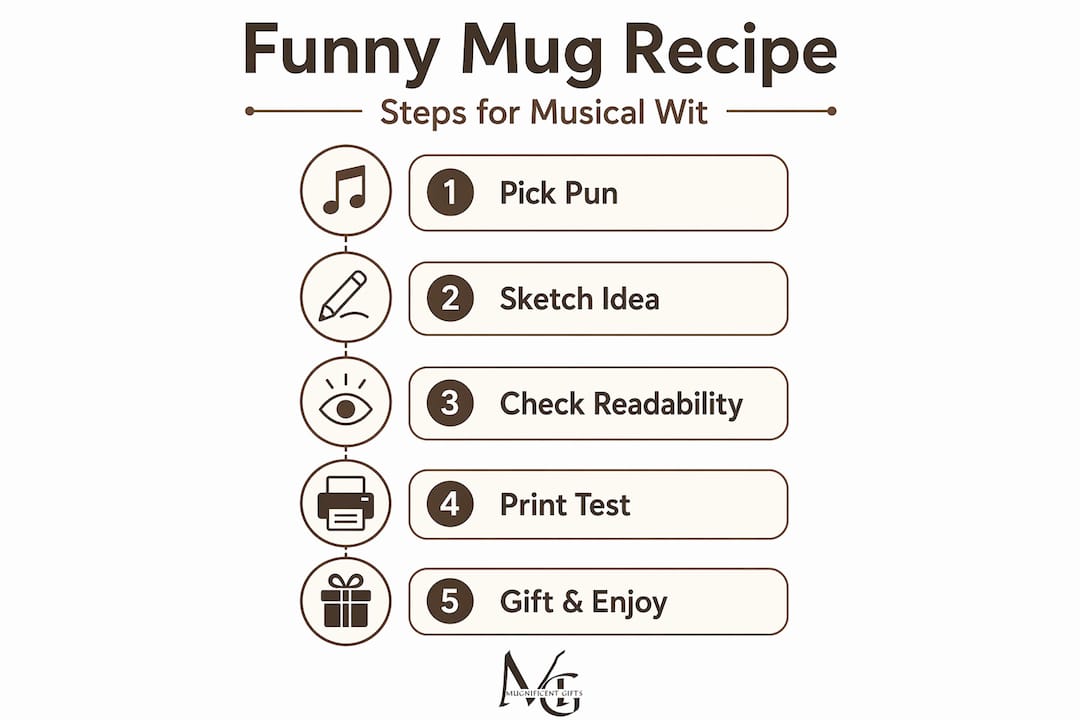
- Choose your joke first. Write it out in plain text and read it aloud. If it makes you smile without any visual support, it is strong enough to carry a design.
- Draft the text layout. Decide on font size, weight, and placement. Aim for large, bold lettering that fills the central panel of the mug without crowding the edges.
- Select one supporting image. A simple line drawing of an instrument, a musical note, or a relevant symbol. Keep it to one element.
- Check contrast. Dark text on a light background, or vice versa. Never grey on white or pale yellow on cream.
- Test on a template. Most print services provide a flat mug template. Wrap your design around it digitally to see how it reads at the curve.
Pro Tip: Print your flat design on a sheet of paper and wrap it around a cylindrical mug or glass. This low-tech test reveals immediately whether your joke stays readable as it curves around the surface.
For a closer look at balancing humour and readability in practice, the principles apply whether you are designing for yourself or choosing from a curated collection of personalised music mugs.
Execution: Bringing your music pun mug to life
With the groundwork laid, it is time to put your plan in action and get your joke onto a mug.
The production stage is where many good ideas meet an avoidable end. The key is treating your humour the way a typographer treats a headline: every word earns its place, and nothing competes for attention. As ceramic mug printing guidelines confirm, one strong visual combined with one short line of text beats multi-joke layouts for readability on curved surfaces. Keep that principle at the front of your mind throughout.
Follow these steps to prepare your artwork correctly:
- Set your canvas size to match the print area specified by your chosen printer, typically around 8.5 inches wide by 3.7 inches tall for a standard 11oz mug.
- Place your joke text in the centre of the canvas, at least 0.5 inches from any edge to account for bleed and wrap.
- Add your single supporting image above or below the text, keeping it proportional and not competing with the words.
- Check your resolution is at least 300 DPI. Anything lower will print soft and undermine the crispness your joke needs.
- Export as a high-quality PNG or PDF with no compression artefacts, particularly around text edges.
- Review the flat file by squinting at it. If the joke is still readable when your vision is slightly blurred, it will survive the curve.
A curved surface is an unforgiving editor. It shrinks margins, bends straight lines, and hides anything you placed too close to the edge. Design as though the mug is trying to hide your punchline, and then make your punchline impossible to hide.
Pro Tip: Before committing to a full print run or a final order, print your design on paper, cut it to size, and tape it around an actual mug. Walk across the room and look back at it. That distance and angle is roughly how someone will first see it on a desk or shelf.
When your mug is destined to be a gift, the execution matters even more. A perfectly printed joke becomes a genuinely memorable gift that the recipient will reach for every single morning.

Common mistakes and how to troubleshoot them
Even the best ideas sometimes run into trouble; here is how to troubleshoot if your joke does not read as planned.
The most frequent culprit is overcrowding. Designers who are enthusiastic about their concept tend to add a second joke, a decorative border, a small logo, and a tagline. Each addition seems harmless in isolation. Together, they create a visual noise that punishes complexity on curved mugs, making humour far more likely to fail than a clean aesthetic design.
Other common design failures include:
- Text cut off at the seam: The joke wraps around and the punchline is hidden unless you rotate the mug.
- Low contrast washing out the humour: A pale font on a mid-tone background becomes unreadable after printing.
- Fonts that are too decorative: Script fonts that look elegant on screen become illegible on ceramic at small sizes.
- Images that are too detailed: Fine linework, cross-hatching, or photographic elements lose definition on a curved, glazed surface.
Here is a quick reference for diagnosing and fixing the most common problems:
| Problem | Likely cause | Fix |
|---|---|---|
| Joke text is cut off | Placed too close to the seam | Recentre design, add 1cm margin on each side |
| Punchline is faded or washed out | Low contrast colour choice | Switch to black on white or white on a bold solid colour |
| Image looks blurry | Resolution below 300 DPI | Re-export artwork at correct resolution |
| Text is hard to read | Font too thin or decorative | Switch to a bold, sans-serif typeface |
| Design looks squished | Template dimensions incorrect | Confirm print area with your supplier and resize |
Pro Tip: Always request a single printed sample before ordering multiple mugs. A physical sample reveals contrast, sizing, and readability issues that a screen preview will never show you.
If a design consistently fails to read well after adjustments, the most honest solution is to simplify the joke itself. Sometimes the best recovery is selecting a cleaner concept entirely. For guidance on what makes a mug worth giving, the principles behind a truly giftable mug apply equally to humorous designs. You can also browse popular ceramic mug styles to see which formats translate best in practice.
Enjoy your results: Sharing and gifting musical humour
Once your design is spot-on, make the most of the result by gifting or sharing it in a way they will never forget.
A well-executed music pun mug is more than a functional object. It is a small, daily reminder that someone understood your sense of humour well enough to put it on something you use every morning. That is precisely why music-specific wordplay and recognisable musical references translate so effectively into gifts. The joke does not expire. It earns a fresh smile with every cup of tea or coffee.
Consider who in your musical world would genuinely appreciate a mug like this:
- Bandmates: An inside joke from rehearsal, a shared musical frustration turned into a punchline.
- Music teachers: A clever nod to the patience required for teaching scales or sight-reading.
- Choir friends: References to particular voice parts, conductors, or the eternal battle over breath marks.
- Amateur musicians: Anyone who has ever apologised for a wrong note mid-performance will recognise themselves in the right pun.
- Music students: Graduation gifts, end-of-term presents, or just a "keep going" gesture with a laugh built in.
For presentation, wrap the mug with a few sheets of music manuscript paper or tuck it inside a small tote bag with a packet of their favourite tea. The packaging does not need to be elaborate. The joke on the mug is already doing the heavy lifting.
Sharing your design on social media works particularly well when you photograph the mug in a natural setting: on a piano, beside sheet music, or next to an instrument case. The context reinforces the joke without needing a caption. For more on the deeper meaning behind this kind of gift, exploring the significance of music-lover mug gifts is well worth your time. And when you are ready to find the ideal option for someone special, the range of personalised mugs for gifts covers everything from classical puns to rock-and-roll wit.
Why less is more: The surprising power of simple music mug humour
Reflecting on what works best, here is what most mug designers and even musicians tend to overlook.
There is a temptation, especially among creative people, to prove how clever you are by layering references. A mug that references Beethoven, contains a staff of notation, lists three instrument-specific puns, and includes a quote from a famous conductor might seem impressively thorough. In reality, it reads like a confused paragraph. Nobody laughs at a paragraph.
The mugs that earn the biggest reactions are almost always the simplest ones. A bold, single line. One image. One laugh. That is it. This is not a limitation; it is a discipline. The constraint forces you to identify the best version of your idea rather than every version of it simultaneously.
As ceramic mug printing research consistently shows, one strong visual combined with one short line of text outperforms multi-joke layouts every time. The curved surface is partly responsible, but the deeper reason is psychological. Humour works through surprise and resolution. When a viewer has to work to find the joke, the surprise is gone before the resolution arrives.
Think of it like a musical performance. A single, perfectly placed note in a quiet bar carries more emotional weight than a flurry of semiquavers. The same principle applies to mug design. Restraint is not laziness; it is confidence. The best music puns on mugs feel inevitable, as though no other words could possibly have gone there.
If you find yourself adding a second joke "just in case," that is a signal the first one is not strong enough. Sharpen it. Simplify it. Trust it. Browse the personalised music mug collection for examples of how this philosophy looks in practice across a range of instruments and styles.
Ready to create or gift the perfect humorous music mug?
If this guide has sparked an idea, the next step is making it real. Whether you want to design your own or find something ready-made that already nails the joke, there are excellent options waiting.

Explore a curated range of personalised music mugs designed specifically for musicians and music lovers, where every pun has been tested for readability, wit, and that all-important first-glance laugh. Looking for a gift that truly hits the high notes? The best mugs for gifting collection brings together designs that feel thoughtful, funny, and genuinely personal. Or, if you want to see what is resonating right now, take a look at the most popular ceramic mugs for fresh inspiration before you commit to a design direction.
Frequently asked questions
What are the best types of music jokes for mugs?
Broad musical puns and instantly recognisable references work best, as music-specific wordplay built around composers, genres, or shared musician experiences lands immediately without needing explanation.
How do I make sure my mug joke stays readable?
Keep your design bold and high-contrast, and always test it on a physical printout before finalising, because fine details and low-contrast gradients become unclear on a curved ceramic surface.
Is it better to use text, images, or both for humour?
Combining a clear image with a short, bold pun gives the best results, as one visual plus one line of text consistently outperforms complex multi-element layouts on curved surfaces.
What is the biggest mistake people make in humour mug design?
Fitting too many jokes or using intricate details into a single design, since complexity on curved mugs causes humour to fail far more readily than it would on a flat surface.