
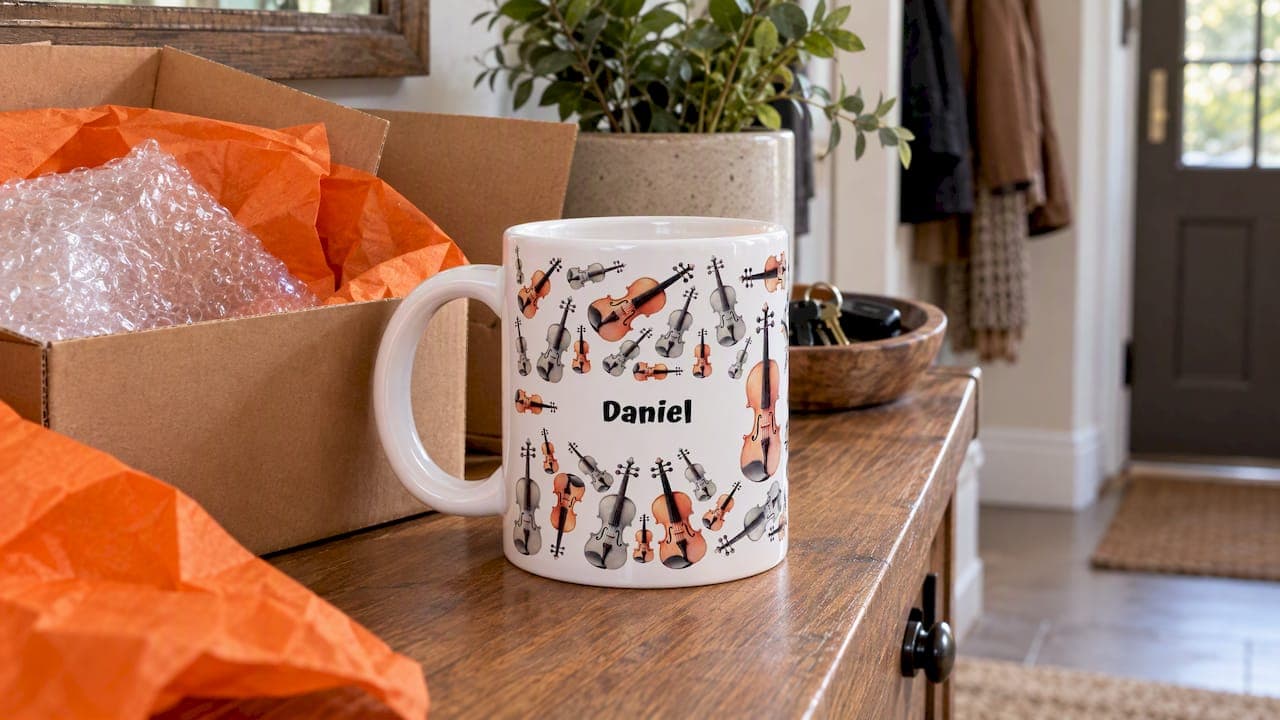
Usually, no, not if you have simply changed your mind. Under UK rules, personalised or custom-made goods are an exception to the online cancellation rights that normally let you send things back. But if a personalised gift is faulty, damaged or not as described, you are fully protected and entitled to a remedy. This guide explains where the line falls, what to do in each situation, and how to order so you never need to test it.
TL;DR
- Changing your mind is not enough to return a personalised item bought online: it is made to your specification, so the usual 14-day cooling-off period does not apply.
- Faulty, misdescribed or damaged items must be put right, and you can still ask for a refund if a repair or replacement does not fix the problem.
- A gift receipt helps the recipient exchange a standard gift, but for a personalised one the buyer will usually need to make the claim.
- If a seller refuses a valid refund, complain in writing, then look at chargeback, Section 75 and Citizens Advice.
- The cheapest return is the one you avoid: check the proof, the spelling and the delivery date before you pay.
Table of Contents
- Why personalised gifts are treated differently
- If you changed your mind
- If the gift is faulty, damaged or not as described
- Returning a gift you have received
- When a seller refuses a refund you are owed
- Quick reference: which situation are you in?
- Perspective: why we put so much into getting it right first time
- How to avoid needing a return in the first place
- Choosing a gift the recipient will actually keep
- Looking for a personalised music gift?
- FAQ
- Sources
Why personalised gifts are treated differently
When you buy something online, you normally get time to change your mind. Citizens Advice explains that buyers automatically get a 14-day cooling-off period for goods they have not seen in person. The exception is bespoke or made-to-measure goods, and personalised or custom-made items have no cooling-off period.
The reasoning is practical. A mug printed with a name, a photo or an inside joke cannot be resold to someone else. The maker has already spent materials and time on something with no second buyer. That is why almost every UK seller of personalised goods states the same thing in its returns policy: no returns for change of mind, but faults will be put right.
It is worth noting what this does not mean. It does not mean a seller can ignore a defect, send the wrong design or print something different from the proof you approved. Your rights on quality are untouched by the personalisation.
If you changed your mind
This is the hardest case, and the honest answer is that you probably cannot return the item for a refund. A few details are worth knowing.
Online purchases
GOV.UK sets out the standard rule for online sales: you must tell the seller you are cancelling within 14 days of receiving the goods, then return them within a further 14 days. Personalised and custom-made goods sit outside that rule. If your order was made to your specification, that clock never starts.

Shop purchases
Buying in a shop is different again. Citizens Advice notes that there is no automatic legal right to a refund merely because you changed your mind for goods bought in person. The shop's own returns policy decides. Some retailers are generous with standard stock, but few extend that to engraved or printed items.
Goodwill is still possible
Nothing stops a small maker from offering a goodwill gesture, such as a discount on a replacement. If you ordered the wrong colour by mistake, or the recipient moved house before delivery, a polite, prompt message is worth sending. Do not expect it, and do not demand it as a legal right, because it is not one.
Who pays for return postage
Where a change-of-mind return is allowed, return postage is normally the buyer's responsibility, unless the seller agreed to pay or failed to disclose the cost before purchase. Read the delivery and returns page before you pay, not after.
If the gift is faulty, damaged or not as described
This is where UK law is firmly on your side. GOV.UK says faulty, misdescribed or non-functional goods must receive a full refund, and you may still reject the goods after an attempted repair or replacement if the problem remains.
The underlying standard is that goods must be of satisfactory quality, fit for purpose and as described under the Consumer Rights Act 2015, as Consumer Protection UK summarises. For a personalised item, this covers several real situations:
- A mug that arrives cracked, chipped or with a damaged handle.
- A print that is faded, peeling or visibly misaligned compared with the proof.
- A name, date or message that differs from what you typed and approved.
- The wrong item entirely, such as a different colour or size.
The 30-day window
The Act sets a short-term right to reject. The explanatory notes confirm a minimum of 30 days, and that the 30-day period does not run while a repair or replacement is under way. In practical terms, inspect a gift on arrival rather than leaving it in the wrapping until the occasion. If it is a Christmas present ordered in November, unbox and check it before wrapping.
A mistake in the text is not always the seller's fault
This is the grey area that causes most disputes. If you typed "Happy Birthday Jon" and the person is Joan, and the seller printed exactly what you approved, that is generally an error on your side, not a fault. If you typed it correctly and the print differs, it is the seller's error and should be corrected at the seller's cost. Screenshots of your order confirmation and the proof settle this quickly, so keep them.
What to do, step by step
- Photograph the item and the packaging as soon as you spot the problem.
- Keep your order confirmation, proof and any messages.
- Contact the seller in writing (email or the platform's message system), describing the fault and what you want: a replacement, a repair or a refund.
- Give a clear, reasonable deadline for a reply.
- Do not throw away the packaging until the matter is resolved.
Returning a gift you have received
The recipient's position is more awkward than the buyer's, because the contract is between the buyer and the seller.
Receipts
For a non-faulty change-of-mind return of ordinary stock, Which? says there is no legal entitlement to a refund without a receipt, though a store may offer an exchange or credit note. For faulty goods, proof of payment such as a bank statement may be enough.
Gift receipts
A gift receipt will usually let the recipient return an unwanted gift themselves, subject to the retailer's policy. That helps with a jumper or a book. It rarely helps with a mug carrying someone's name, because the seller has no obligation to take it back.
Faulty gifts
For a faulty gift, the same source notes that the retailer may require the original purchaser to make the claim. If you are the recipient, ask the buyer to contact the seller or to authorise you to act for them. If you are the buyer, tell the recipient to keep the packaging and any photos of the damage.
When a seller refuses a refund you are owed
Sometimes a seller says "personalised, no returns" even when the item is genuinely faulty. That blanket wording does not remove your statutory rights. The Centre for Digital Consumers sets out the escalation route:
- Complain in writing. State the fault, the law you rely on and the remedy you want. Keep copies.
- Section 75. For a credit card purchase over £100, the card provider can be jointly liable with the seller.
- Chargeback. For card payments, ask your bank to request a chargeback.
- Citizens Advice. Report the matter through the Citizens Advice consumer service for guidance on next steps.
- Small claims. Use the court route as a last resort.
If you paid through a marketplace, use its resolution process alongside these steps, since that is often the quickest way to a response.
Quick reference: which situation are you in?
| Situation | Can you usually return it? | What helps |
|---|---|---|
| Changed your mind, personalised, bought online | No, personalised goods are excepted | Ask politely for goodwill; do not rely on it |
| Changed your mind, standard stock, bought online | Yes, notify within 14 days, return within a further 14 | Check who pays return postage |
| Faulty or damaged on arrival | Yes, repair, replacement or refund | Photos, order confirmation, written complaint |
| Printed differently from the approved proof | Yes, as not as described | Proof and order screenshots |
| Typo you approved yourself | Generally no | Seller may offer a discounted reprint |
| Gift receipt, unwanted personalised gift | Unlikely | Ask the buyer to contact the seller |
Perspective: why we put so much into getting it right first time
We make personalised music mugs, so we sit on the seller's side of this rule, and we understand why it exists. A mug with a violin sketch and a student's name on it has one buyer. That is exactly why the moments before checkout matter more than the moments after delivery.
In our experience of how people buy gifts for musicians, the problems that cause disappointment are rarely the dramatic ones. They are small: a name spelled the American way for a British teacher, a date typed in the wrong order, a photo that looked fine on a phone but is low resolution when printed. Each is avoidable with a slow, calm read-through before you pay. Our guide on proofing British spelling on mugs walks through that check, and our piece on avoiding personalised mug delays covers proofs, postage and rights together.

The same logic applies across personalised gifts generally. Makers of personalised candles with photo labels, for instance, work from the same bespoke principle, so the personalised candle options you see elsewhere follow the same rule: check the text and the image before the item is made, because afterwards it is yours.
Our advice, as simply as we can put it: treat checkout as the real return window. Read the proof aloud, ask someone else to read it, and confirm the delivery date against the occasion.
— Lasse
How to avoid needing a return in the first place
Most of the cost of a personalised gift gone wrong is preventable. Use this checklist before you pay.
Check the words
- Read every name, title and date aloud, one letter at a time for unusual names.
- Check UK spelling and date format (day, month, year) if the recipient is in Britain.
- Check apostrophes and capitals. "Dr" or "Mrs" matter to some recipients.
- Have a second person look at it. You will not spot your own typo.
Check the image
- Use the largest, sharpest photo you have, not a screenshot from a messaging app.
- Avoid faces near the edge of the photo, since mugs wrap a design around a curve.
- Look at the preview on a larger screen than your phone if you can.
Check the timing
Personalised items are made to order, so they take longer than off-the-shelf gifts. For Christmas especially, order 5 to 7 days earlier than you think you need to, so that a faulty item can be replaced before the day, not after it.
Check the policy
Before you pay, read the seller's returns page, delivery page and any statement about proofs. Look for who pays return postage on faulty goods, how long they give you to report a problem and how to contact them. A clear policy is a good sign. A missing one is a reason to look elsewhere.
Pay in a way that protects you
A credit card gives you the Section 75 route on purchases over £100, and any card payment gives you chargeback as a back-up. That is not a reason to expect trouble, only a sensible habit for larger orders.
Choosing a gift the recipient will actually keep
A returns problem often starts with a gift that was never quite right for the person. With a musician or teacher, specifics help: the actual instrument they play, a joke they would recognise, the name their students use for them.
If you are unsure, choose a design that does not depend on a detail you might get wrong. An instrument sketch with a short caption is safer than a long personal message you half remember. If you want to understand what personalisation can and cannot do, our guides on what design personalisation means and what custom means for gift buyers explain the options before you commit.
Looking for a personalised music gift?
We make personalised ceramic mugs for musicians, music teachers and their students: instrument illustrations, music quotes, names, photos and gift messages. Browse the personalised music mugs collection for instrument, funny, music theory and name designs, or see our best personalised music mugs for gifts if you are buying for someone else and want a safe place to start.
FAQ
Can I return a personalised gift if I just don't like it?
Usually not. Personalised and custom-made goods are excepted from the online cancellation rights, so change of mind is not a legal ground for a refund. Some sellers offer goodwill gestures, but you should not count on one.
Do I need a receipt to return a faulty gift?
Not necessarily. For faulty goods, proof of payment such as a bank statement may be enough. The retailer may still ask the original purchaser to make the claim, so the buyer may need to act for you.
What if the seller says personalised items are never refundable?
That wording cannot remove your rights where the item is faulty, damaged or not as described. Complain in writing, then consider chargeback or Section 75 for card payments, and the Citizens Advice consumer service if the seller still refuses.
Who pays to send a faulty item back?
For a faulty item, the seller is responsible for putting it right, and you should ask them how they want it returned before posting anything. For a permitted change-of-mind return, postage is normally the buyer's cost unless the seller agreed otherwise or did not disclose the cost beforehand.
How long do I have to report a fault?
The Consumer Rights Act gives a short-term right to reject for at least 30 days, and you should report problems as soon as you find them. Photographs taken straight away make any later conversation much easier.
Sources
- Accepting returns and giving refunds: the law, GOV.UK
- Changing your mind about something you've bought, Citizens Advice
- Get a refund when you return something you bought online, Centre for Digital Consumers
- Know Your Rights, Consumer Protection UK
- I want to return my goods, what are my rights?, Which?
- Returning an Unwanted Gift or Christmas Present, Consumer Protection UK
- Consumer Rights Act 2015, section 22 explanatory notes, legislation.gov.uk