

Order made-to-order personalised gifts well in advance of December for guaranteed pre-Christmas delivery. That buffer covers production time, proof approval, and Royal Mail's peak-season transit, which together push real deadlines earlier than most retailers admit. In-stock items with fast dispatch can stretch into mid-December using Royal Mail's guaranteed services, but personalised, made-to-order pieces need that earlier cushion. The exact cut-offs by product type are below.
TL;DR:
- Personalised gifts require ordering at least five to seven days before the retailer's production cut-off to ensure timely delivery.
- Embroidered textiles and handmade pottery demand significantly longer processing times, often well before mid-December, due to their complex creation stages.
- Proof approval is the most common delay, so responding promptly within a few hours can save several days in the production schedule.
- Carrier last posting dates, especially for remote areas, limit the latest possible dispatch date but are secondary to the retailer's internal deadlines.
- Overreliance on a simple "order by mid-December" date risks missing deadlines for handmade or engraved items that need earlier preparation.
Table of Contents
- Last order dates for Christmas personalised gifts UK: a product-by-product breakdown
- When do Royal Mail and couriers stop taking Christmas parcels?
- How personalised gift production actually works behind the scenes
- What are your rights if a personalised gift arrives wrong?
- What to do if you've missed the personalised gift deadline
- How we manage Christmas deadlines at Mugnificent Deals
- Why the "just order by mid-December" advice is misleading
- Get your personalised music mug ordered in good time this Christmas
- Official pages worth checking before you order
- Sources
Last order dates for Christmas personalised gifts UK: a product-by-product breakdown
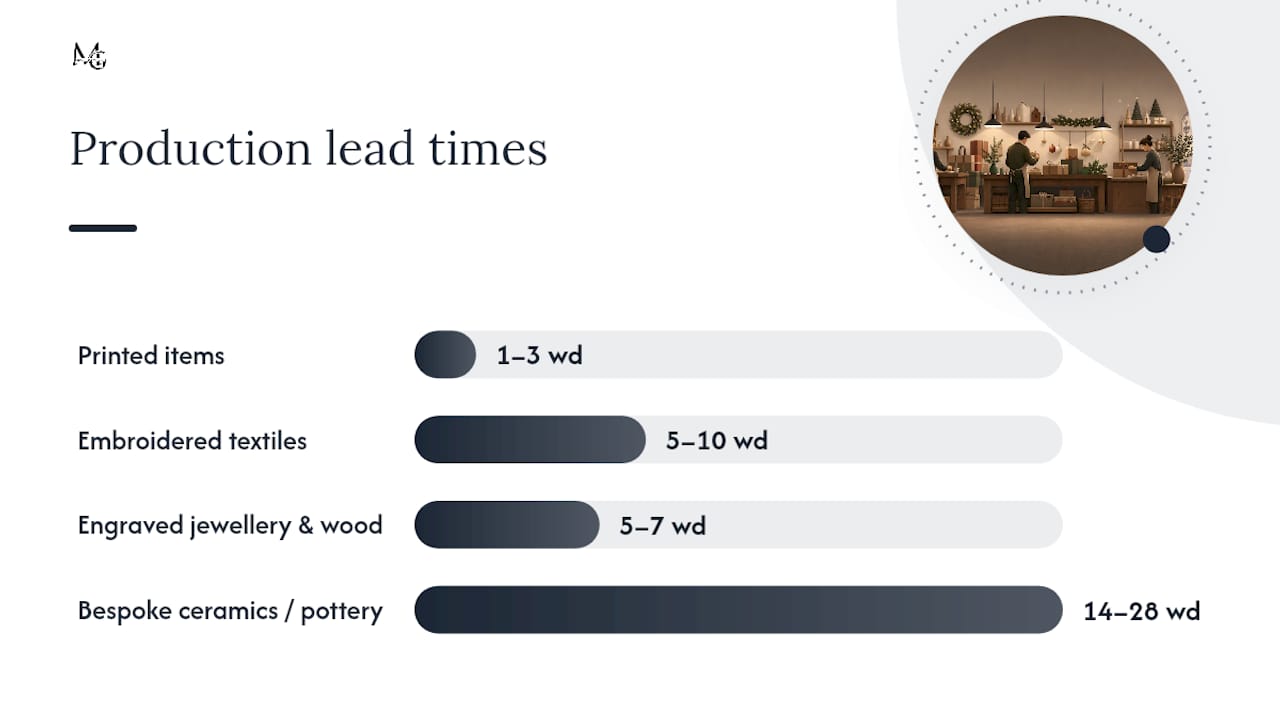
Every personalised item carries its own production clock, and that clock matters more than any carrier's last posting date. A photo mug takes hours to print. A hand-embroidered stocking takes days. Treat these as separate problems, because retailers do.
Printed items move fastest through production. Photo mugs, photo books, and printed canvases typically need one to three working days once a proof is approved. Many UK retailers advertise order windows running into mid to late December for these, but that assumes instant proof approval and no printer backlog, both of which vanish in peak season. For genuine safety, order printed personalised gifts by the end of November.
Embroidered textiles run slower. Monogrammed towels, stockings, and personalised blankets often need five to ten working days for stitching alone, before packing and dispatch. Retailers commonly set embroidery cut-offs a week or more earlier than their printed-goods deadlines, and industry buying guides reflect that gap consistently.
Engraved jewellery and wood sit in the middle but carry higher stakes for errors. Engraving machinery is precise, but the checking process (verifying names, dates, and special characters before the laser runs) adds a manual review step that printed goods skip. Expect five to seven working days, and build in extra time if the design needs a proof sign-off first.
Bespoke ceramics and handmade pottery are the slowest category by a wide margin. Anything thrown, glazed, or fired individually can need two to four weeks, since each firing cycle in a kiln is fixed and can't be rushed by paying more. If a gift involves genuine handmade pottery rather than printed ceramics, treat late November as your absolute latest order date, not your target.
Personalised cards and calendars are quicker but still need proofing time. Photo calendars typically take two to five working days once approved, while personalised cards can often be turned around within 24 to 48 hours. The bottleneck here is rarely production. It's how long the buyer takes to review the proof.
A few realistic examples make this concrete:
- Printed photo mugs: many shops advertise cut-offs in mid to late December, but ordering earlier is safer for peace of mind.
- Embroidered stockings or towels: aim to order well before mid-December, especially if the design needs approval.
- Engraved jewellery: order in good time before December to allow for proofing and engraving queues.
- Handmade or bespoke pottery: order well before December as kiln schedules don't flex for Christmas.
- Personalised cards or calendars: ordering earlier is recommended, but mid-December might be workable if proofs are approved promptly.
Pro Tip: Set your own personal cut-off five to seven days earlier than the retailer's advertised deadline. That gap absorbs a slow email reply, a typo you catch late, or a courier delay, without derailing the whole gift.
The pattern across every category is the same: production time plus proof time plus carrier transit time adds up faster than shoppers expect, and the retailer's advertised "order by" date usually assumes everything goes right first time.
When do Royal Mail and couriers stop taking Christmas parcels?
Retailer cut-offs only tell half the story. Once your personalised gift leaves the workshop, it still needs to travel, and Royal Mail's last posting dates set the ceiling on how late that journey can start. Special Delivery Guaranteed is typically the last service still running close to Christmas Day itself, usually around 23 December, but that's a guarantee on the parcel's journey, not on whether your gift has even been made yet.
Here's how the main UK services typically line up in the run-up to Christmas, based on Royal Mail and Post Office published guidance:
| Service | Typical last posting window | Notes |
|---|---|---|
| 2nd Class | Mid-December | No guarantee; busiest, slowest option |
| 1st Class | Late, close to the 20th | No guarantee; faster than 2nd Class |
| Tracked 48 | Similar to 1st Class | Tracking included, no delivery guarantee |
| Tracked 24 | A few days later than Tracked 48 | Tracking included, faster transit |
| Special Delivery Guaranteed | Around 23 December | Next-day guarantee, latest safe option |
| Major couriers (DPD, Evri, Parcelforce) | Varies by postcode and service | Some next-day services close earlier for remote areas |
Read these dates as the latest point a parcel can enter the postal system, not as your ordering deadline. The real formula is: retailer dispatch date + carrier transit time = arrival date. If a mug ships on 20 December via 2nd Class, arrival before the 25th is genuinely uncertain. If it ships the same day via Special Delivery, next-day arrival is contractually guaranteed.
Postcode matters more than most shoppers realise. Couriers including Post Office partners often set earlier cut-offs for Highlands and Islands postcodes, Northern Ireland, and other remote areas, since next-day guarantees don't stretch as far geographically. If you're ordering for delivery to a rural or island address, shave another two to three days off every deadline in this article.
Saturday delivery is another variable worth checking before you commit to a service. Not every tracked or guaranteed option includes weekend delivery as standard, and Christmas Eve often falls awkwardly close to a weekend, which can quietly remove a day you were counting on.
How personalised gift production actually works behind the scenes
Understanding the production sequence explains why "order by" dates vary so wildly between retailers, even for similar-looking products.
- Order placed and payment confirmed. This starts the clock, but nothing moves until personalisation details are captured accurately.
- Proof generated. A digital mock-up (text, image, layout) is sent for your approval, usually within 24 to 48 hours of ordering.
- Proof approval or revision. You review it. This step has no fixed length. It depends entirely on how quickly you reply.
- Production queued. Approved orders enter the print run, engraving batch, or embroidery schedule.
- Quality check and packing. Finished items are inspected against the approved proof before packing.
- Dispatch. The parcel enters the carrier network, starting the transit clock covered in the previous section.
In a normal month, steps two through five might take three to five working days combined. In December, workshops handling personalised orders see volume spike sharply, and that same sequence can stretch to seven to ten days simply because there's a queue ahead of yours at every stage.
The proof-approval step is where most delays actually happen, and it's the one shoppers control directly. Replying to a proof within the hour rather than the next day can save an entire production cycle in peak season.
Before approving any proof, check:
- Spelling of every name, especially unusual ones or family nicknames.
- Special characters like accents, umlauts, or ampersands, which sometimes drop out in automated proof systems.
- Sizing and placement of text or images relative to the product's printable area.
- Photo resolution, since a low-quality image that looks fine on screen can print blurry.
Pro Tip: Ask the retailer for their daily production cut-off time, not just their overall Christmas deadline. Many production-managed sellers lock a print run at a fixed time each day (for example, 10am), and missing that by ten minutes pushes your order to the next day's batch, and potentially the next queue entirely.
What are your rights if a personalised gift arrives wrong?
Personalisation changes your legal position, and it's worth knowing this before you order, not after a mistake arrives. Under UK consumer law, personalised or made-to-order items are generally excluded from standard change-of-mind returns, because the retailer can't resell something engraved with someone else's name. That's not a retailer being difficult. It's how the regulations are written.
Faulty goods are a different matter entirely. If the mug arrives cracked, the engraving is misspelled through the retailer's own error, or the wrong photo was printed, that's a fault, and you're entitled to a remedy: a replacement, a repair, or a refund, at the retailer's discretion in the first instance. Coverage from consumer commentators has flagged cases where buyers assumed personalisation meant no protection at all, which isn't accurate once a genuine fault is involved.
If you paid by credit card and the item cost more than £100, Section 75 of the Consumer Credit Act gives you additional protection against your card provider if the retailer won't resolve a legitimate dispute.
Three habits protect you regardless of where the order goes:
- Always request and keep a copy of the proof you approved, with a timestamp.
- Keep every email or message thread relating to the order in one place.
- Never approve a proof you haven't actually checked properly against the checklist above.
One detail catches out more shoppers than any other: once you approve a proof, you've effectively signed off on the spelling and layout, and a retailer's fault-based remedy won't stretch to cover an error you personally waved through.
What to do if you've missed the personalised gift deadline
Missing a cut-off isn't the disaster it feels like at the time. It just narrows your options and usually adds cost.
- Ask the retailer about rush production. Many workshops offer an expedited service for a premium, sometimes doubling the standard fee, that jumps your order to the front of the queue.
- Upgrade the courier service. Switching to Royal Mail Special Delivery or a guaranteed next-day courier can claw back two or three days, provided the item is already made and ready to dispatch.
- Check for geographic limits before paying for speed. Remote and island postcodes often can't access true next-day guarantees no matter what you pay, so confirm coverage first.
- Consider a non-personalised local backup. A ready-stock gift bought locally can cover Christmas morning, with the personalised item following once it's ready.
- Tell the recipient honestly if a delay is unavoidable. A short note (something like "your real gift is on its way, just running a few days behind because it's being made specially for you") tends to land better than silence.
Accepting a short delay gracefully almost always beats forcing a rushed order through at the last minute, where mistakes are far more likely.
How we manage Christmas deadlines at Mugnificent Deals
Running a personalised mug shop through December means treating every proof reply as time-critical, because it genuinely is. At Mugnificentdeals, orders are matched against a daily production cut-off, and proofs go out fast specifically so buyers have room to catch a typo before it's fired onto ceramic permanently.
The internal target is straightforward: proofs turned around within a day of the order landing, and a firm internal last-order date published well ahead of the carriers' own cut-offs, precisely so a slow reply doesn't sink someone's Christmas morning.
A checklist worth copying from that approach, whichever retailer you're ordering from:
- Confirm the retailer's daily production cut-off, not just their headline Christmas date.
- Ask when you'll receive a proof, and reply within hours, not days.
- Double-check names, instrument details, or quotes against the checklist above before approving anything.
- Choose a guaranteed courier service once the item is confirmed ready to dispatch.
Why the "just order by mid-December" advice is misleading
Most Christmas shopping guides quote a single generic cut-off date, and that's the part of the conventional advice that doesn't hold up. A mid-December date might genuinely work for a printed photo mug ordered from a retailer with spare production capacity. It will not work for embroidered goods, engraved jewellery, or anything fired in a kiln, and treating all personalised gifts as one category is where most last-minute panic comes from.
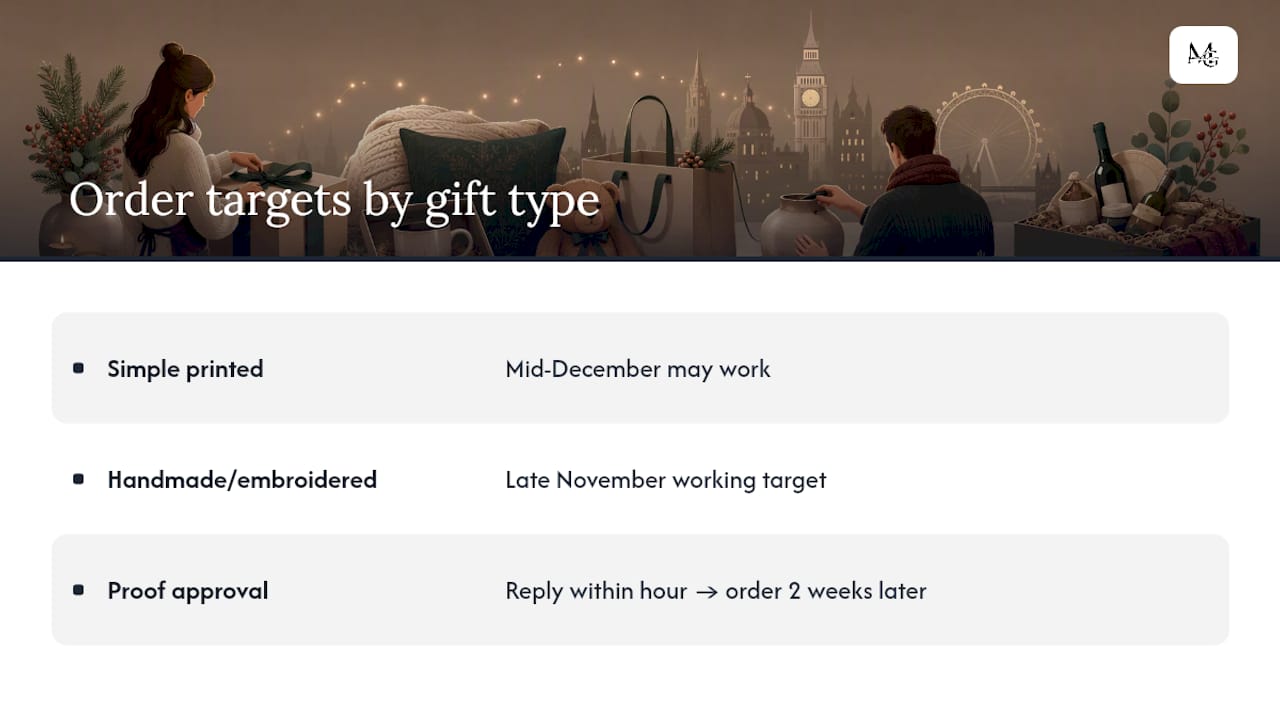
The bigger factor isn't the carrier at all. It's the proof-approval step, the one stage entirely within the buyer's control and the one most guides barely mention. A shopper who replies to a proof within the hour can realistically order two weeks later than one who checks email once a day.
If you take one thing from this article, prioritise the retailer's daily production cut-off over their advertised Christmas deadline, and treat late November as your working target for anything genuinely handmade or embroidered. Everything else, the carrier dates, the courier upgrades, the returns rules, matters far less than getting that first decision right.
— Lasse
Get your personalised music mug ordered in good time this Christmas
Mugnificentdeals is built around exactly the production discipline this article recommends: fast proofs, a clear internal cut-off, and mugs made for people who actually care about music, not generic gift-shop stock. Whether it's a violin sketch for a teacher, a drummer's in-joke for your bandmate, or a name and instrument combo for someone who lives for their Saturday rehearsal, the personalised music mugs collection is designed to be personal without being complicated to order.

To hit your deadline, pick your design, add the personalisation details carefully (check spelling twice), and reply to your proof as soon as it lands in your inbox. Choosing a guaranteed courier once your mug is ready removes the final risk from the equation. If you're short on time, the best personalised music mugs for gifts collection highlights designs with quicker turnaround, so browse now and get your order confirmed while there's still room in the production queue.
Official pages worth checking before you order
Dates shift slightly each year, so verify specifics on the primary sources rather than relying on memory. Check Royal Mail's last posting dates and the Post Office's last posting dates for current carrier deadlines, and review gov.uk's consumer rights guidance for the legal position on personalised and faulty goods before you buy.
Sources
- Christmas last posting dates | Royal Mail
- Last posting dates | Post Office
- Personalised Christmas Gifts: Complete UK buying guide 2026 – Personalised Gift UK