

"Custom" is defined as something made or done specifically to meet an individual's needs, preferences, or specifications, and it also describes a habitual practice within a community or personal routine. The word carries two quite distinct meanings in everyday English, and understanding both helps you make smarter decisions when choosing personalised gifts. Whether you are shopping for a musician friend or commissioning a one-of-a-kind keepsake, knowing what "custom" genuinely promises separates a meaningful purchase from a disappointing one. Authorities such as Merriam-Webster and Cambridge Dictionary each recognise this dual nature, making it a richer word than most buyers realise.
What does custom mean in everyday language?
The definition of custom covers two core senses: an accepted way of behaving within a community, and a product or service made specifically for one person. Both meanings share the same root idea, which is that something is shaped by particular needs rather than mass production or general convention. Merriam-Webster distinguishes "custom" as both a social practice passed through generations and an adjective describing goods built to individual order. Cambridge reinforces this by defining custom-made items as those "specially made for a particular person or built according to a buyer's needs." That phrase "built according to a buyer's needs" is the benchmark worth holding in your mind when you evaluate any product claiming to be custom.
In product contexts, the custom meaning in English shifts from describing behaviour to describing manufacture. A custom mug is not simply one pulled from a warehouse shelf with a name printed on it. Genuinely, it is one where the design, text, colour scheme, or imagery has been shaped by your input. The distinction matters enormously in gift buying, because a gift that truly reflects the recipient carries far more emotional weight than one that merely has their name appended to a generic template.
How does custom differ from bespoke and made-to-order?
These three terms are frequently used interchangeably in marketing, yet they occupy different positions on the personalisation spectrum.
| Term | What it typically means | Degree of buyer input |
|---|---|---|
| Custom | Made or modified to individual specifications | Moderate to high |
| Bespoke | Fully tailored from scratch, often implying exclusivity | Very high |
| Made-to-order | Produced only when ordered, but from a fixed design | Low to moderate |
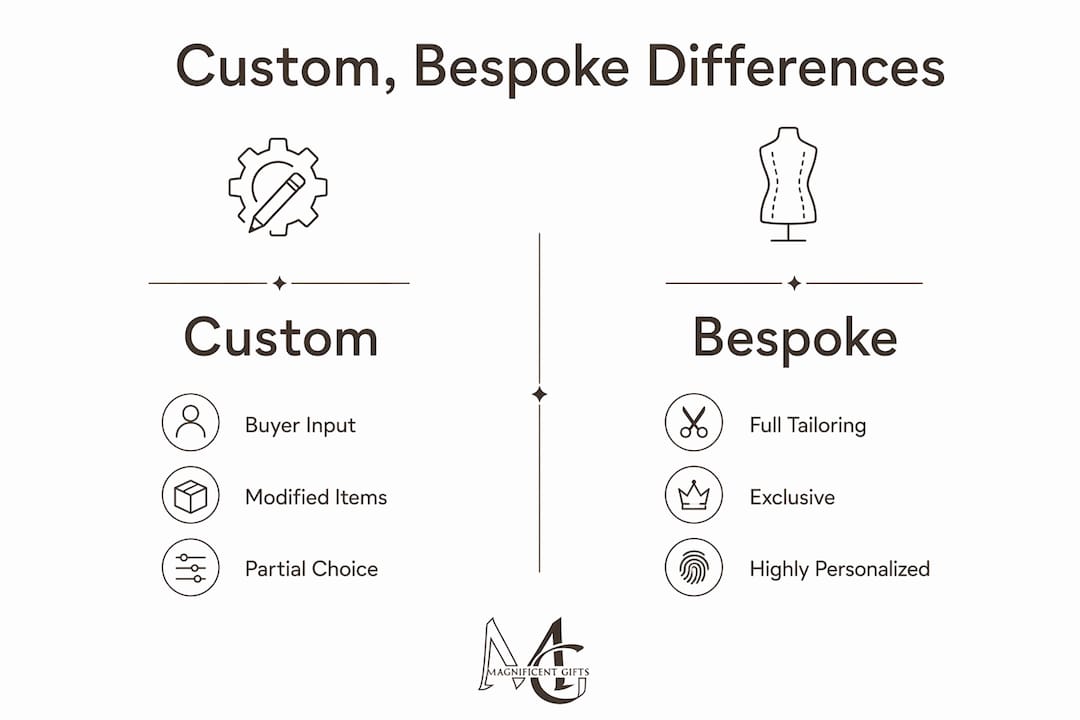
Bespoke implies exclusivity and originates from the tailoring trade, where cloth was said to have been "bespoken" for a specific customer. Wikipedia notes that bespoke now carries connotations of premium branding beyond its literal meaning of tailoring to specification. This is where buyers need to be cautious. A product labelled "bespoke" may simply be a premium-priced version of a standard item with minimal actual tailoring involved.
"Custom" sits in the middle of this spectrum. It can mean anything from choosing a font for a printed name to working with a designer to create an entirely original piece. Marketing often inflates terms like bespoke and custom to imply exclusivity when the reality is closer to selecting from a dropdown menu. Understanding this distinction protects you from paying a premium for something that is, in practice, off-the-shelf with a label change.
Pro Tip: Before purchasing anything described as "custom" or "bespoke," ask the vendor directly: "Can I change the design itself, or am I choosing from preset options?" The answer tells you everything about the real level of personalisation on offer.
What are the different meanings of custom in language and culture?
The word "custom" carries at least three distinct meanings in English, and recognising which one applies in context prevents confusion.
- Social tradition. A custom is an accepted practice within a community, passed down through generations. Wedding customs, funeral customs, and seasonal customs in culture all fall here. These are collective habits that define group identity and social cohesion.
- Personal habit. At the individual level, custom describes habitual behaviour specific to one person. "It is her custom to read before bed" uses the word in this sense. This meaning is closest to "routine" or "practice."
- Customer patronage. The Oxford Advanced Learner's Dictionary includes a third meaning: the business or purchases brought to a shop by customers. "We value your custom" is a formal British expression meaning "we value your business." This usage is common in retail and hospitality.
Checking sentence context is the most reliable way to identify which meaning applies. A phrase like "local customs" refers to traditions. "Custom-built" refers to manufacture. "Thank you for your custom" refers to patronage. Each meaning is grammatically and semantically distinct, even though the same word carries all three.
The cultural dimension of customs is particularly worth noting for gift buyers. Giving a personalised gift is itself a custom in many societies, one that signals care, attention, and knowledge of the recipient. When the gift is also custom-made in the product sense, both meanings of the word converge into something genuinely special.
How to evaluate whether a custom claim is genuine
Not every product labelled "custom" delivers real personalisation. Custom is best treated as a spectrum, ranging from minor template adjustments at one end to fully buyer-driven builds at the other. Knowing where a product sits on that spectrum before you buy prevents disappointment, particularly when the gift is intended to carry personal meaning.
Here is a practical process for evaluating any custom product claim:
- Ask what can actually be changed. Find out whether you can alter the design, imagery, colour palette, and text, or whether you are limited to entering a name into a fixed template. Genuine customisation gives you control over multiple elements simultaneously.
- Request examples of previous work. A vendor offering true custom products should be able to show you varied outputs that look meaningfully different from one another. If every example looks nearly identical, the customisation is superficial.
- Clarify the production process. Ask whether the item is produced from scratch based on your brief or whether it starts from a pre-existing template. Custom-made items built to buyer needs involve the buyer's specifications shaping the creation, not the other way around.
- Check the revision policy. Vendors who offer genuine customisation typically allow you to review a proof and request changes before production. A rigid "no changes after order" policy suggests limited flexibility in the design process.
- Compare the price against standard alternatives. True customisation requires additional labour and skill. If a "custom" product costs the same as a mass-produced equivalent, the level of personalisation is likely minimal.
Shallow customisation risks disappointment when the gift is meant to feel personal and considered. A music lover who receives a mug with their name printed in the same font as every other mug in the range will notice the difference between that and one where the design genuinely reflects their instrument, their playing style, or an inside joke only they would recognise.
Pro Tip: For music-themed gifts in particular, look for vendors who incorporate instrument-specific imagery or personalised humour rather than generic musical notes. The psychology of personalised gifting shows that specificity is what creates emotional resonance, not just the presence of a name.
What customisation options actually mean for product value
Understanding the types of customisation available helps you judge whether a product's personal meaning will hold up over time.
- Text personalisation. Adding a name, date, or short message is the most common and most basic form of customisation. It is meaningful but limited. The underlying design remains unchanged.
- Colour and size selection. Choosing from preset colour schemes or sizes is closer to product configuration than true customisation. The buyer selects from options the manufacturer has already decided upon.
- Design input. Providing your own artwork, specifying layout, or collaborating with a designer on original imagery represents genuine customisation. The product would not exist in that form without your specific input.
- Full bespoke creation. Starting from a blank canvas with a designer who builds entirely around your brief is the highest level. This is rare in mass-market retail but available from specialist makers.
The difference between custom-made and mass-produced personalised items is not always visible at first glance, but it is felt over time. A mug with a hand-drawn instrument illustration specific to a violinist carries a different weight than one with a generic treble clef. The former says "I thought about you specifically." The latter says "I thought about musicians generally." For gift buyers, that distinction is the entire point.
Custom software offers a useful analogy here. Custom software is made specially for a single organisation rather than sold as a ready-made product to many users. The same logic applies to physical gifts. A truly custom item is built around one person's identity, not adapted from something designed for everyone. That specificity is what drives both perceived value and emotional impact.
Key takeaways
Custom means something made specifically to individual needs, and understanding the full spectrum of customisation helps gift buyers choose products that genuinely resonate rather than merely appear personalised.
| Point | Details |
|---|---|
| Custom has multiple meanings | It describes social traditions, personal habits, customer patronage, and made-to-order products. |
| Bespoke implies more than custom | Bespoke suggests full tailoring from scratch; custom covers a wider spectrum of personalisation depth. |
| Evaluate before you buy | Ask vendors what can actually be changed to distinguish genuine customisation from template selection. |
| Specificity drives gift impact | A design built around one person's identity carries more emotional weight than a generic personalised item. |
| Context determines meaning | Always check sentence context to identify which of the three meanings of "custom" applies. |
Why I think most buyers underestimate the word "custom"
I have spent a considerable amount of time looking at personalised products across dozens of categories, and the pattern is consistent. Buyers see the word "custom" and assume it means the product was built around them. Vendors use the word "custom" and mean something far more modest, often just a name field in a fixed template. That gap is where disappointment lives.
The most revealing question you can ask any vendor is not "is this custom?" but "what would two different customers' versions of this product look like?" If the answer is "basically the same, just with different names," you are looking at personalisation theatre rather than genuine customisation. Real custom products look genuinely different from one another because they reflect genuinely different people.
What I find most encouraging is that truly custom products do exist at accessible price points, particularly in the gift market. Music-themed gifts are a good example. A mug featuring a hand-drawn violin with the recipient's name woven into the design is meaningfully different from one with a stock music note and a printed name. The emotional impact of custom gifts comes from that specificity, not from the word "custom" appearing on the product page.
My advice is simple. Read the product description carefully, ask one direct question about what can be changed, and trust your instinct about whether the result would look like it was made for your recipient or for anyone who plays an instrument. The difference is always obvious once you know what to look for.
— Lasse
Find a genuinely custom gift for the musician in your life
If you have been searching for a gift that goes beyond a name on a template, Mugnificentdeals offers personalised music mugs where the design itself reflects the recipient's instrument, personality, and sense of humour. Each mug is crafted with specific musicians in mind, from violinists to drummers, with hand-drawn imagery and personalised details that make the product feel commissioned rather than mass-produced.
Whether you are buying for a birthday, a recital, or simply because someone deserves a coffee moment that feels like them, the personalised music mugs at Mugnificentdeals are a strong place to start. You can also explore the best personalised music mugs for gifts to find options curated specifically for gift buyers who want something that genuinely resonates.
FAQ
What does custom mean in product descriptions?
In product contexts, "custom" means the item is made or modified specifically to meet a buyer's individual requirements. Cambridge defines custom-made as "specially made for a particular person or built according to a buyer's needs," which is the standard benchmark for evaluating any custom claim.
What is the difference between custom and bespoke?
Bespoke implies full tailoring from scratch with a high degree of exclusivity, while custom covers a broader spectrum from minor modifications to fully buyer-driven builds. Bespoke carries connotations of premium exclusivity beyond its literal meaning, so the two terms are not always interchangeable in practice.
What are the different meanings of custom in English?
Custom has three main meanings in English: a social tradition or community practice, a personal habitual behaviour, and customer patronage or business brought to a shop. Merriam-Webster recognises both the social and individual habit senses, while the Oxford Advanced Learner's Dictionary adds the patronage meaning.
How can I tell if a custom product is genuinely personalised?
Ask the vendor what specific elements can be changed and request examples of previous orders that look meaningfully different from one another. If every example looks nearly identical with only a name swapped, the customisation is superficial rather than genuine.
Why does customisation matter for gifts?
A gift built around a specific person's identity, interests, and personality carries significantly more emotional weight than a generic item with a name added. The specificity of genuine customisation signals that the buyer invested thought and care, which is what makes personalised gifts feel truly meaningful rather than convenient.