

Baking soda paste, a white vinegar soak, or an effervescent denture tablet will remove tea stains from mugs in most cases, and you should always try the gentlest option first. Melamine sponges and Bar Keepers Friend work faster on set-in stains, but they're abrasive enough to dull glaze or fade a printed design over time.
- Light, fresh stains: bicarbonate of soda paste, left on for 15 to 20 minutes.
- Heavier, older stains: white vinegar soak or a denture-tablet soak.
- Delicate or personalised mugs: gentle soaks only, no scrubbing.
- Really stubborn, set-in marks: soda crystals or Bar Keepers Friend, used sparingly.
- Last resort, plain mugs only: a melamine sponge, used with light pressure.
Key takeaways
Bicarbonate paste, a vinegar soak, or a denture-tablet soak will remove most tea stains from mugs when applied for 10 to 20 minutes, with stronger cleaners reserved for set-in marks on unpersonalised ceramic.
| Point | Details |
|---|---|
| Start gentle | Try bicarbonate paste (15 to 20 minutes) before reaching for anything stronger. |
| Match method to mug | Reserve soda crystals, Bar Keepers Friend, and melamine sponges for plain, undecorated mugs. |
| Understand the chemistry | Tannins bond with calcium in hard water; alkaline cleaners break that bond rather than scrubbing it away. |
| Prevent, don't just clean | A splash of milk or lemon in your tea, plus rinsing promptly, cuts staining significantly. |
| Know when to stop | A dulled or rough glaze means etching, not staining, replacement is the practical next step. |
| Replace with confidence | Mugnificentdeals' personalised music mugs offer a durable, giftable alternative once a mug is beyond saving. |
Table of Contents
- How to remove tea stains from mugs: six tested methods
- Why does tea leave a stubborn brown ring?
- How to stop tea stains coming back
- When to avoid DIY cleaning altogether
- What to do when the stain just won't shift
- Sources
How to remove tea stains from mugs: six tested methods
Work through these in order. Gentle first, stronger only if you need it, and always rinse thoroughly before the mug goes anywhere near your morning brew.
1. Bicarbonate of soda paste
Mix a heaped teaspoon of bicarbonate of soda with a few drops of warm water until you get a thick paste. Rub it into the stained area with a soft cloth or your fingers, leave it for 15 to 20 minutes, then wipe and rinse under warm water. Bicarbonate is alkaline, and it neutralises the acidic tannins that make up the stain, loosening the bond between the deposit and the glaze, according to McGill's Office for Science and Society. It costs a fraction of a specialist cleaner, too. A typical 500g box runs to around £3, which will see you through dozens of mugs.
2. White vinegar soak
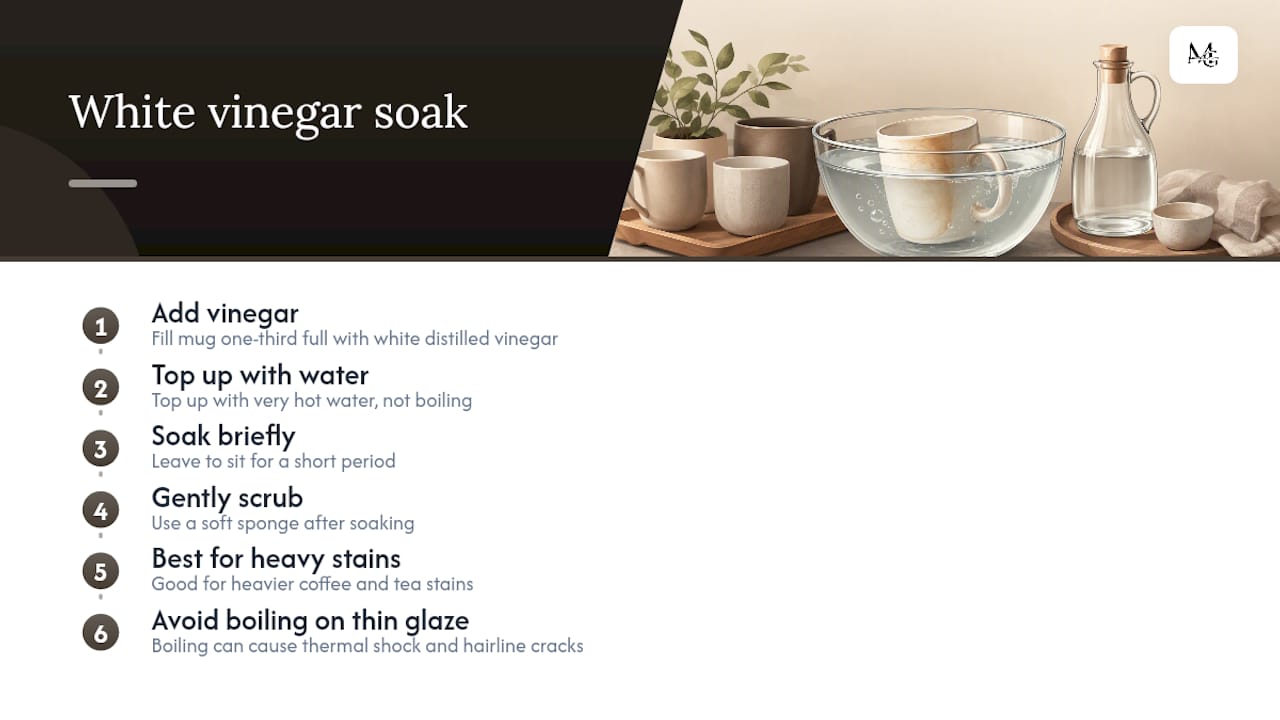
Fill the mug about a third full with white distilled vinegar, top up with very hot (not boiling) water, and leave it to sit for a short period before giving it a gentle scrub with a soft sponge afterwards. This method is particularly good for heavier coffee and tea stains that a quick paste won't shift. Avoid boiling water on thin or cracked glaze, since a sudden temperature jump can cause thermal shock and hairline cracks.
3. Denture-tablet soak
Drop one effervescent denture tablet into the mug, fill with hot water, and leave for around 15 minutes. The fizzing action helps loosen tannin deposits without any scrubbing at all, which makes it a good middle-ground option for mugs you'd rather not touch with an abrasive.

4. Melamine sponge
A damp melamine sponge (the kind sold as a "magic eraser") will often shift a stain in seconds with light, circular pressure. It works by micro-abrading the surface rather than dissolving the stain chemically, which is precisely why it's the last method on this list, not the first. It also sheds microplastic fibres as it wears down, and repeated use on the same spot can dull a glossy glaze.
5. Bar Keepers Friend
For genuinely set-in staining, a soft cleanser such as Bar Keepers Friend, applied with a damp cloth and light pressure, tends to succeed where paste and soaks haven't. Rinse thoroughly afterwards. Reserve it for plain, unpersonalised mugs, since its mild abrasives can wear away printed detail with repeated use.
6. Soda crystals (sodium carbonate)
Dissolve a tablespoon of soda crystals in hot water and soak for 20 to 30 minutes. Soda crystals are more alkaline than bicarbonate, which means they can break down tannin films with less scrubbing, useful for the mugs that have been sitting stained at the back of the cupboard for months.
Pro Tip: Always work through gentle methods first, bicarbonate, vinegar, or denture tablets, and only reach for soda crystals, Bar Keepers Friend, or a melamine sponge if the stain genuinely won't budge. Rinse each method off completely before trying the next; leftover residue can react oddly with the following cleaner.
Why does tea leave a stubborn brown ring?
Tea contains more than twice the tannins found in coffee, and it's typically steeped hotter and longer, which is why tea rings prove harder to shift than coffee stains. Those tannins, a type of polyphenol, react with calcium in hard water to form an insoluble scum that clings to the ceramic glaze. Left long enough, the stain oxidises and polymerises, essentially hardening into a tougher, more stubborn film. Research into black tea residue has found the deposits contain oxidised polyphenols bonded with calcium silicates, and this calcium bridging stabilises the stain chemically. That's exactly why alkaline agents like bicarbonate work: they neutralise the acidity and break the bond holding the film in place, rather than simply scraping it off.
How to stop tea stains coming back
A few small habits do more to prevent staining than any cleaner does to remove it.
- Rinse your mug straight after drinking rather than letting the last mouthful evaporate and concentrate.
- Wash mugs the same day, not after they've sat overnight.
- Use filtered water for your tea if you live in a hard-water area, since less dissolved calcium means less scum.
- Add a splash of milk, its proteins bind to tannins before they can settle on the glaze, or a squeeze of lemon, whose citric acid ties up calcium ions that would otherwise fuel staining.
- For personalised or printed mugs, stick to a quick rinse and soft cloth rather than any scrubbing, to keep the design looking sharp for longer.
When to avoid DIY cleaning altogether
Some mugs simply aren't worth the risk. Abrasive scouring, strong alkaline soaks left overnight, and high heat can all damage thin, gilded, or personalised finishes, sometimes permanently.
- Skip melamine sponges and Bar Keepers Friend on gilded rims or printed designs.
- Never leave soda crystals or vinegar soaking for hours unattended; stick to the timings above.
- Test any new cleaner on a small, unseen patch, such as the underside of the handle, before treating the whole mug.
If in doubt, a gentle overnight soak in warm water alone is safer than any scrub, however soft, on a mug you'd hate to ruin.
Checking how a mug's glaze and finish were made beforehand tells you how much cleaning it can realistically take. If a favourite piece is too precious to risk, contacting the seller or a ceramics restorer is a safer route than experimenting.
What to do when the stain just won't shift
If a wash cycle or two hasn't touched the mark, work through this sequence rather than reaching straight for the harshest option.
- Repeat the gentle soak, bicarbonate or vinegar, for a full 20 minutes rather than 10.
- Move up to soda crystals or Bar Keepers Friend, applied with minimal pressure.
- Try a melamine sponge last, and only with light, even pressure.
- Check the surface afterwards: a dulled patch or a rough feel under your fingertip means the glaze itself has etched, not just stained, and no amount of further cleaning will bring the shine back.
At that point, the practical choice is replacement rather than more scrubbing, and choosing an easy-clean glaze next time will save you this whole process.
A quick note from Lasse
Personalised mugs earn a gentler hand. I'd always choose a soak over a scrub when a print is involved, since even a "soft" cleanser can dull ink faster than you'd expect. If a stain wins in the end, a fresh design from the shop is a fair trade for a mug that's given good service.
If the stain wins, a fresh mug might be the easier fix
Sometimes a mug has earned its stains honestly, years of tea, hundreds of mornings, and no amount of soaking brings back that first-day shine. That's not a failure of cleaning technique; it's just ceramic doing what ceramic does over time.

If you'd rather start again than keep scrubbing, Mugnificentdeals' personalised music mugs make a genuinely easy swap, glazes chosen for durability, designs built around instruments, quotes, and names that matter to you rather than generic stock art. Browsing gift-ready personalised mugs is also a good shortcut if the stained mug in question belongs to someone else, a music teacher, a student, a fellow tea drinker in your life. Have a look at the current collection and see which design would suit the mug you're about to retire.
Sources
- Why is tea more likely than coffee to leave a stain in a mug? — New Scientist
- The key to cleaning your teapot is chemistry — McGill Office for Science and Society
- How to remove coffee stains from mugs
- The chemical composition and formation mechanism of black tea stains on teacups and teapots (abstract)