

Any ceramic mug sold for food use in the UK must meet set migration limits for lead and cadmium and be backed by a written declaration of compliance. If you cannot currently produce that declaration or a lab test report for your mugs, your first job this week is simple. Ask your supplier for one, or commission migration testing and file the result where you can find it fast.
TL;DR:
- Most mugs only need testing if their glaze or decorative elements are added after the base product, as supplier declarations or composition evidence may suffice instead.
- A proper declaration of compliance must include specific test results, testing conditions, and traceable supplier details, not just a general statement of safety.
- Testing for lead and cadmium migration should be done using a 4% acetic acid solution sampled over 24 hours, with results compared against legal limits of 4.0 mg/l for lead and 0.3 mg/l for cadmium.
- Accreditation by UKAS is key when selecting labs, as it ensures independent validation of testing methods; lab reports must include detailed test conditions and contact information.
- Enforcements usually happen due to consumer complaints or market checks, so sellers should keep comprehensive records, batch codes, and supplier documentation ready at all times.
Table of Contents
- Mug safety standards UK: which laws actually govern your products
- Lead and cadmium limits: the numbers you actually need
- What a declaration of compliance must actually say
- Your compliance checklist, step by step
- Picking a lab, and what testing actually costs
- If an inspector calls: enforcement and what happens next
- Practitioner notes: decoration, design and the pitfalls nobody warns you about
- Where to find the official rules and templates
- What the industry gets wrong about mug safety
- Sources
Mug safety standards UK: which laws actually govern your products
The starting point is the Food Safety Act 1990, the broad statute that gives UK authorities their powers over anything sold as food or in contact with food. It sits above everything else discussed here, and enforcement officers will invoke it alongside the specific rules that follow.
The specific rules come from the Materials and Articles in Contact with Food (England) Regulations 2012, which carries forward the principles of assimilated Regulation 1935/2004 into domestic law. Those principles are refreshingly plain: a food-contact material must not release anything that could endanger health, or change the taste, smell, or composition of the food or drink it holds. Mugs, being fillable vessels that routinely hold hot liquid for extended periods, sit squarely inside scope.
Since the UK's departure from the EU, the framework has been kept current through the Materials and Articles in Contact with Food (Amendment) (EU Exit) Regulations 2019, which adjusted who is responsible for issuing compliance paperwork now that Great Britain sits outside the EU's own system. GOV.UK's food contact materials guidance is the practical companion to all this, and it is worth bookmarking rather than reading once and forgetting.
One distinction catches out a lot of new sellers: these rules apply to new articles placed on the market for food use. A charity shop reselling a used mug is not caught by the same obligations as a manufacturer or importer putting a freshly decorated batch up for sale. If you are making or personalising mugs to sell, though, you are the manufacturer (or the importer, if you are sourcing blanks from overseas) and the obligations land on you, not on some distant factory you have never spoken to.
Lead and cadmium limits: the numbers you actually need
Ceramic ware is split into three categories under the regulations, and the category depends on how the item is used and how deep it is. Mugs, cups, and other fillable drinking vessels fall into Category 2, and that category carries the numbers that matter most to anyone in this trade.
For a standard mug, the governing figures under regulation 10 are lead at 4.0 mg/l and cadmium at 0.3 mg/l, measured through a defined migration test rather than a simple check of the raw glaze ingredients. Testing works by filling the vessel with a 4% acetic acid solution, the standard surrogate for what a hot drink might leach from a glaze, and leaving it for 24 hours at room temperature before measuring how much lead and cadmium have migrated into that liquid.
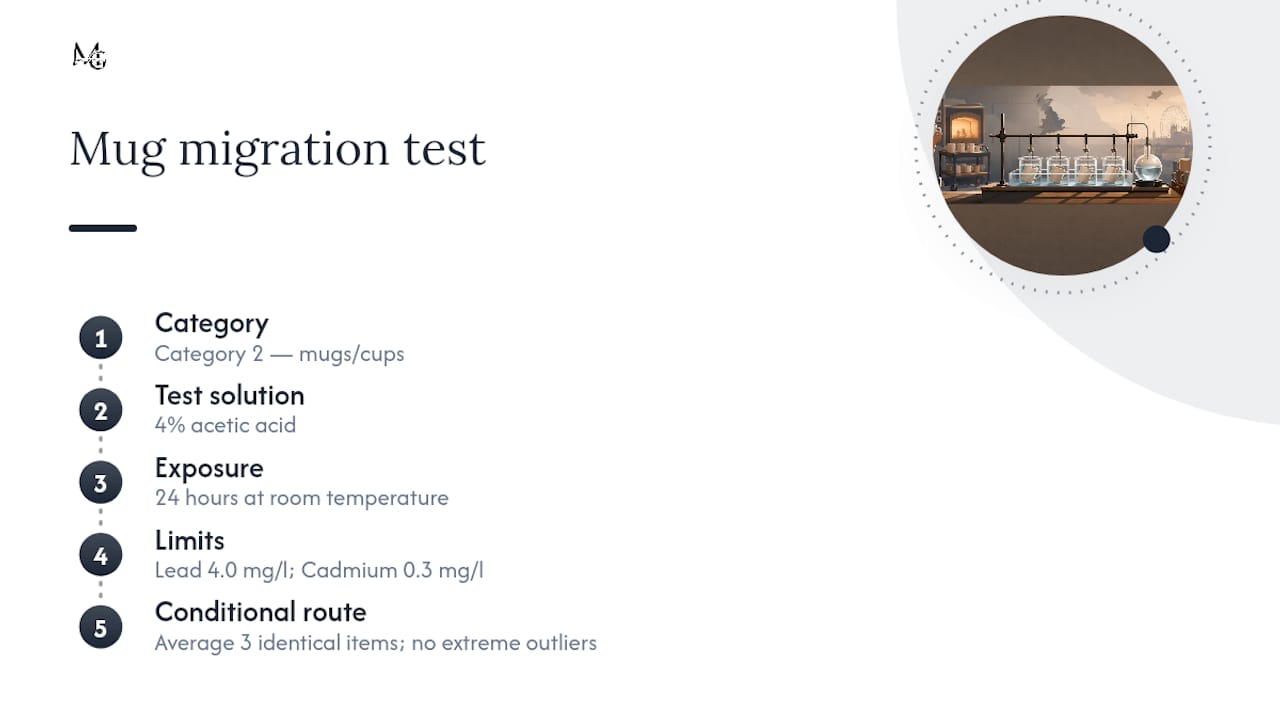
Two practical wrinkles matter here. First, if a mug has a separate lid or an unusual multi-part design, each food-contact surface can need testing in its own right rather than being treated as one uniform object. Second, the regulations allow a conditional route when an article sits marginally above the limit: testing three identical items and averaging the results can still demonstrate conformity, provided none of the individual readings blows the limit by an excessive margin. This three-sample averaging approach gives small-batch producers some breathing room rather than demanding perfection on every single unit tested.
None of this is about trusting a glaze "because it looks fine." Lead and cadmium migration is invisible, tasteless, and cumulative, which is precisely why the regulation insists on a measured figure rather than a visual judgement call.
What a declaration of compliance must actually say
A declaration of compliance, usually just called a DoC, is the paperwork that turns "we believe this mug is safe" into something a trading standards officer can actually check. Under the 2019 amendment regulations, ceramic articles must carry a written declaration at the marketing and retail stages, issued by the manufacturer or by a seller established in Great Britain.
If you are buying blank mugs from a supplier and adding your own designs, you need that supplier's DoC covering the base article. If you are the one glazing and firing from scratch, the obligation to issue the declaration falls on you directly.
Authorities can ask to see specific technical evidence behind that declaration, and regulation 10 spells out what that evidence should contain: the actual test results, the conditions under which testing was carried out, and the name and address of the laboratory that performed it. Batch numbers and supplier contact details round out a complete file, because a DoC with no traceable link back to a specific production run is far weaker evidence than one that is.
There is a genuine shortcut worth knowing about. If you can show, through supplier documentation, that the raw materials used contain no lead or cadmium at all, that can exempt you from testing every individual article. This matters for makers using certain modern lead-free glazes, where a supplier's composition statement can do the work that an expensive lab test would otherwise need to do. It only works, though, if the documentary evidence is specific and credible, not a vague marketing claim about "food-safe glaze" with nothing behind it.
Your compliance checklist, step by step
Turning legal text into a working routine is where most small sellers actually get stuck, so here is a practical order of operations.
- Map your materials and processes. List every mug body, glaze, transfer, ink, and decal you use, and note which supplier each one comes from.
- Request a DoC and composition statement from every supplier. Ask specifically about lead and cadmium content, not just a generic "food safe" assurance.
- Flag anything decorative separately. Metallic rims, hand-applied decals, or custom inks are not automatically covered by the base mug's certificate, and need their own evidence.
- Decide whether you need to commission testing. If supplier documentation genuinely proves no lead or cadmium content, testing may not be necessary; if it is vague or absent, commission migration testing yourself.
- Label and file every batch. Give each production run a batch code and store the matching lab report or supplier DoC against that exact code.
- Keep supplier contact details on file. Full names, addresses, and dates of correspondence, not just an order confirmation email.
- Photograph representative items from each batch. A simple photo record helps you match a customer query back to the right batch months later.
What should a credible lab report actually contain? Look for the numeric results themselves, the test conditions (acid concentration, temperature, duration), the laboratory's name and address, and ideally a reference to the testing schedule it followed. A one-line email saying "your mugs passed" is not a test report, and would not survive contact with an inspector who actually asked to see one.
Pro Tip: Stamp or engrave a small batch code on the base of each mug before firing, and photograph a sample from every batch alongside its packaging before it ships. If a compliance question ever comes up months later, that thirty seconds of admin is the difference between a quick answer and a frantic search through old invoices. Our own guide on shipping a mug safely covers how to fold batch photography into your normal packing routine without adding real time to the job.

Picking a lab, and what testing actually costs
Not all labs are equal, and the accreditation that matters most is UKAS recognition, which confirms a laboratory's methods and equipment have been independently checked against recognised standards. An accredited lab's report carries far more weight with an inspector than an uncertified one's, even if the uncertified option is cheaper.
When comparing quotes, check three things: whether the price includes sample preparation, whether the report will cite the specific migration test method used, and whether the final report includes lab name, address, and test conditions as standard, rather than as a paid extra. Costs and turnaround vary by lab and by how many samples you send, but expect testing to take days rather than hours, and to price per sample rather than per batch. Testing one representative mug from a production run, rather than every single unit, keeps this manageable for small makers, provided the run is genuinely uniform in glaze, clay body, and firing conditions.
A supplier DoC backed by solid composition evidence remains the cheapest route of all, since it avoids lab fees entirely. The trade-off is that it only covers what the supplier actually tested, so any decoration you add afterwards is not automatically included.
If an inspector calls: enforcement and what happens next
Enforcement in this area usually comes from your local authority's environmental health or trading standards team, though imported goods can also be intercepted by port health authorities before they even reach you. Inspections are often triggered by a consumer complaint, a random market check, or a customs referral rather than routine scheduled visits, so being ready at all times matters more than trying to guess when a check might happen.
If contacted, an officer can request your DoC, your underlying test reports, and your batch and supplier records. Produce them promptly and completely. Where documentation is missing or a batch fails to meet the migration limits, expect outcomes ranging from a formal warning to a requirement to withdraw or recall stock, and in serious or repeated cases, prosecution under the Food Safety Act 1990. Keep it simple: have the paperwork ready before you need it, not after.
Practitioner notes: decoration, design and the pitfalls nobody warns you about
Working with personalised mugs day to day, the pitfall we see most often is treating a supplier's base certificate as if it covers the finished, decorated product. It doesn't. Adding a transfer, a metallic accent near the rim, or a custom glaze overlay introduces new materials into the food-contact surface, and those materials were not part of whatever testing produced the original DoC.
Ask your ink and decal suppliers directly whether their products have been tested as part of a finished ceramic item, not just as a standalone pigment. Metallic finishes deserve particular scepticism, since decorative metals are exactly where lead and cadmium tend to hide.
Simple household checks, like running a mug through a dishwasher a few times to see if a decal degrades, are worth doing as a rough pre-screen, alongside checks like our microwave safety test. They tell you nothing about actual migration levels, though, and should never be mistaken for a substitute for proper testing. Our notes on checking mug quality before buying go into more depth on spotting supplier red flags before you commit to a production run.
Where to find the official rules and templates
Keep four things bookmarked: the 2012 regulations text for the migration limits themselves, the 2019 EU Exit amendment for who must issue a DoC, GOV.UK's food contact materials guidance for the plain-English explanation, and the FSA's Safer Food, Better Business resources for inspection readiness.
Save every DoC, supplier declaration, and lab report into one digital folder, organised by batch code. That single habit does more for your compliance position than almost anything else on this list.
What the industry gets wrong about mug safety
The advice most sellers stumble across treats a DoC as a box to tick once and forget. That misses the point entirely. A declaration covers a specific material and process, and the moment you add a hand-painted rim or a new transfer supplier, the paperwork you are relying on no longer describes the product you are actually selling.
Testing gets oversold too, in the opposite direction. Small makers often assume every batch needs an expensive lab test, when a genuinely lead-free glaze with solid supplier documentation can exempt you from that cost entirely. The skill is knowing which route applies to your specific materials, not defaulting to fear or defaulting to assumption.
If you take one thing from this guide, make it this: traceability beats testing as your primary defence. A trading standards officer is far more reassured by a seller who can produce a batch code, a supplier contact, and a dated declaration within minutes than by one who has a single old test certificate and no idea which production run it actually covers.
— Lasse