
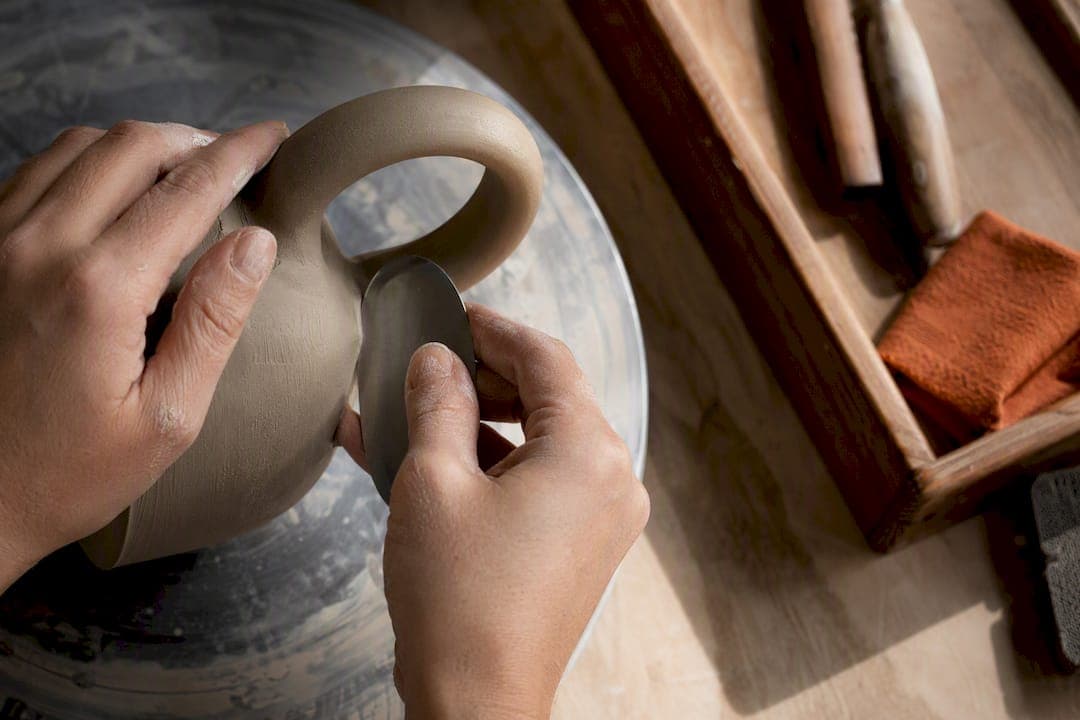
The most comfortable mug handles share three traits: enough room for two to four fingers to pass through, a flattened or oval cross-section rather than a thin round one, and a position close to the mug's centre of gravity. Makers should target roughly 73.7–89.2 mm of clearance for a four-finger fit after allowing for shrinkage. Before buying or using a mug, try fitting two or three fingers through the handle, lift it full, and run a thumb round the inside edge to check for sharp ridges.
TL;DR:
- Handles designed for a four-finger fit should measure between 73.7 and 89.2 mm internally after accounting for ceramic shrinkage to ensure comfort.
- Using flattened or oval cross-sections on handles distributes weight more evenly and reduces pressure points compared to traditional round shapes.
- Proper handle attachment involves scoring, slipping, blending seams, and shaping while soft to prevent cracks and ensure durability.
- Positioning the handle close to a mug's center of gravity significantly lowers wrist torque and enhances ease of use, especially for those with grip issues.
- For better grip and comfort, textured or matte finishes on the handle surface and considering handle placement relative to hand size are highly effective.
Table of Contents
- Mug handle comfort: clearance, aperture area and cross-section
- How do you form and attach a comfortable pottery handle?
- Why does handle placement affect wrist strain more than size does?
- Do materials and surface texture change how a handle feels?
- Which handle designs work best for reduced grip strength?
- How can you test a mug's handle comfort before buying or after making it?
- What three rules actually matter for handle comfort?
- Why we care about handle comfort as much as the artwork
- Personalised music mugs built with handle comfort in mind
- Sources
Mug handle comfort: clearance, aperture area and cross-section
Handle comfort starts with geometry, not aesthetics. The gap you can put your fingers through, known as the aperture, is the single biggest factor in how a mug feels in daily use. Too tight, and only one or two fingers squeeze in, forcing an awkward pinch grip. Too loose, and the handle wobbles under load, doing nothing useful at all.
Anthropometric research on drinking vessels gives a clear target. A handle sized for a comfortable four-finger fit should measure between 73.70 mm and 89.17 mm once you account for ceramic shrinkage. That range came from measuring adult hand dimensions against handle openings in care settings, where getting the fit wrong meant real users struggling to hold a simple cup of tea. It is a useful benchmark whether you are throwing mugs on a wheel or scrolling through an online shop.
A four-finger handle needs roughly 73.7 to 89.2 mm of internal clearance after firing, once you build in shrinkage allowance during forming. That single figure does more to predict comfort than glaze colour, handle style, or even overall mug shape.
Shrinkage matters more than most first-time potters expect. Skip this allowance and a handle that felt roomy on the wheel becomes a knuckle-scraper on the shelf.
Cross-section shape changes how the load feels in the hand just as much as the size of the gap does. Three shapes dominate:
- Round handles are quick to pull and traditional-looking, but they concentrate the mug's weight onto a narrow line of contact, which becomes noticeable after a full mug or a long meeting.
- Flattened D-shaped handles spread that same weight across a wider surface, reducing the pinch-point feeling considerably.
- Oval cross-sections sit between the two, offering some of the tactile softness of a flattened handle while keeping a slightly more elegant profile.
Ceramic Arts Network's guidance on functional handle design backs this up directly: flattened oval or D-shaped cross-sections with smooth internal radii resist rotational tipping better than thin round handles and reduce pressure points along the fingers. Thin round handles look neat in profile photos, but they are the shape most likely to dig in after the third refill.
Internal corner radii deserve their own mention. A handle joint with a sharp interior angle, often left behind where the handle meets the mug wall, creates exactly the kind of pressure point that turns a nice-looking mug into an uncomfortable one. Smoothing that junction with a rib or flexible scraper before it sets removes the problem at source.
As a rough scaling rule, handle thickness should track with the mug's rim thickness rather than being fixed at one number regardless of mug size. A midpoint thickness in the region of a quarter to five sixteenths of an inch works well for standard mug proportions, thinning slightly for delicate porcelain and thickening for chunkier stoneware pieces. Engineering guidance for manufactured drinkware lands in a similar place, recommending an aperture height of roughly 40–55 mm and an internal diameter around 35–50 mm, with many adult-focused designs converging near 38 mm as an optimal middle ground.
How do you form and attach a comfortable pottery handle?
Getting a handle right on the wheel or by hand is less about talent and more about following a sequence that avoids the usual failure points. Most uncomfortable handles trace back to one of three moments: sizing, attachment, or finishing.
- Size the pull before you commit clay to it. Decide whether you are aiming for a two-finger, three-finger, or full four-finger grip, then pull a length that will leave the target clearance after shrinkage. If your clay body shrinks around 21%, add that allowance at the forming stage rather than guessing and correcting after the kiln has already had its say.
- Pull with rotation, not from a fixed thumb position. Pulling a handle repeatedly from the same thumb angle presses a ridge into the clay that will later sit exactly where a knuckle rests. Rotating the pull as you work, and finishing with a flexible scraper, produces a smooth internal radius instead of that pressure ridge.
- Score and slip both surfaces before attaching. Scratch cross-hatching into the mug wall and the handle end, apply slip to both, and press together firmly enough to see a small bead squeeze out at the joint.
- Backfill and blend the junction immediately. Use a small coil or extra slip to fill any gap at top and bottom of the attachment, then blend the seam into the mug wall with a rib. A weak or hollow junction is the single most common reason handles crack off in the kiln or on the draining rack.
- Shape the cross-section while the handle is still soft. Press gently with a finger or flexible rib along the length of the handle to flatten a round pull into an oval or D-shape, checking that no ridge has formed on the inside face.
- Check fit at the wet stage with your own fingers. This is the easiest point to catch a handle that is already too tight, since clay only shrinks from here.
- Recheck at leather-hard. Small adjustments are still possible, particularly smoothing any interior ridge that has become more obvious as the clay firms up.
- Do a final check at bisque. This is your last chance before glaze firing locks in the dimensions, so treat any tightness here as a genuine warning sign rather than something glaze will somehow fix.
Pro Tip: Keep a set of "reference fingers", a length of dowel or an old pencil cut to your own two, three, and four finger widths, on your workbench. Pressing it through a wet handle takes seconds and catches sizing mistakes long before the kiln makes them permanent.
The blending step trips up more beginners than any other stage. It is tempting to attach a handle and move on, but an unblended junction leaves a hard transition that concentrates stress exactly where the handle takes the most load, right at the top attachment point. A few extra seconds with a rubber rib here saves handles from snapping later.
Why does handle placement affect wrist strain more than size does?
A mug's weight does not act through its centre. It acts through its centre of gravity, and the further your grip sits from that point, the harder your wrist has to work to keep the mug level. This is the biomechanical reason two mugs with identical handle openings can feel completely different to hold.
Wrist moment is the technical term for this effect: it is the twisting force your wrist muscles must resist to stop a held object from rotating. A full mug held by a handle set far from the body's centre of gravity creates a longer lever arm, which multiplies that twisting force even though the mug's actual weight has not changed. Ergonomic reviews of drinking vessels found that cups with low mass, generous handle orifice area and handles placed near the cup's centre produced lower wrist forces and stronger user preference across the board.
Handles positioned close to a mug's centre of gravity measurably cut the wrist torque needed to hold it level, and that reduction shows up directly in usability preference scores.
A few design factors change how much torque a given handle placement creates:
- Handle height relative to the mug's midpoint matters more than most people assume; a handle set too high or too low shifts the effective lever arm even if the aperture size is perfect.
- Mug body width widens the distance between grip and centre of gravity on bulbous designs, which is one reason very rounded mugs can feel heavier than their actual weight suggests.
- Finger support pattern changes the picture too. A grip where the thumb sits adducted against the handle top and the ring finger braces underneath distributes load across more of the hand than a two-finger pinch grip, cutting the strain on any single joint.
- A slight upward tilt to the handle, somewhere in the region of 5 to 8 degrees, reduces wrist extension during lifting by keeping the wrist closer to a neutral posture through the drinking motion, which matters more than it sounds for anyone nursing a mug through a long desk session.
You can test this without any equipment. Fill the mug with water, grip it exactly as you would for a normal sip, and hold it out at arm's length for ten seconds. If your wrist starts rotating to compensate, or you feel the strain concentrating in one or two fingers rather than spreading across your palm, the handle is probably sitting too far from the mug's balance point. Makers can perform the same check on greenware before the kiln makes changes impossible, simply by holding the piece as a customer would and paying attention to where the effort lands.
Do materials and surface texture change how a handle feels?
Material choice affects two separate things: how quickly heat travels from your drink to your hand, and how much grip your skin gets on the surface itself. Both matter for comfort, and they do not always pull in the same direction.
Ceramic and porcelain conduct heat noticeably faster than most polymers, which is why a thin porcelain handle can feel surprisingly warm on a hot drink while a thicker stoneware handle with the same wall thickness stays cooler longer, simply because there is more mass absorbing the heat before it reaches your fingers. This is one reason ceramic and porcelain mugs behave so differently in the hand despite looking similar on a shelf; porcelain's thinner walls transmit heat faster even when the glaze looks identical.
Surface finish changes grip through friction rather than temperature. A glassy, highly vitrified glaze looks smart but offers less resistance against wet or soapy fingers than a matte or lightly textured surface. Engineering notes on drinkware materials confirm that textured finishes and soft-touch layers raise the coefficient of friction considerably, which is exactly why so many commercial travel mugs use a slightly rubberised band rather than bare plastic or metal.
For handmade mugs, a few practical choices follow from this:
- Leave a slightly textured or satin glaze on the outer handle surface rather than a fully glossy finish, particularly if the mug is likely to be used with wet hands around a sink or kettle.
- Consider a silicone sleeve or add-on grip for mugs intended for outdoor or workshop use, where hands are more often wet, cold or gloved.
- Glaze the inside of the handle orifice properly, not just the outside face; an unglazed interior can feel rough against fingers and is harder to keep clean over time.
- Avoid overly thick glaze application at the handle junction, since pooled glaze there both looks untidy and can leave a slightly gritty texture exactly where fingers grip hardest.
Care matters too. Repeated dishwasher cycles can dull a satin glaze's texture over years of use, so hand-washing a favourite handmade mug preserves both the grip and the glaze's appearance for longer.
Which handle designs work best for reduced grip strength?
Standard handle geometry assumes a reasonably strong, dexterous grip, and that assumption fails a meaningful number of people, whether from arthritis, age-related grip decline, tremor, or temporary injury. Occupational therapy guidance in this space tends to favour a holistic approach rather than treating handle shape as a fix on its own, combining a stable wide base, an easy-to-grip handle and sensible thermal management together rather than relying on any single feature.
Two broad design families cover most needs:
- Two-handled mugs distribute weight across both hands, dramatically cutting the wrist torque any single hand needs to manage, and they suit anyone with reduced grip strength in one hand or general fatigue during long drinking sessions.
- Helve or internal-handle designs, where the grip runs partly inside the mug's structure rather than as a projecting loop, sit closer to the body's natural grip line and reduce the leverage problem described earlier.
Purpose-built drinking aids show what this looks like in practice. Products such as the Ornamin double-wall mug combine an oversized ergonomic handle with an integrated thumb rest and a wide, stable base, features aimed squarely at users with limited finger mobility who need to drink independently without excessive wrist effort.
For everyday mugs that were not designed with these needs in mind, a few simple retrofits help:
- Silicone sleeve grips slide over an existing handle and add both cushioning and friction without altering the mug itself.
- Clip-on handle extenders widen the effective grip area for people who struggle with narrow apertures.
- Spill-reducing lids reduce the consequence of a shaky grip, which matters as much as the handle geometry itself for some users.
Double-handled mugs are worth preferring specifically when tremor, one-sided weakness, or fatigue is a known factor, since splitting the load between hands does more for safety than any single-handle tweak can achieve alone.
How can you test a mug's handle comfort before buying or after making it?
A handle can look perfectly proportioned in a photograph and still feel wrong in the hand, so a short physical check beats guessing every time. This applies equally whether you are inspecting your own greenware or deciding whether to order a mug online.
- Run the finger insertion test. Slide two, three, then four fingers through the handle and note where the fit becomes tight; comfortable everyday mugs should comfortably take three fingers without pinching.
- Do the filled-balance test. Fill the mug (or imagine it full, if you're checking greenware) and hold it out as you would to take a sip; a well-placed handle keeps the wrist roughly neutral rather than forcing it to bend upward or sideways to compensate.
- Watch for wrist extension. If lifting the mug to drinking height requires visibly cocking the wrist backward, the handle tilt or placement is working against you rather than for you.
- Compare pinch grip against power grip. A mug you can hold with a relaxed, whole-hand power grip rather than a two-finger pinch will feel more secure over a full drink, especially when the mug is hot.
- Check for sharp internal edges by running a fingertip round the inside of the handle loop; any ridge or unglazed rough patch here is a comfort fault, not a stylistic choice.
- Note the key measurements if buying online, particularly aperture height, internal diameter, and, where listed, the distance between the handle's midpoint and the mug's centre of gravity.
- Ask a seller directly about interior finish and handle dimensions if a listing does not specify them; a maker who has thought about comfort will usually have these figures on hand.
- Run a home water-tipping test on a new mug by filling it and tilting it gently as if drinking; a handle set too far from the centre of gravity will make the mug want to rotate in your hand rather than staying level.
For buyers comparing options across sizes, matching your usual drink volume to the right mug size in millilitres or ounces helps avoid the mismatch where a handle sized for a small mug ends up supporting a much heavier full one. A broader pre-purchase quality check covers glaze and finish issues alongside the handle-specific tests above.
What three rules actually matter for handle comfort?
Strip away the technical detail and three rules cover most of what determines whether a handle feels good in daily use. First, size the aperture for the grip you actually want, whether that is two fingers for a delicate teacup or a full four-finger wrap for a large everyday mug, and build shrinkage into that target from the start rather than correcting for it afterwards. Second, favour a flattened or oval cross-section with smoothed internal edges over a thin round pull; it costs little extra effort on the wheel and changes how the mug feels within the first sip. Third, always test with the mug at the weight and volume it will actually be used at, since a handle that feels fine empty can behave very differently full.
None of this is about compromising personality for function. A mug covered in a hand-drawn violin or a cheeky music pun can follow every one of these rules just as easily as a plain stoneware cup, since comfort lives in the geometry, not the decoration. Readers curious about how mug proportions interact with print area and handle balance can find more detail in the guide to choosing mug sizes by print area, which covers how body width shifts alongside handle placement as mugs scale up.
Anyone checking a specific piece before it ships or before it leaves the kiln shelf can lean on the mug quality checklist for the wider set of finish and durability checks that sit alongside handle comfort.
Why we care about handle comfort as much as the artwork
I have watched a genuinely beautiful mug design get let down by a handle nobody thought about twice. A thin round pull, a joint left unblended, a grip set too high above the mug's balance point. None of it shows up in a product photo, and all of it shows up on the third cup of coffee.
The fix is rarely dramatic, as insights from clarinet playing ergonomics show how thoughtful handle design can greatly boost comfort and ease of use. Widening a handle by a few millimetres, or smoothing one internal ridge with a rib before the clay sets, changes how a mug feels for years of daily use without touching the design on the outside at all. That is the part I want makers and buyers alike to hold onto: comfort and character are not competing for the same space on a mug. A handle can carry a hand-drawn trumpet or a name and still be shaped with real care underneath.
Well-made personalised mugs prove this every day. They can be charming, specific, a little funny, and still sit properly in the hand because someone paid attention to the geometry before they picked up a paintbrush.
— Lasse
Personalised music mugs built with handle comfort in mind
Our brand designs every mug to be picked up and used, not just photographed, which is the real gap between a novelty print and a mug you actually reach for each morning. Our personalised music mugs are sized and shaped with the same handle principles covered above in mind, so the printed design on the side sits on a mug that still feels right in the hand at the fifth refill.

Every product page lists the measurements you need to judge fit for yourself, and the company offers a returns policy that covers cases where a mug does not suit you once it arrives. If you have a specific grip need, an unusual hand size, or a custom sizing request for a gift, you can get in touch before ordering to discuss options. Browse the full range of personalised music mugs or explore our curated gift collection to find a design that fits both your hand and your sense of humour.
Sources
- Fancy a Brew? Understanding factors influencing ease of use of cups used in care homes (White Rose ePrint)
- Handle dynamics (Ceramic Arts Network)
- Ergonomic handle and grip design for custom drinkware (Mofe)
- Double Wall Mug with ergonomic Handle – Drinking Aid for Elderly | ORNAMIN