

Gifting culture is a social system in which people exchange goods, favours, or gestures without a fixed price, bound instead by unwritten rules of reciprocity, timing, and obligation. It runs on relationship capital rather than currency: every gift given creates a quiet expectation, and every gift received builds a tie that market transactions simply don't. Understanding how it works helps you give more thoughtfully and dodge the social missteps that come from treating a gift like a purchase.
Consider the Pacific Northwest potlatch ceremony, where chiefs gave away vast wealth to earn standing rather than money, or the modern "five gift rule" many families now use at Christmas to keep giving intentional rather than excessive. Both sit on the same foundation.
A few things worth holding onto before we go further:
- Gifting culture predates money and continues to run alongside it in every society studied by anthropologists.
- A gift is never really "free" — it carries an implicit expectation of return, even if that return is simply gratitude or loyalty.
- The value of a gift often lies less in its price and more in what it signals about how well the giver knows the recipient.
Key Takeaways
Gifting culture functions as a relationship system built on reciprocity, obligation, and signalling, not a market transaction measured by price.
| Point | Details |
|---|---|
| Gifts create obligation | Mauss's theory holds that every gift demands giving, receiving, and reciprocating in turn. |
| Reciprocity has types | Sahlins distinguishes generalised, balanced, and negative reciprocity based on social closeness. |
| Personalisation beats price | Gifts function as information media, so tailored items signal more care than costly generic ones. |
| Neurochemistry explains the glow | Giving and receiving trigger dopamine and oxytocin, with the latter linked to lasting trust. |
| Watch the ethical line | Gifts near business decisions or above roughly $250 abroad often need documented legal review. |
Table of Contents
- What is gifting culture, and where did the idea come from?
- What separates a gift from a market transaction?
- What do the classic gifting rituals actually reveal?
- Why does giving a gift feel so good?
- What social functions does gift-giving actually serve?
- When does gift-giving cross into ethical trouble?
- How does the "5 gift rule" actually work?
- How is gifting culture changing in the digital age?
- Why gifting culture still matters today
- Why this topic matters to us
- Where to read more on gifting culture
- Frequently asked questions
- Sources
What is gifting culture, and where did the idea come from?
The clearest starting point is Marcel Mauss, a French sociologist whose 1925 essay The Gift remains the founding text on this subject nearly a century later. Mauss studied exchange practices among Polynesian, Melanesian, and Pacific Northwest societies and concluded that gift-giving is never a one-off, isolated act. It's a "total social fact", meaning a single gift exchange simultaneously does economic, legal, moral, and religious work all at once.
Mauss's central claim, stripped of academic language, is this: every gift-giving system runs on three linked obligations. You must give, you must receive, and you must reciprocate. Refuse any one of these three and you damage the relationship, sometimes seriously. In the societies Mauss studied, declining a gift was often read as a declaration of war or a rejection of the relationship itself, not simply bad manners.
Later anthropologists built on this. Marshall Sahlins), writing decades after Mauss, refined the theory by categorising reciprocity into distinct types based on social distance, an idea explored further in the next section. Lewis Hyde, meanwhile, took Mauss's framework into contemporary culture in his book The Gift, arguing that creative work (art, music, writing) behaves like a gift economy even inside a market society. Hyde's insight is particularly relevant to anyone who makes or commissions personalised, creative gifts: the value isn't in the raw materials, it's in what passed between giver and maker.
None of this is settled science, and it's worth saying so plainly:
- Critics have accused Mauss of ethnocentrism, projecting Western ideas of "obligation" onto societies with very different concepts of ownership and personhood.
- Some anthropologists argue the "pure gift", one with genuinely no expectation of return, may not exist at all, which challenges how charitable and religious giving get theorised.
- Sahlins' own typology has been criticised as too tidy for the messiness of real exchange, where motives blur and shift within a single relationship.
Pro Tip: Next time you feel obliged to reciprocate a gift you weren't expecting, that discomfort is Mauss's theory playing out in real time. It's not awkwardness. It's the social machinery of gifting culture doing exactly what it evolved to do.
What separates a gift from a market transaction?
Three features distinguish gifting culture from ordinary commerce: reciprocity, inalienability, and obligation. Get familiar with these and you'll read gift-giving situations far more accurately.
Reciprocity isn't one thing. Sahlins identified three distinct forms:
- Generalized reciprocity — giving with no expectation of immediate or even eventual return, typical of close family (a parent feeding a child).
- Balanced reciprocity — a fairly direct exchange within a reasonable timeframe, such as swapping dinner invitations with a neighbour.
- Negative reciprocity — trying to get more than you give, which is essentially market behaviour dressed up as an exchange.
Most everyday gifting sits between the first two. A birthday gift from a close friend leans generalized; a wedding gift among acquaintances leans balanced, because there's an unspoken sense that you'll receive something comparable if the roles reverse.
Inalienability is the idea, borrowed from Mauss's reading of Polynesian hau (the "spirit" believed to inhabit a gift), that something of the giver stays attached to the object even after it changes hands. This is why regifting feels uncomfortable and why a handmade or personalised item carries more weight than a generic one bought off a shelf. The gift is never fully separated from the person who gave it.
Obligation is what keeps the whole system moving. A gift closes nothing; it opens a small, ongoing account between two people. That's precisely why gifting culture builds relationships so effectively; a single market purchase settles a debt, but a gift deliberately leaves one unsettled.
Pro Tip: Read a gift as a message before you read it as an object. A generic gift card signals "I don't know you well enough to choose", while a gift built around your recipient's specific interests (their instrument, their favourite in-joke, their name) signals real attention. This is why personalisation carries more relational weight than price.
What do the classic gifting rituals actually reveal?
Anthropology's most cited examples of gifting culture come from a handful of societies whose ritual exchanges shaped the entire field.
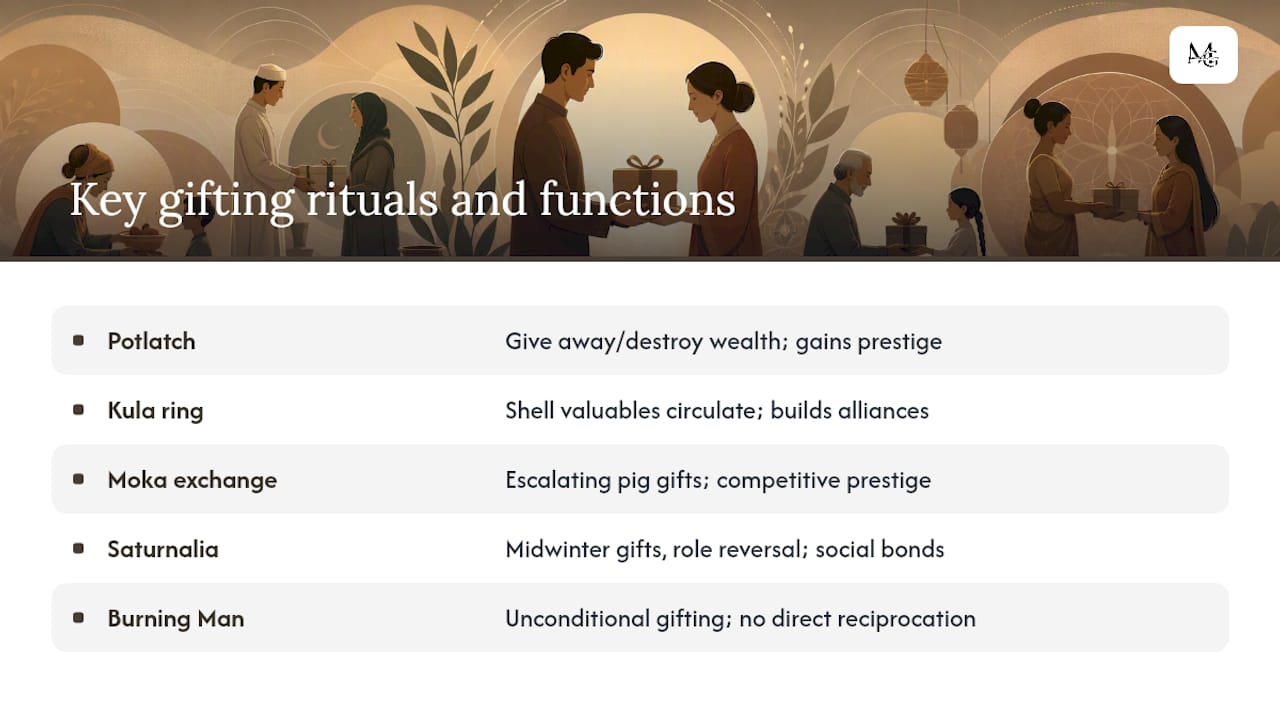
The potlatch, practised by Indigenous nations of the Pacific Northwest Coast including the Kwakwaka'wakw and Tlingit, involved chiefs giving away or destroying enormous quantities of wealth (blankets, canoes, food) in front of rivals. The social effect was status redistribution: the person who gave away the most gained the highest prestige, inverting the market logic where accumulation equals status.
The Kula ring, documented by Bronisław Malinowski in the Trobriand Islands, involves shell valuables (armbands and necklaces) travelling in a permanent circular route among island communities. No one keeps a Kula item permanently. Its entire purpose is circulation, which builds and maintains alliances across otherwise isolated island groups.
The Moka exchange in Papua New Guinea's highlands centres on pigs and other wealth given in escalating rounds between "big men" and their rivals. Unlike balanced reciprocity, Moka is explicitly competitive: a successful giver must return more than they received, turning gift exchange into a route to political leadership.
Midwinter gift customs have an equally long history in Europe. The Roman festival of Saturnalia involved gift-giving, role reversal, and feasting in late December, and elements of that midwinter exchange tradition were absorbed and reinterpreted into later Christian customs rather than disappearing outright. The function, cementing social bonds during the darkest part of the year, persisted even as the meaning shifted.
Burning Man, the annual gathering in Nevada's Black Rock Desert, offers a modern contrast. Its organisers describe it as running on a strict gift economy where no buying or selling is permitted inside the event, only unconditional giving. Unlike the potlatch or Moka, there's no expectation of a return gift to the specific giver. It's closer to Mauss's generalised reciprocity scaled up to tens of thousands of strangers, functioning more as social infrastructure than personal exchange.
Laid end to end, these examples trace a rough timeline: competitive status-gifting (potlatch, Moka) in small-scale societies, circulatory alliance-building (Kula) across island networks, seasonal cohesion rituals (Saturnalia) in agrarian societies, and voluntary mass gifting (Burning Man) in a modern, temporary community.
Why does giving a gift feel so good?
The pleasure of giving isn't just sentiment. The American Psychological Association notes that giving and receiving activate the brain's reward pathways, often triggering the release of dopamine and oxytocin. Dopamine drives the short burst of pleasure, while oxytocin supports the slower, longer-lasting sense of trust and connection between giver and recipient.
The "warm glow" people report after giving isn't just a figure of speech. It reflects a genuine neurochemical response, and researchers increasingly distinguish between the quick dopamine hit of a novel purchase and the steadier oxytocin-linked bond that comes from a gift that feels personally meaningful.
That distinction matters because the two responses don't always arrive together. Stress can blunt them both. Anyone who has stood in a shop on Christmas Eve, overspending on something they suspect won't land well, knows the "pain of paying" that offsets the pleasure of giving. Social anxiety around gift-giving occasions, worrying about fairness, appropriateness, or being judged, can suppress the reward response almost entirely, turning what should be a bonding ritual into a source of dread.
This is where the psychology of gift-giving connects directly back to Mauss's obligation framework. Karen Pine's research on the psychology of gift exchange documents a phenomenon sometimes called the "deadweight loss of Christmas": givers routinely overpay for gifts that recipients value less than the price paid, because the giver misjudges what actually matters to the other person. Expensive doesn't reliably translate into meaningful, and the neuroscience helps explain why: a costly but impersonal gift produces a dopamine spike in the giver without necessarily producing the oxytocin-linked trust response in the recipient.
Pro Tip: If you want a gift to build a relationship rather than just mark an occasion, aim for the oxytocin response rather than the dopamine one. Shared experiences, thoughtful personalisation, and gifts that show you've paid attention to someone's specific interests tend to sustain connection longer than novelty items, however impressive they look unwrapped.
What social functions does gift-giving actually serve?
Gifting culture works as social infrastructure. Anthropologists tracing back to Mauss, and refined through Sahlins' later work, point to several distinct functions running underneath what looks, on the surface, like simple generosity:
- Bonding — reinforcing existing relationships through regular, expected exchange (birthdays, anniversaries, holidays).
- Signalling respect — a gift chosen with care communicates status recognition, particularly in hierarchical or professional contexts.
- Redistributing status — as with the potlatch, giving away wealth can raise rather than lower a person's standing.
- Repairing ties — a gift offered after conflict or absence often functions as an apology or a bridge back to normal relations.
- Establishing obligations — creating a reciprocal debt that keeps two parties connected over time.
- Building patronage networks — political and business gifting has historically cemented alliances between unequal parties, from feudal tribute to modern corporate hospitality.
Family ritual maintenance is the clearest everyday example: the birthday card that arrives every year without fail isn't really about the card. It's a small, repeated confirmation that the relationship still matters enough to maintain. On a larger scale, political alliances throughout history have been sealed with formal gift exchange, and communities facing crises (natural disasters, bereavement, financial hardship) often respond with a surge of informal gifting, meal trains, shared resources, small cash gifts, that functions exactly as Mauss described: an obligation to give that strengthens the collective fabric precisely when it's under strain.
When does gift-giving cross into ethical trouble?
Gifting culture has a shadow side that anthropologists sometimes call the "poison of the gift", a phrase referring to how a gift's power to create obligation can just as easily coerce as it can connect.
The clearest modern example is the blurry line between a gift and a bribe. A present offered near a business decision, an unusually generous gift to someone who reports to you, or a "gift" with an unstated expectation attached all sit in dangerous territory. International compliance guidance under laws such as the FCPA and the UK Bribery Act treats this seriously: practitioner guidance for 2026 notes that gifts above a rough working-consensus threshold, around $250 per recipient in cross-border business contexts, should typically go through legal review before they're given.
Working-consensus figure: Compliance teams at multinational firms commonly flag international corporate gifts above roughly $250 per recipient for review, treating gifting like a procurement transaction that needs documentation and decision-neutral timing.
The safest professional practice is documentation discipline: logging gifts, avoiding timing that coincides with pending decisions, and having a written gift-and-hospitality policy that lets people decline gracefully without embarrassment.
Use this checklist to spot a gift heading in the wrong direction:
- Does the timing coincide with a pending decision, contract, or performance review?
- Would you be uncomfortable if the gift, and its timing, were made public?
- Is the gift disproportionate to the relationship or occasion?
- Does accept it create a sense of debt the recipient didn't ask for?
- Does it favour a relative, friend, or personal connection over merit?
How does the "5 gift rule" actually work?
The 5 gift rule has become one of the most widely adopted frameworks for intentional gift-giving, particularly at Christmas. It structures giving into five categories: something they want, something they need, something to wear, something to read, and something as an experience. Instead of buying reflexively, you're forced to think through five distinct dimensions of a person's life.
Families adapt it constantly. A common variation pools the budget for a single shared "experience" gift, a family trip or a concert ticket, rather than splitting it across five separate items, which keeps the framework's discipline while avoiding the trap of buying for the sake of buying.
Beyond the five-gift structure, a compact decision framework helps with any gift choice; this is especially true when selecting why candle gifts suit every occasion, as thoughtful presentation and appropriateness enhance their meaning.
- Intention — what are you actually trying to communicate with this gift?
- Cultural fit — does this gift make sense within the recipient's background and expectations?
- Timing — is the moment right, and free of any decision-adjacent pressure?
- Presentation — does how it's given match the care that went into choosing it?
- Transparency — would you be comfortable if anyone else saw exactly what was given and why?
For adults, apply the 5 gift rule loosely as a mental checklist rather than a strict shopping list. For children, it works better as a literal structure, since it naturally limits over-buying while still covering the categories that matter to them.
Pro Tip: A personalised, information-rich gift tends to outperform an expensive generic one precisely because it communicates attention rather than budget. A mug printed with someone's own instrument, their name, or an in-joke about their playing style says "I know you" in a way a gift card never can, which is exactly the signalling function gifts are built to serve.
How is gifting culture changing in the digital age?
Gifting hasn't stayed still. Several contemporary forms now sit alongside, and sometimes blur into, traditional practices:
- Digital gift cards and in-app gifting, letting people send value instantly across distance without a physical object changing hands.
- Platform-based gifting communities, where streamers or creators receive small digital "gifts" from audiences as a form of real-time appreciation.
- Festival-based gift economies, following the Burning Man model, now appear in smaller regional events built on similar no-cash-exchange principles.
- Corporate gifting programmes, which formalise client and employee appreciation but sit closest to the ethical grey zone discussed earlier.
The risk running through all four is commodification. When gifting gets industrialised, mass corporate hampers sent to hundreds of clients, gift campaigns designed purely to trigger a purchase in return, the signalling value Mauss described starts to erode. A gift that clearly required no thought about the specific recipient stops functioning as a gift in the anthropological sense and starts behaving like a marketing transaction wearing a bow.
Transparency is the safeguard. A brand or individual using gifting as a customer-acquisition tool isn't necessarily doing anything wrong, but pretending it's a spontaneous gesture rather than a deliberate strategy erodes the very trust that makes gifting valuable in the first place.
Why gifting culture still matters today
Gifting culture survives because it does something markets can't: it builds relationship capital that has no direct price. Understanding Mauss's obligation cycle, Sahlins' reciprocity types, and the neuroscience of the "warm glow" gives you a genuine advantage, not academic trivia, but a practical lens for reading social situations and choosing gifts that actually land.
The theory only earns its keep once it changes how you give. Apply the five-gift structure, favour personalisation over price, and treat every gift as a message rather than a transaction. A personalised music mug built around someone's actual instrument or a lyric that means something to them is a small, concrete way to put the theory into practice.
Why this topic matters to us
Gifting culture isn't an abstract subject for Mugnificentdeals; it's the mechanism the entire brand is built around. Working daily with people trying to find the right present for a musician, a music teacher, or a student, you notice quickly how often the anthropology holds up in ordinary life. The gift that gets remembered years later is almost never the most expensive one. It's the one that proves someone paid attention.
That's the thinking behind Mugnificentdeals' approach to personalised, music-themed mugs: instrument illustrations, names, quotes, and inside jokes that function exactly as the research describes gifts should, as information media, not just objects. A mug isn't inherently a meaningful gift. What makes it one is whether it says something true about the person receiving it.
None of this replaces the judgement a thoughtful giver brings to a specific relationship. But knowing why a gift works, the obligation it creates, the signal it sends, the psychology behind the reaction, makes that judgement sharper.
Where to read more on gifting culture
- American Psychological Association, on the neuroscience of giving — accessible primary summary of the brain science behind gift exchange.
- Karen Pine, The Psychology of Gift Exchange — academic paper on obligation, misjudged value, and gift psychology.
- Gifts as information media — scholarly chapter on how gifts communicate relational knowledge.
- Gift economy overview — popular summary covering historical and contemporary gift economies, including Burning Man.
- Pagan origins of Christmas — accessible historical essay on Saturnalia and midwinter gift customs.
Frequently asked questions
What is gifting culture in simple terms? Gifting culture is a social system where people exchange gifts governed by unwritten rules of obligation and reciprocity rather than fixed prices. It builds and sustains relationships in a way ordinary buying and selling doesn't.
What is gifting psychology? Gifting psychology studies why giving and receiving feel rewarding, covering the neurochemical responses (dopamine, oxytocin) and the social pressures, like obligation and misjudged value, that shape how people choose and respond to gifts.
Why do people gift instead of just trading? People gift because it builds relationship capital that trading can't. A trade closes an exchange; a gift deliberately leaves it open, creating an ongoing tie between giver and recipient.
What is the 5 gift rule? The 5 gift rule organises gift-giving into five categories: something wanted, something needed, something to wear, something to read, and an experience. It keeps giving intentional rather than excessive, especially at Christmas.
What is the difference between a gift and a bribe? The distinction usually comes down to timing, transparency, and proportion. A gift given openly, with no link to a pending decision and documented through a clear policy, sits in normal social practice. One timed near a business decision or hidden from scrutiny risks crossing into bribery under laws like the UK Bribery Act.
How does Burning Man relate to gifting culture? Burning Man runs on a strict gift economy where buying and selling are banned inside the event. It reflects Mauss's generalised reciprocity at scale: giving without expecting a direct return from that specific recipient.
Sources
- Gift economy - Wikipedia
- What happens in the brain when we give and receive? | American Psychological Association
- Dlish
- The Psychology of Gift Exchange (Karen Pine)