
Small gifts carry a disproportionate emotional weight. Research published in the Journal of Consumer Psychology found that receiving a small tangible gift produces greater emotional recovery than a supportive conversation, because recipients perceive the gift as a receiver-focused sacrifice with no expectation of return. The monetary size is almost irrelevant. What registers is the thought, the effort, and the surprise.
Here is why small gifts matter so profoundly:
- They signal selfless care, focused entirely on the recipient rather than the relationship dynamic.
- They activate oxytocin release, creating sustained feelings of trust and social connection.
- Their surprise element interrupts negative thought loops more effectively than words alone.
- Spending as little as £5 on someone else increases giver happiness, disproving the assumption that bigger spending yields greater reward.
- In UK cultural contexts, small, low-pressure gifts tend to be more warmly received than grand gestures.
The psychology behind why small gifts have big impact
Gift-giving does something measurable to the brain. The American Psychological Association confirms that gift-giving activates reward pathways that release oxytocin, a neuropeptide linked to trust, safety, and lasting social connection. Unlike a pure dopamine response, which fades quickly, the oxytocin effect sustains the feeling of warmth well beyond the moment of exchange. Crucially, this reward activates not just during the giving itself, but during shopping, wrapping, and anticipation.
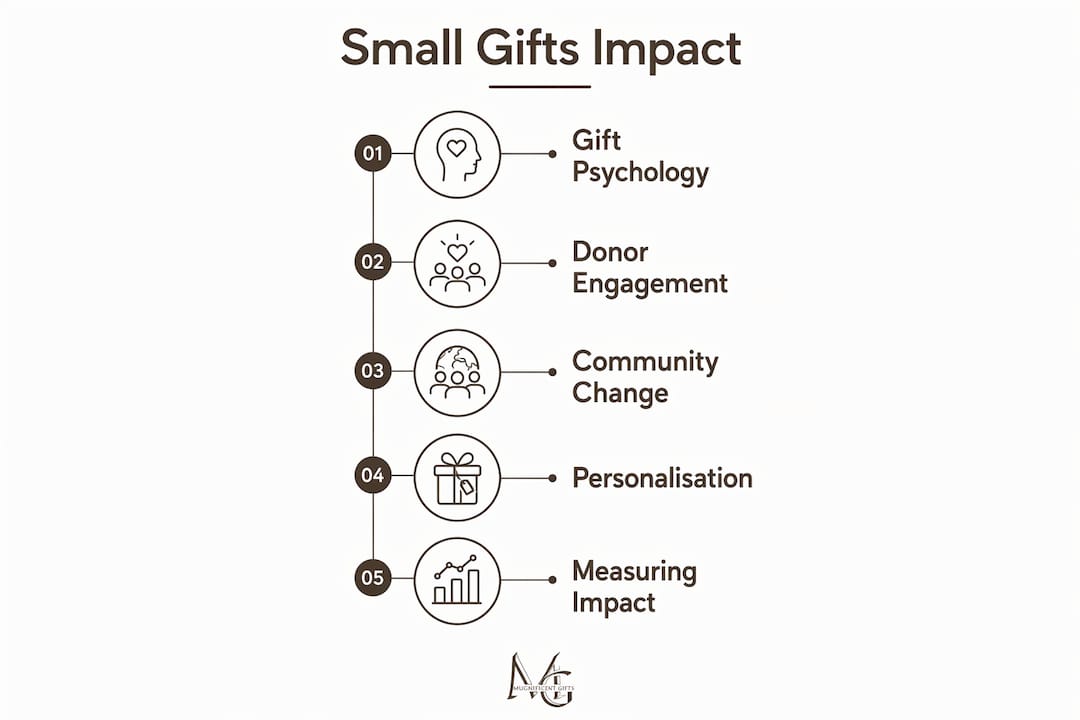
The perceived selflessness of a gift is where much of its power originates. Professor Tanya Chartrand of Duke University's Fuqua School of Business found that gifts feel more selfless than conversations because recipients believe a conversation also benefits the giver, while a gift exists purely to help them. A small snack, a candle, a bunch of flowers: these objects communicate "I was thinking only of you."
Surprise amplifies this further. An unexpected gift disrupts negative emotions by providing a momentary escape from worry, something a conversation rarely achieves with the same speed.
Pro Tip: When supporting a friend through difficulty, a small physical gift often works faster than a phone call. The thought behind it does the heavy lifting.
The University of Birmingham's Jubilee Centre found that gratitude in the UK carries complex associations, including feelings of indebtedness and mild awkwardness. This cultural nuance makes small, unpretentious gifts particularly well-suited to British social norms: they express care without placing the recipient under pressure. The Greater Good Science Center at Berkeley similarly describes gratitude as "social glue," strengthening bonds and encouraging prosocial behaviour across communities.
- Oxytocin release sustains the emotional reward longer than dopamine alone.
- Perceived sacrifice, not monetary value, determines emotional impact.
- Surprise breaks negative thought cycles more effectively than conversation.
- UK cultural norms favour understated, thoughtful gestures over grand ones.
- Gratitude triggered by gifts promotes generosity and cooperative behaviour.
How small gifts drive nonprofit donor engagement
Small gifts reshape how donors relate to charitable causes. The logic is counterintuitive: offering donors more choices, rather than fewer, increases both generosity and satisfaction. A pre-registered experiment with over 2,248 participants donating real money to UK charities found that allowing donors to support multiple causes boosted donations on average by £0.23, without increasing regret.

The concept driving this is "choice deprivation." When donors face a narrow selection of programmes, they struggle to align giving with personal values, and donations fall. Cambridge Judge Business School research confirms that expanding charitable options increases both total giving and donor satisfaction, with no evidence of the decision fatigue that conventional fundraising wisdom has long feared.
Two organisations illustrate this principle in practice:
| Organisation | Approach | Impact |
|---|---|---|
| Transform Trade | Fair trade goods supporting small producers | Connects UK donors to artisans via tangible, meaningful products |
| World Help | Bibles and educational materials distribution | Small, specific gifts create direct, traceable community benefit |
- Accessible gift options lower the barrier to entry for first-time donors.
- Personalised giving choices increase donor satisfaction and retention.
- Tangible small gifts reinforce the donor's sense of direct, meaningful impact.
- Diverse giving options reduce choice deprivation without causing overload.
Real initiatives where small gifts changed lives
Transform Trade works with producers across Africa, Asia, and Latin America, channelling small fair trade purchases into sustainable livelihoods. A UK consumer buying a fairly traded product for a few pounds creates a chain of economic dignity that reaches a craftsperson thousands of miles away. The gift is small; the consequence is not.
World Help distributes Bibles, educational materials, and basic supplies to communities with limited access to resources. Individual donors contribute modest amounts that fund specific, tangible items. The specificity of the gift, knowing exactly what your contribution provides, is what builds lasting donor connection.
Community gratitude projects across the UK, from school-based gratitude journals to workplace recognition programmes, demonstrate that small, deliberate acts of acknowledgement improve mental well-being and social cohesion. The Jubilee Centre's research supports incorporating gratitude practices into educational and workplace settings as a measurable public good.
Pro Tip: For charity campaigns, frame small gifts around a specific outcome ("this £3 provides a meal") rather than a general appeal. Specificity converts browsers into donors.
How personalised gifting multiplies the impact of small gifts
Personalisation transforms a small gift into a statement of genuine attention. When a gift reflects the recipient's identity, their instrument, their sense of humour, their name, it signals that the giver paid close attention. That signal carries more emotional weight than the object's price tag ever could. You can read more about this dynamic in the psychology of personalised gifting.

Mugnificentdeals builds this principle into every product. Music-themed mugs featuring hand-drawn instrument illustrations, personalised names, and wry captions like "I improvise, not mistakes" work precisely because they speak to a specific person's world. The recipient does not just receive a mug; they receive proof that someone knows them. That recognition is what creates enduring affinity, and it is what separates a memorable gift from a forgettable one.
The ritual of choosing a personalised gift also rewards the giver. Selecting the right design, imagining the recipient's reaction, anticipating the moment of opening: these steps activate the same reward pathways that the APA identifies in gift-giving research. Thoughtful creative gifting is, in this sense, a gift to yourself as much as to the person receiving it.
Pro Tip: Choose a gift that references something specific about the recipient, a favourite instrument, an inside joke, a shared memory. Specificity is what makes a small gift feel large.
Practical tips for choosing effective small gifts
Choosing well matters more than spending much. A few principles consistently produce gifts that land:
- Match the gift to the person's identity, not your own taste. A music lover receiving an instrument-themed gift feels seen; a generic gift feels like an afterthought.
- Prioritise surprise over occasion. Gifts given outside birthdays and holidays carry extra emotional weight precisely because they are unexpected.
- Keep it tangible. Physical gifts outperform verbal appreciation for short-term emotional recovery, as Chartrand's research consistently shows.
- Embrace specificity. A personalised item, a book on their exact interest, a product tied to their hobby, signals effort and knowledge.
- Consider the ritual. Presentation, wrapping, and a handwritten note extend the reward experience for both giver and recipient.
How to measure the impact of small gift campaigns
Measuring gift impact requires looking beyond transaction data. For nonprofits and community programmes, useful metrics include donor retention rates, average gift size over time, and qualitative feedback on perceived connection to the cause. Organisations using Transform Trade's model track producer livelihoods alongside donor satisfaction, creating a two-sided impact picture.
For personal or workplace gift initiatives, self-reported well-being scores before and after a gratitude or gift programme offer a practical baseline. The Jubilee Centre recommends its Multi Component Gratitude Measure for educational and organisational contexts. Digital campaigns can track open rates, repeat giving, and social sharing as proxies for emotional resonance.
Limitations and ethical considerations of small gift giving
Small gifts are not universally positive. Reciprocity norms can create discomfort when a recipient feels unable to match the gesture, a tension the Jubilee Centre's UK gratitude research identifies explicitly. In professional settings, gifts can blur boundaries or create perceptions of favouritism.
In nonprofit contexts, token gifts used as fundraising incentives must be proportionate and transparent. Donors should never feel manipulated into giving through guilt or obligation. The Cambridge research on choice architecture is a reminder that expanding options serves donors best when it reflects genuine programme diversity, not artificial complexity designed to inflate giving figures.
Cultural sensitivity also applies. What reads as a warm gesture in one context may feel intrusive or inappropriate in another. The most effective small gifts are those offered freely, without expectation of reciprocation, and calibrated to the relationship and setting.
Key takeaways
Small gifts create outsized emotional and social impact because they signal selfless, receiver-focused care, not because of their monetary value.
| Point | Details |
|---|---|
| Perceived sacrifice drives impact | Recipients rate gifts as a greater sacrifice than conversation, boosting emotional recovery. |
| Oxytocin sustains the reward | Gift-giving releases oxytocin, creating lasting feelings of trust and connection beyond a brief dopamine spike. |
| Choice expands generosity | Allowing donors to support multiple causes boosted donations by £0.23 on average in UK charity research. |
| Personalisation amplifies meaning | A gift tied to the recipient's identity signals attention and care that generic gifts cannot replicate. |
| UK culture favours small gestures | British gratitude norms make low-pressure, thoughtful gifts more effective than grand, obligation-heavy ones. |
Mugnificentdeals' personalised music mugs are designed for exactly this kind of meaningful giving. Each mug combines hand-drawn instrument artwork, personalised names, and music-lover humour into a gift that feels genuinely considered. Whether for a violinist, a drummer, or someone who air-guitars in the kitchen, these are small gifts built to leave a lasting impression.