
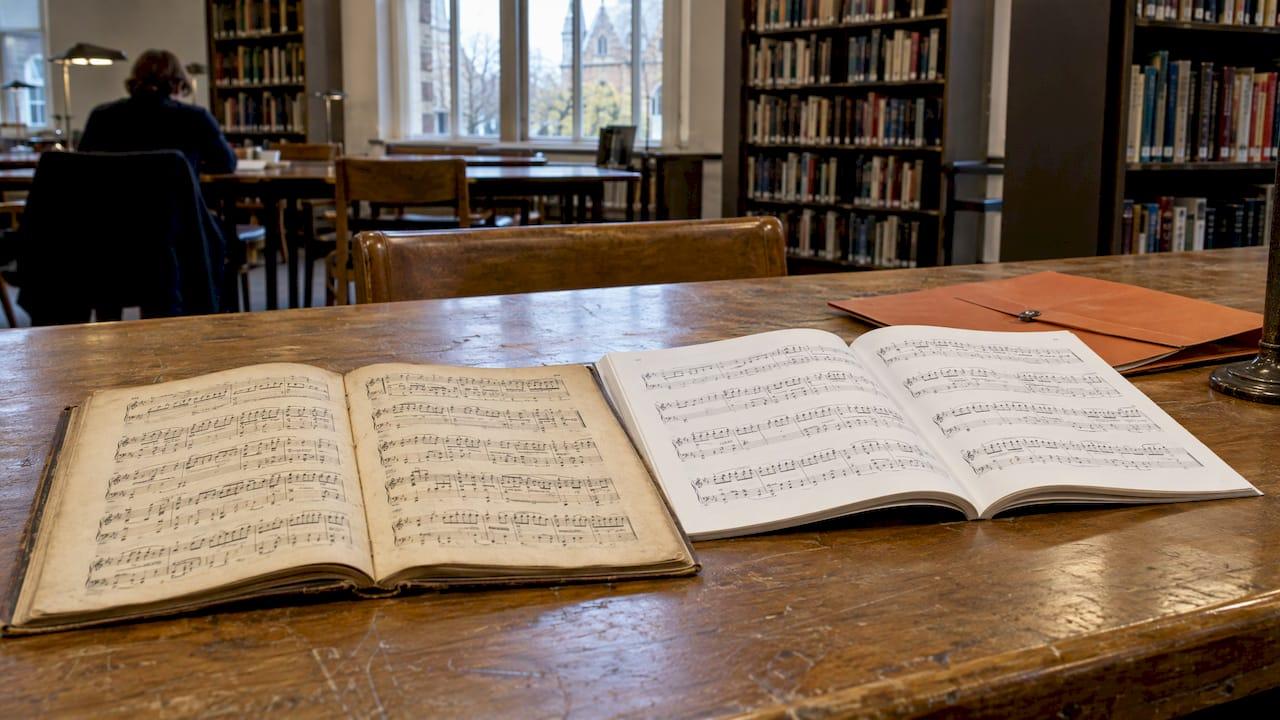
Public domain sheet music art is artwork, collage, print or decoration made from scores whose copyright has run out. In the UK, the composition is usually free to use 70 years after the composer's death, but the printed edition you are copying from can carry its own, separate protection. Check both, and old scores become a generous source of imagery for wall art, gifts and designs that feel personal rather than mass-produced.
This guide is for musicians, music teachers and the people who buy gifts for them. It explains what "public domain" means, how to check a score in a few minutes, where to find scores worth using, and how to turn them into something you will want to keep on a shelf or give away.
TL;DR
- A musical work in the UK is generally protected until 70 years after the author's death; after that the composition is public domain.
- A published edition has its own typographical copyright for 25 years, so an old piece can sit in a new, protected layout.
- Printed music can carry up to three copyrights: the music, any lyrics and the edition. Check all three before you copy.
- Choose a clearly old edition or a source that states its licence, and keep a note of where each score came from.
- Public domain scores work well on gifts. A personalised mug turns an old score into something personal to one player.
Table of Contents
- What "public domain sheet music art" actually means
- The UK rules in plain English
- A five-minute check before you use a score
- Where to find scores worth using
- What about copying for private study or quotation?
- Ideas that work well with public domain scores
- Why this matters for gift buyers
- Lyrics and quotes need their own check
- Our view: a score is a story, not a texture
- Turn an old score into something personal
- FAQ
- Sources
What "public domain sheet music art" actually means
A work enters the public domain when its copyright expires. The British Library's copyright guidance explains that, from that point, any amount of the work may be copied by anyone for any purpose without permission. It also notes that institutions can add their own conditions on how items from their collections are reproduced, so the library or archive you borrow from matters as well as the date.
For sheet music art, that covers a wide range of things people make:
- framed prints of a handwritten or engraved page
- collage and decoupage using torn or cut score pages
- illustrations that incorporate a bar of a well-known melody
- decorative backgrounds for invitations, programmes and cards
- designs printed on homeware, such as mugs, cushions and tote bags
It is worth separating two ideas that get mixed up. The public domain is about permission, not about quality or source. A score that is free to use can still be a poor scan, a modern re-engraving or a page that someone else has retyped and now owns. That is why the practical work is in the checking.
The UK rules in plain English
UK law gives printed music up to three separate layers of protection. The Intellectual Property Office's notice on printed music says a score can carry copyright in the musical work, in any lyrics as a literary work, and in the typographical arrangement of a published edition. If any one of them is still protected, you need the owner's permission before copying.

Here is what each layer means for you.
The composition: 70 years after death
GOV.UK states that musical works generally remain protected until 70 years after the death of the author, with exceptions possible. In practice, you work out the year the composer died and add 70. For the year 2026, that puts a composer who died in 1955 or earlier on the safe side of the simple rule. Bach, Mozart, Beethoven, Chopin, Debussy and Elgar all clear it easily.
If an arranger, editor or translator contributed to the version you are using, their details matter too. IMSLP's guide to verifying copyright says to find the death year of the composer and of any arrangers, editors, text authors or translators, and, for composers who died after 1949, to establish the year and place of first publication.
The lyrics: a separate literary work
A song has words as well as notes, and the words are protected on their own terms. A famous melody from the 1800s with a freshly written English translation may carry a translator's copyright. If your design includes text, check the author of that text, not only the composer.
The edition: 25 years from first publication
This is the layer most people miss. The Intellectual Property Office and the ISM both describe the typographical arrangement, the way a particular publisher has laid out the page, as protected for 25 years from the end of the year of first publication. The ISM adds that a publication can remain in copyright when the underlying work does not, and that the same principle applies to scanning and storing PDFs.
IMSLP gives a concrete example: in the UK, a new typesetting of a public domain piece, for instance Mozart entered into notation software, gains its own 25-year copyright, although that copyright does not extend to the underlying composition. So a clean, modern-looking score of a Mozart sonata may not be as free as it appears, whereas a nineteenth-century engraved edition is on firmer ground.

A five-minute check before you use a score
You do not need to be a copyright lawyer. Work through these steps in order and write down the answers.
- Name the composer and every contributor. Look for arranger, editor, lyricist and translator credits on the title page.
- Find the death years. If every named person died more than 70 years ago, the music and text are likely free. Allow for exceptions, which GOV.UK warns about.
- Find the edition's publication year. Copyright information is often on the first page, as the IPO's notice points out. If the edition was first published more than 25 years ago, its layout protection has expired.
- Do not rely on a publisher's notice or its absence. IMSLP notes that many European scores from the 1800s to the 1980s carry no notice, and that no notice is no longer a guarantee of public domain status. A forum discussion on printed sheet music copyright makes the related point that a publisher's claim should be checked against older editions.
- Record the source. Keep the website, the page address, the date you saved it and the licence statement. If you are asked where a design came from, you can answer in one line.
There is no single official UK register of copyrighted songs. Making Music's guide says so and suggests checking publication dates or contacting the Music Publishers Association when you are unsure. If a piece is genuinely unclear, choose a different score. There are plenty of others.
A worked example
Say you want a page from a Chopin nocturne as a framed print. Chopin died in 1849, so the composition is long out of copyright. You find a scan of an engraved edition from the late 1800s on a music library site. The edition is far older than 25 years, so its layout protection has expired too. The site states the scan's licence, you note it, and the page is safe to use.
Now say you find a crisp, modern edition of the same nocturne with a 2012 publisher imprint. The music is free, but the typesetting is protected until 25 years after the end of 2012. You would use the older engraving instead.
Where to find scores worth using
Good sources state their reuse terms clearly. Oxford's Bodleian Libraries guide to finding creative commons media points readers to Musopen, which can filter music and sheet music by licence, including CC0, and it lists the Open Goldberg Variations score and recording and the Public Domain Review. It also reminds users to read the terms of Creative Commons materials, because some require attribution or have other conditions.
Two cautions from reliable sources are worth keeping in mind:
- Recordings are a different matter. The Open Music Archive says its recordings are public domain in the UK, but downloading from outside the UK may not be legal because compositions and recordings can fall under different laws elsewhere. If you are an American reader, check US rules rather than assuming UK dates apply to you. This article describes UK law.
- Educational licences do not stretch to art projects. York St John's copyright team notes that the higher-education CLA licence does not cover copying sheet music, and points staff to public domain scores, item-level reuse terms or specific exceptions. Teachers will find that useful for classroom handouts, but decorative products for sale or gifting are a different use.
When you browse, favour pages where the score is plainly old, the composer is named, and the date of publication is visible. A clean title page is worth more than a pretty scan.
What about copying for private study or quotation?
UK law has exceptions, and teachers and students meet them often. The ISM explains that scores may be copied for research and private study for non-commercial purposes only to the extent necessary, with an acknowledgement of the composer. The IPO's notice adds that fair dealing exceptions require using no more of the work than necessary.
Those exceptions are narrow and built for study, criticism and review, not for turning a protected page into a decorative object. For art, the dependable route is simpler: choose material that is fully out of copyright, edition included.
Ideas that work well with public domain scores
The best sheet music art uses the music as a texture or a signature, not as wallpaper. A few approaches that tend to look considered:
- A single meaningful bar. Choose the opening phrase of a piece the recipient loves or plays. One line of notation reads as personal.
- An instrument illustration over faded staves. A hand-drawn violin, cello or trumpet laid over a pale background gives depth without cluttering.
- Composer portraits with a score fragment. Useful for teachers' studios and music rooms.
- Hand-annotated pages. Fingerings, bowings and pencil marks give a page the look of a working score.
- Name and date placement. A name set in the margin of a score page turns decoration into a keepsake.
The same designs can travel to other products. If you are comparing how artwork looks on different surfaces, a gallery of custom printing on apparel shows how a single design can be adapted to fabric as well as ceramic, which is a handy way of judging how much detail a design can hold.
If you want more inspiration on the mug side, our guide to sheet music mug ideas for musicians covers sentimental, clear layouts, and our piece on music room decor that starts with a mug and a shelf shows how a printed design sits within a wider space.
Why this matters for gift buyers
A gift made from a public domain score has a quiet advantage: the music itself means something. A pianist who has spent a winter on a Satie piece, a cellist preparing a Bach suite for an exam, a choir leader with a favourite hymn: each recognises the page immediately. It says that you noticed what they play, which is rarely true of a generic gift.
For students buying for a teacher, the choice is easy to get right. Pick a composer the teacher loves, add a short message, and keep the design restrained. The check described above makes sure the artwork behind that message is sound.
Lyrics and quotes need their own check
If your design includes a line of words, such as a song lyric or a famous quotation about music, treat it separately from the notation. Lyrics are a literary work with their own term, and a translated text can be protected even if the original is not. Our guides on music quotes and copyright in the UK and what the law means for music merchandise go into what you can print and what records to keep.
Our view: a score is a story, not a texture
We design for people who play, teach and love music, and we have a simple rule: the notes on a design should mean something.
A page of notation is not just a pretty pattern. It is the thing a violinist has practised for months or a student has finally got right. When a design uses a real, out-of-copyright score, with the composer and the period behind it, the person holding the mug feels seen.
That is why we focus on personal touches: a name, an instrument, a short line of humour, a photo. Public domain scores give those touches a handsome backdrop, and they give gift buyers a way to say something specific without saying too much.
Our advice is to start with the person and then pick the music, not the other way round. The right score makes a gift that is thoughtful without being over the top.
Lasse
Turn an old score into something personal
If you would rather give the finished object than the idea, our personalised music mugs bring instrument illustrations, music quotes, names, photos and gift messages together on ceramic. Browse the personalised music mugs collection for names, instruments and funny music designs, or see the instrument sketch mugs and composer and music history mugs if the person you are buying for has a favourite composer or instrument.
For present ideas by occasion, our selection of personalised music mugs for gifts is a good place to begin.
FAQ
What sheet music is public domain in the UK?
In general, music is public domain once 70 years have passed since the composer's death, as GOV.UK explains. You should also check the edition, because a published layout is protected for 25 years from first publication. Older engraved editions are usually the safest choice.
Can I use a modern edition of an old piece for artwork?
Only with care. The notes may be free, but the typographical arrangement of a modern edition can still be protected, and a new typesetting of a public domain piece gains its own 25-year copyright. Using an older edition avoids the question.
Is a score without a copyright notice free to use?
Not necessarily. IMSLP warns that the absence of a notice is no longer a guarantee of public domain status. Look at the composer's death year, the publication date and any arranger or lyricist credits instead.
Where can I find free sheet music to print?
Libraries and archives that state their licences are the best starting point. The Bodleian's guide lists Musopen, the Open Goldberg Variations and the Public Domain Review among its suggestions. Read each item's reuse terms before you print.
Do the same rules apply in the US?
No. This article describes UK law, and other countries use different terms and dates. The Open Music Archive notes that material public domain in the UK may not be free to download elsewhere, so US readers should check their own rules.
Sources
- British Library: Copyright FAQ
- GOV.UK: Duration of copyright
- IPO: Copyright notice on printed music
- ISM: Understanding copyright for printed music
- IMSLP: Verifying copyright status
- IMSLP: Licensing policy and guidelines
- Making Music: How to check if a piece is copyrighted in the UK
- Copyright Aid: Copyright of printed sheet music
- Bodleian Libraries: Finding creative commons media
- Open Music Archive: FAQ
- York St John University: Can I copy printed music?
- T-Shirt Printing Portfolio