

No, not without permission. Song lyrics are literary works protected by UK copyright law, and printing them on mugs without a licence from the music publisher is generally infringement, whatever the run size. Licensing for print use is often impractical for small sellers, so the safer route is usually public domain lyrics, original wording, or a design that evokes the song without quoting it.
TL;DR:
- Printing song lyrics on mugs in the UK is copyright infringement without a license because lyrics are protected literary works from the moment they are written.
- Until 70 years after the songwriter's death, most popular or recent lyrics remain under copyright, especially for works created after the 1950s.
- Licensing must be obtained from the music publisher, not performance rights organizations, and negotiations can take weeks and cost more than small-order profits.
- Fair dealing and short quote rules do not generally protect commercial lyric use, especially for recognizable or substantial parts of a song.
- Using song titles, original wording, or thematic imagery avoids licensing issues and allows for legally compliant music-themed products.
Table of Contents
- Is it legal to put lyrics on mugs in the UK? A quick checklist
- What UK law actually protects and for how long
- How do you get permission to print lyrics legally?
- Do fair dealing or the 'one line' rule protect you?
- What can you print instead of copyrighted lyrics?
- How Mugnificentdeals designs music mugs without lyric risk
- Why cautious design choices protect your business
- Compliant personalised music mugs from Mugnificentdeals
- Sources
- FAQ
Is it legal to put lyrics on mugs in the UK? A quick checklist
Before you send a design to print, work through this in order. It takes ten minutes and could save you a takedown notice, a refund bill, or worse.
- Check the lyric's copyright status. Has the songwriter been dead for more than 70 years? If not, the lyric is almost certainly still protected.
- Identify the publisher. Copyright in a song's words usually sits with a music publisher, not the performing artist, and rarely with PRS or MCPS directly.
- Ask whether the use is commercial and decorative. Selling a mug with a lyric printed across it is a textbook commercial use, which is exactly the category licensing exists to control.
- Weigh the cost and delay against alternatives. A licence negotiation can take weeks and may not be worth it for a run of twelve mugs.
- Keep a written record of everything you check, including dates, publisher correspondence, and where you sourced any "free to use" claim.
Miss any of these and you are effectively gambling that nobody notices. Given how easily lyrics are searched and matched online, that is not a safe bet for a small business relying on repeat customers and marketplace reviews.
What UK law actually protects and for how long
Song lyrics count as original literary works under the Copyright, Designs and Patents Act 1988, and that protection is automatic. There is no registration to check, no symbol to look for, and no need for the songwriter to have done anything beyond writing the words down. The moment lyrics exist in fixed form, copyright applies.
That protection hands the rights holder a bundle of exclusive controls: the right to copy the work, issue copies to the public, adapt it, and communicate it. Printing a lyric onto a mug and selling it touches at least two of those rights at once, copying and distribution, which is why the "I only used one line" defence rarely holds up in practice.
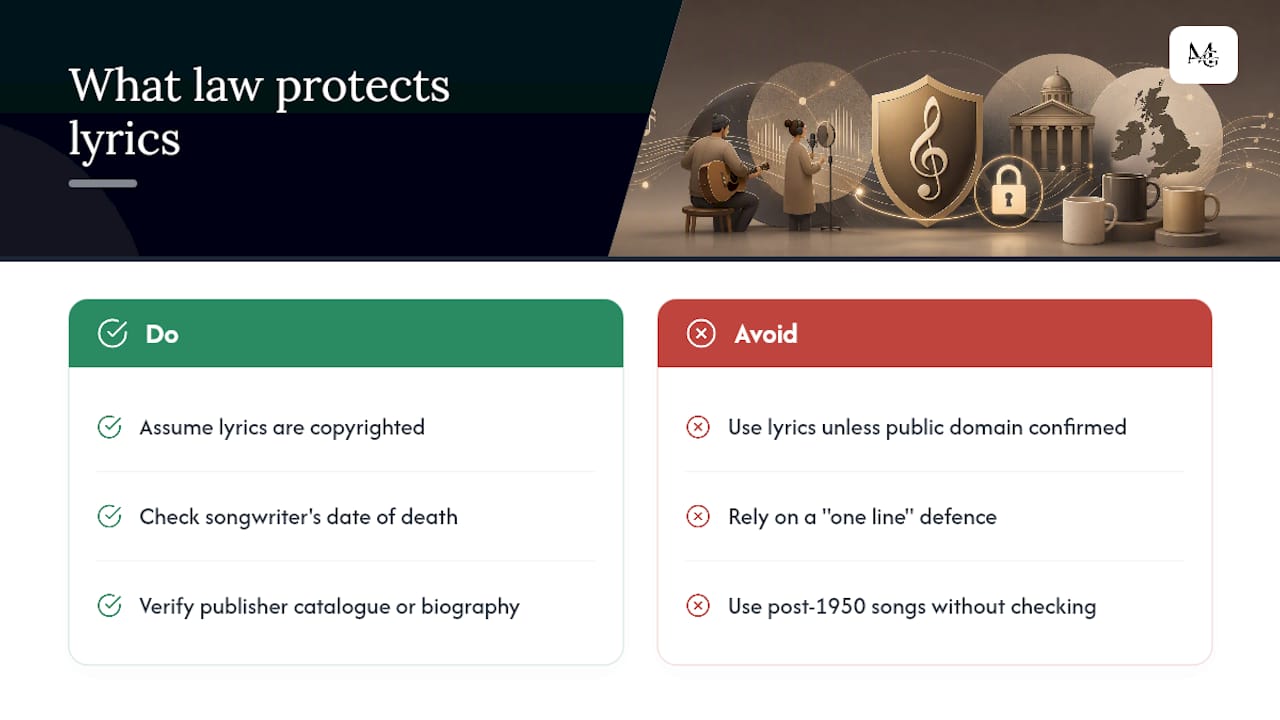
Duration is the part most sellers get wrong. UK copyright in a literary work lasts for the life of the author plus 70 years, counted from the end of the calendar year in which they died. For a song with more than one writer, the clock only starts once the last surviving author has died.
Run the maths on this and the practical implication becomes obvious: unless you are working with a song from before the 1950s whose writer has since died and the 70 year window has closed, assume the lyric is still in copyright. Most wedding-song classics, most chart hits from any decade you can remember hearing on the radio, and virtually every song released this century remain fully protected. Checking a songwriter's date of death against a reliable biography or the publisher's own catalogue takes minutes and removes any doubt.
How do you get permission to print lyrics legally?
This is where most sellers hit a wall, and it is worth understanding why before you start.
Contact the music publisher, not PRS or MCPS. PRS for Music and MCPS handle performance and mechanical rights, meaning royalties for playing or streaming a song. They do not issue licences for printing lyric text on physical products. That job sits with the music publisher, and you can usually find the right one via the songwriting credits on a release or through a publisher's own permissions department.
Prepare a proper request. A publisher will typically want the exact lyric wording, a mock-up of the mug design, the intended print run, your sales territories, which channels you sell through (your own site, Etsy, a market stall), and how long you want the licence to run.
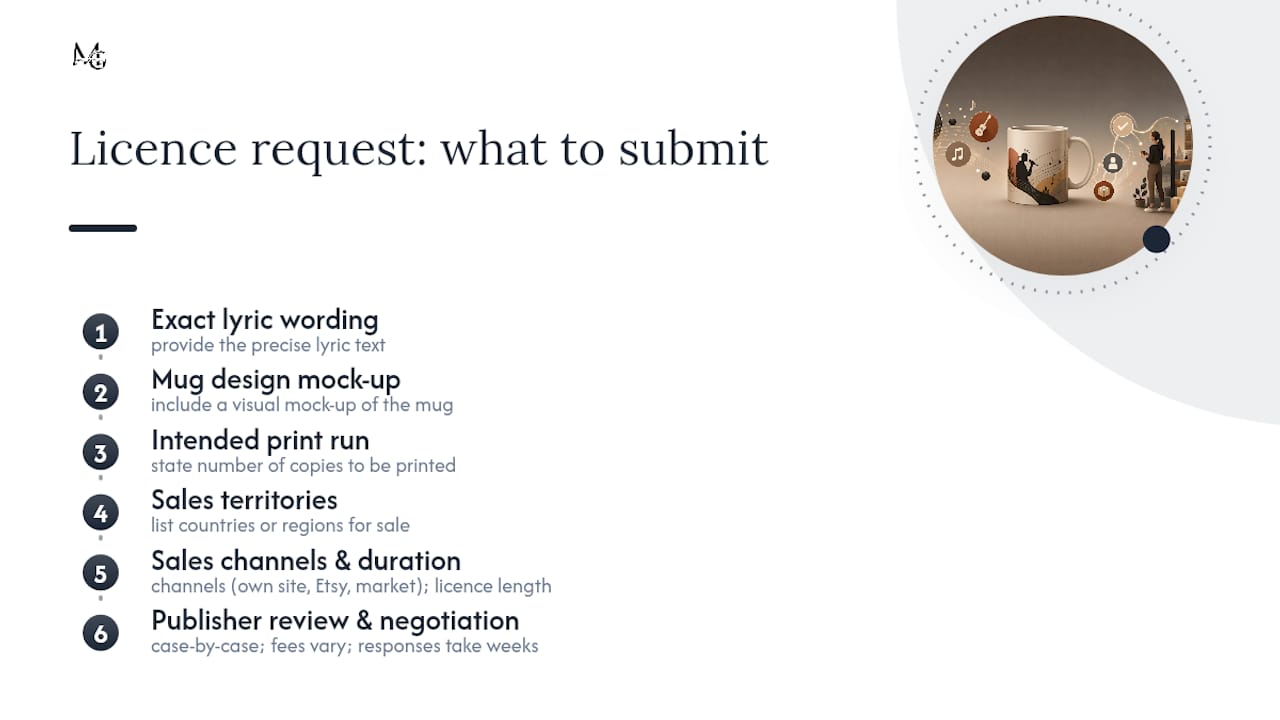
Expect a case-by-case negotiation, and expect it to be slow. There is no fixed price list. Fees vary hugely depending on the song's popularity, the publisher, and the scale of use, and responses can take weeks. For small batches of personalised mugs, the licensing overhead frequently costs more than the entire order is worth, which is precisely why so few small sellers pursue it.
The orphan works licensing scheme exists for cases where a rights holder genuinely cannot be traced, but it rarely applies to commercial song lyrics, since publishers are almost always identifiable. Skip the licence altogether and you risk takedown notices, marketplace account penalties, and in persistent cases, a legal claim for damages, as sellers on platforms like Etsy have discovered when rights holders enforce against infringing listings.
Do fair dealing or the 'one line' rule protect you?
Neither does what most sellers assume, and both misconceptions cause real damage.
- Fair dealing is narrow. UK exceptions under Section 30 cover things like genuine criticism, review, or quotation for illustrative purposes. Printing a lyric on a mug to sell for profit is not criticism or review; it is decoration, and decoration is not covered.
- There is no safe one-line rule. Courts assess whether the part reproduced is a "substantial part" of the work, and that test is qualitative, not a word count. A short, instantly recognisable chorus line can be judged substantial precisely because it is the most memorable part of the song.
- A listing staying live proves nothing. Marketplaces do not vet copyright before a product goes on sale. Enforcement typically happens after a rights holder or their agent spots the listing, sometimes months later, and by then you may have dozens of orders to account for.
- Parody has a narrow exception too. UK law does allow limited use for genuine parody, but the bar is high and the use must be transformative, not simply a lyric reprinted verbatim with a joke added. Guidance on parody merchandise is worth reading if you are tempted down this route.
Pro Tip: If a lyric feels "too iconic to cause a problem," treat that as a warning sign rather than reassurance. The most recognisable lines are exactly the ones publishers monitor most closely.
What can you print instead of copyrighted lyrics?
The good news is that you can build a strong, music-themed product without touching a single protected line.
- Use song titles and artist names. Titles are generally not protected by copyright in the same way as the lyrics themselves, so "Bohemian Rhapsody, est. 1975" style references carry far less risk than quoting the verse.
- Write original micro-copy. Instead of quoting a line about rhythm or melody, write your own short phrase capturing the same feeling. A guide to crafting original musician mug sayings is a useful starting point if you want ideas that land without legal exposure.
- Check public domain catalogues properly. If you genuinely want historic lyrics, verify the songwriter's date of death against a source like IMSLP or Mutopia rather than trusting a forum post that says a song is "old enough."
- Lean on original illustration. A hand-drawn violin, a stylised stave, or a cheeky instrument-based joke communicates "this is for a musician" without needing a single borrowed word.
- Keep provenance records for every asset, including fonts and stock art, so you can prove where a design element came from if a marketplace ever queries it.
Pro Tip: Some of the best-selling personalised gifts skip lyrics entirely and lean on the recipient's name, instrument, or an in-joke instead, which also makes the mug feel more personal than a quoted line ever could.
How Mugnificentdeals designs music mugs without lyric risk
The catalogue is built around original instrument sketches, playful original phrasing, and song or composer titles rather than quoted lyric text, precisely because that approach sidesteps publisher licensing altogether. Every design brief starts by checking whether wording is original or falls into a grey area, and any borrowed phrase is reworked before it reaches print. That habit of documenting design decisions mirrors the asset provenance practice recommended across the music publishing industry, and it is what lets the brand offer instrument-specific and composer-themed designs with confidence.
Why cautious design choices protect your business
Getting a cease-and-desist letter over a £15 mug is a miserable way to learn about copyright law, and it happens more often than most new sellers expect. My advice: if a lyric is central to your idea, budget for a proper licence or drop it. Reworking a design costs an afternoon; a legal dispute costs a great deal more, in money and in the trust of customers who bought from you in good faith.
— Lasse
Compliant personalised music mugs from Mugnificentdeals
This business is built around exactly the problem this article covers: how to sell music-themed gifts without gambling on lyric permissions. Every design in the personalised music mugs collection uses original instrument illustrations, composer references, or custom wording rather than quoted lyric text, so you get a distinctive, giftable mug without the licensing headache.
Personalisation still runs deep. You can add a name, an instrument, or a short original message, and the mug gift message examples page has plenty of inspiration if you are stuck for wording that feels personal rather than generic. If you would rather browse ready-made ideas, the best personalised music mugs for gifts collection is a good place to start, and the Composer Music history Mugs range suits anyone shopping for a music teacher or classical enthusiast. Pick a design, add your personalisation, and check out; every option is built to be legally safe from the outset.
Sources
FAQ
Are song lyrics protected by copyright in the UK?
Yes. Lyrics count as original literary works under the Copyright, Designs and Patents Act 1988, and protection applies automatically from the moment they are written down.
Is UK copyright really life plus 70 years?
Yes, for literary works including song lyrics, copyright lasts for the life of the author plus 70 years, counted from the end of the year the author died.
Can I just say I don't own the rights and sell the mug anyway?
No. A disclaimer stating you do not own the rights offers no legal protection and does not stop a publisher issuing a takedown or pursuing a claim for infringement.
What legal protections cover music in the UK generally?
Music is protected in layers: lyrics and sheet music as literary and musical works, and sound recordings separately, all falling under the Copyright, Designs and Patents Act 1988, with performance and mechanical rights typically managed by PRS for Music and MCPS.
Does Mugnificentdeals sell mugs with song lyrics on them?
No. Mugnificentdeals designs its personalised music mugs around original artwork, composer references, and custom wording rather than quoted lyrics, specifically to avoid licensing risk for customers ordering personalised gifts.