
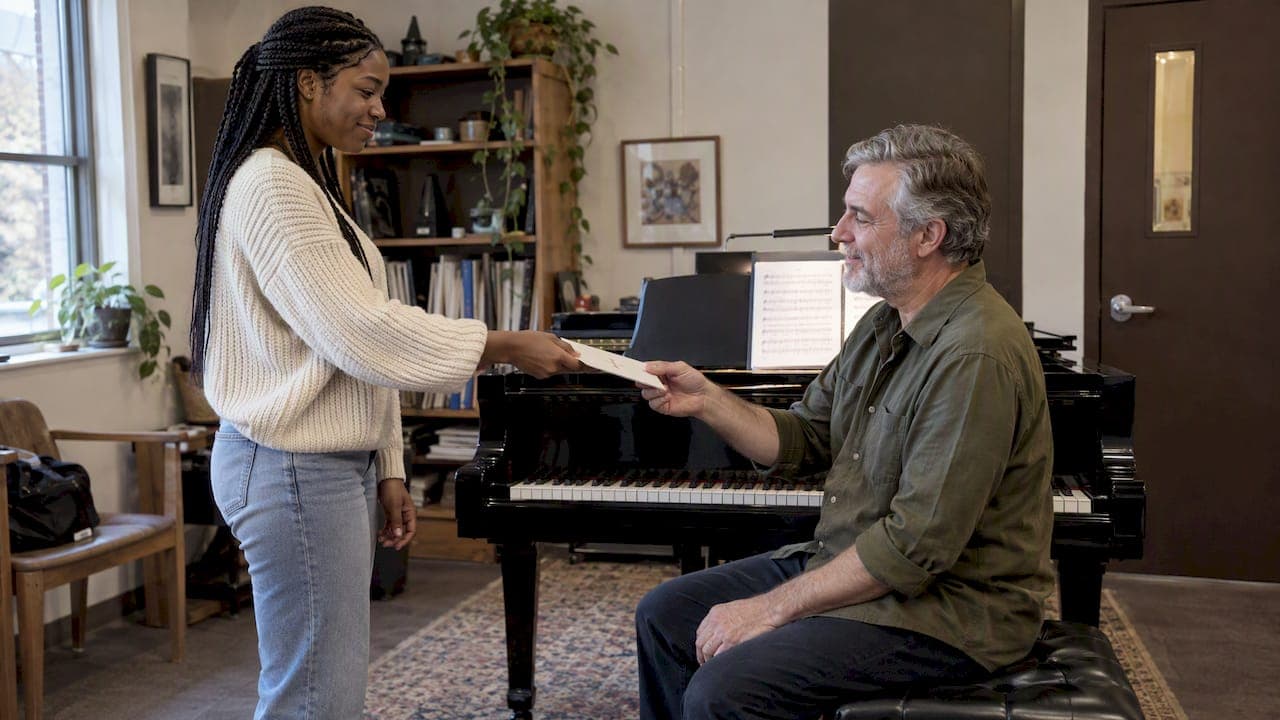
The best thank you message for a music teacher names one specific thing they did and says what it changed for you. "Thank you for teaching me" is kind. "Thank you for the Tuesday you stopped the lesson and made me play eight bars until they sounded like music" is remembered. Below you will find messages for every situation, from a two-line text to a full letter, and a simple method for writing your own.
TL;DR
- Name one real moment, piece or habit your teacher gave you, then say what it changed. That alone lifts a note above the generic.
- Short is fine. A sincere two-sentence note beats a long paragraph of stock praise.
- Match the tone to the relationship: warm and simple from a child, personal and detailed from an adult learner or former student, brief and professional from a parent.
- A handwritten card is the core of the thank you. A small, personal gift, such as a mug with their instrument on it, is a lovely extra, never a replacement.
- Below are ready-to-adapt messages grouped by who is writing and what you want to say.
Table of Contents
- What makes a music teacher's thank you land
- A simple method for writing your own message
- Short thank you messages for a music teacher
- Thank you messages from a student
- Thank you messages from parents
- Messages for end of term, exams and recitals
- Longer notes and letters
- Words that reflect real teaching
- Adding a gift: when it helps and what to choose
- Our view: why a personal thank you matters in music
- Put your message on something they will use
- Common mistakes to avoid
- FAQ
- Sources
What makes a music teacher's thank you land
Music teaching is unusual. A good teacher sits beside you week after week, hears every wrong note, and keeps going. They watch a nervous eight-year-old become someone who can play at a school concert. Few other teachers see that slow growth up close, and many get very little feedback about it.

That is why specifics matter. Guidance from UK card and craft retailers agrees on this point. The Works recommends direct, genuine wording, with simple lines about making learning fun and about time and care given across the year. Hallmark UK advises writing from the heart and notes that sincere thanks need no fancy phrasing.
For music in particular, the things worth naming tend to fall into a few groups:
- Patience: the way they handled the fifth week in a row of the same difficult bar.
- Technique: a fix to your bow hold, breathing, posture or fingering that finally made things click.
- Confidence: the push to enter an exam, audition or recital when you doubted yourself.
- Joy: the moment music stopped being homework and became something you wanted to do.
- Life beyond the studio: discipline, listening and resilience that now show up in school, work and everyday life.
Pick one. A note about one thing reads as true. A note about everything reads as a template.
A simple method for writing your own message
You do not need to be a writer. Use three short steps.
- Start with the thank you. One plain sentence: "Thank you for everything you have taught me this year."
- Add one specific memory. A piece, a lesson, a recital, a comment they made. If you can picture it, include it.
- Say what it changed. This is the sentence the teacher will remember. Adobe Express UK makes the same point about thank you letters in general: explain what the person helped with and what difference it made.
Here is the method at work:
Thank you for the year of lessons. I will never forget the afternoon you had me play the slow movement with my eyes closed. I finally heard what the piece was about, and I have practised differently ever since.
Three sentences, one memory, one change. That is a complete note.
Short thank you messages for a music teacher
Short messages suit cards signed by a class, texts, emails and the tag on a gift. Use them as they are, or swap in your own instrument or piece.
Simple and warm
- Thank you for making music something I look forward to every week.
- Thank you for your patience, especially on the days I did not practise enough.
- Thank you for helping me sound better and enjoy playing more.
- Your lessons are the best part of my week. Thank you.
- Thank you for believing I could play this, long before I did.
Specific to the instrument
- Thank you for teaching me to really listen, not just to play the notes.
- Because of you, my left hand finally knows what it is doing on the fretboard. Thank you.
- Thank you for every scale you made me repeat. I can hear the difference now.
- Thank you for turning my breathing from a problem into a tool.
- Thank you for showing me that the drums are about listening as much as hitting.
For a text or quick email
- Just a quick note to say thank you for today's lesson. That fingering tip changed everything.
- Thank you for staying a few minutes longer today. It really helped.
- I passed! Thank you for every bit of help getting me ready.
Short and sincere tends to feel more genuine than long and polished, so do not feel you must write a paragraph.
Thank you messages from a student
Children and teenagers often write the most memorable notes because they say things plainly. If you are a student, write it in your own words. If you are a parent helping a young child, write down what they say rather than correcting it.
From a younger student
- Thank you for helping me learn my songs. I like it when you clap along.
- Thank you for being kind when I make mistakes. I am getting better because of you.
- Thank you for teaching me the piano. My favourite piece is the one we learned in the summer.
From a teenager
- Thank you for pushing me to do my best while still keeping lessons fun. I would not be doing my grade exam without you.
- Thank you for letting me bring my own pieces to lessons. It made me want to play more.
- Thank you for listening when I was stressed about school and music at the same time.
From an adult learner
- I started lessons thinking I was too old to begin. Thank you for proving me wrong, and for never making me feel behind.
- Thank you for making the one hour a week I spend with you the calmest hour of my week.
- Thank you for teaching me the way I actually learn, not the way a book says I should.
Thank you messages from parents
Parents see the effort behind the sound. Their notes work best when they mention what they have noticed at home.
- Thank you for the patience you show with our daughter. We hear the difference in how she practises, and how she talks about music.
- Thank you for helping our son find his confidence. He now picks up his guitar without being asked.
- We are grateful for the care you put into every lesson, and for the way you celebrate small steps.
- Thank you for everything you have done this year. Our house is much more musical because of you.
- Thank you for staying flexible when our schedule was difficult. It meant a great deal.
A parent's note about a child's growth is often the one a teacher keeps. Keep it concrete: "he now plays for his grandparents" says more than "he has improved".
Messages for end of term, exams and recitals
The natural moments to say thank you are the end of a term, after an exam result, after a recital and at the end of the school year. Each has its own flavour.
End of term or year
- Thank you for all your time and care this year. I have learned more than I expected.
- Thank you for another year of music. I am looking forward to what we learn next.
- Thank you for the way you kept me going through the tough months. It made a real difference.
After an exam or audition
- Whatever the result, thank you for preparing me so well. I walked in feeling ready.
- Thank you for the mock run-throughs and the calm pep talks. I could not have done it without them.
- I got through it, and a lot of that is down to you. Thank you.
After a concert or recital
- Thank you for the countless hours that led up to tonight. I felt every one of them on stage.
- That performance was yours as much as mine. Thank you for getting me there.
If you are on the other side of a recital and want to celebrate a performer, our guide to recital congratulations messages has wording for that too.
Longer notes and letters
Sometimes a card is not enough. A leaving student, a graduating pupil or a former student writing years later may want to say more. A longer letter works when it follows the same structure: a memory, an effect, a thank you.
Dear Mrs Patel,
I have been thinking about our lessons since I left for university, and I wanted to write and say thank you properly. When I first came to you, I could barely play a scale without losing the pulse. You never made me feel that was a problem. You just kept asking me to listen.
I still do. I listen differently in rehearsals, in seminars, and even in conversations. I do not think I would have learned that anywhere else.
With thanks and best wishes, Tom
It is also worth remembering that a letter does not have to arrive on time. A former student's note, sent years after the lessons, can bring a teacher great joy, as this account of thanking a first music teacher describes. If you have been meaning to write, a late note is still welcome.
Words that reflect real teaching
Teachers notice when praise is accurate. Testimonials on a Leeds flute teacher's site show the kind of qualities students tend to value: patience, attention to detail, and the ability to rebuild technique or explain tricky theory clearly. You can borrow that approach and name the quality you actually experienced.
- For a teacher who rebuilt your technique: Thank you for taking my playing apart and putting it back together. It was hard, and it was worth it.
- For a teacher who explains theory well: Thank you for making theory make sense. I used to dread it, and now I enjoy it.
- For a teacher who is endlessly patient: Thank you for never rushing me. Learning at my own pace is why I kept going.
- For a teacher who inspires: Your passion for music is catching. Thank you for sharing it with me.
Adding a gift: when it helps and what to choose
A message is the heart of any thank you. A small gift can sit beside it, particularly at the end of a term or year. Choose something that suits their day-to-day: music teachers drink a lot of tea and coffee between lessons, carry sheet music in bags, and spend long hours with their instrument.
Here are some ideas that pair well with a note:
- A personalised mug with their instrument, a favourite composer, or a line from your message.
- A practical item such as pencils for marking scores, a notebook for lesson plans, or a tote bag.
- A small treat, like good tea or biscuits, to go with a mug.
- A shared gift from a group of students or parents, which suits a teacher with a full studio.
If you want more thoughts on thoughtful presents, this roundup of gift ideas shows how to pair a present with a meaningful message. For music teachers specifically, our own guides cover gift ideas for music teachers, personalised gifts they will actually use and affordable gifts for music students.
If your teacher leads a band or ensemble, you may also like our notes on a band director thank you.
Matching your message to a mug
A mug gives you a small space to say something, so brevity helps. A few lines that work well printed:
- Thank you for helping me find my sound.
- World's most patient music teacher.
- Behind every good musician is a teacher who never gave up.
- Thank you for the notes, the encouragement and the extra five minutes.
For more ideas that work printed on ceramic, see our collection of music teacher coffee sayings and our piece on the role of mugs in teacher appreciation gifts.
Our view: why a personal thank you matters in music
Music teaching is one of the few jobs where you hear the results of your work out loud, and also where the quiet moments of progress go unnoticed. A student plays a clean phrase for the first time, and the teacher is the only person who truly knows what it took.
That is why we believe a thank you to a music teacher should be as personal as the lessons themselves. Our designs are sketched and thought through, not mass-produced, and we focus on musicians and the people who teach and love them. A drawing of the right instrument, a name, or a line that only your lessons would inspire turns an everyday mug into a small recognition of what they do.
Our approach to gifts is simple. Write the note first, from the heart. Then choose something that says the same thing in a form they will use every morning. We aim for thoughtful rather than over the top, and a little humour helps. Teachers appreciate a smile as much as a speech.
Lasse
Put your message on something they will use
If you would like your thank you to sit on their desk or by the piano, we make personalised music mugs with custom instrument illustrations, music quotes, names, photos and gift messages. You can browse personalised music mugs by instrument, humour or theme, look at sketch-style instrument mugs, or explore composer and music history mugs for a teacher with a favourite composer. Our best personalised music mugs for gifts is a good place to start if you are short on time.

If the gift is for the start of the school year, our back-to-school gifts for music teachers collection and our ideas for music classroom gifts teachers keep may help.
Common mistakes to avoid
- Being too generic. "You are the best teacher ever" could be sent to anyone. Add a detail.
- Over-writing. Heartfelt beats polished. A few honest lines are plenty.
- Leaving it too late. The end of term is busy for everyone. A note sent the week after is still welcome.
- Comparing teachers. Praise your teacher for what they did, not for being better than someone else.
- Making it about money. If you give a gift, keep the focus on the message. A note should never feel like it comes with a price tag.
- Forgetting the signature. Sign with your name, and if you are a parent, add your child's name and instrument. Teachers may have dozens of students.
FAQ
What is a good message to thank my music teacher?
A good message names something specific and says what it changed for you. For example: "Thank you for believing in me when I doubted myself. Because of you, I enjoy playing again." Keep it sincere and in your own words.
How long should a thank you note to a music teacher be?
Two to four sentences is enough for a card, and a text can be a single line. A longer letter suits a leaving student or a former pupil writing years later. Length matters less than whether the note contains something true and specific.
Should I give a gift as well as a message?
You do not have to, and a heartfelt note is a complete thank you on its own. If you would like to add something, a small personal item such as a personalised mug, tea or stationery pairs well with a card. For a group gift, one shared present from several students works well.
What can I write if I am not sure what to say?
Start with a plain thank you, then recall one lesson, piece or comment that stuck with you. Finish with how it has helped. Even a short note such as "Thank you for making music fun, I look forward to every lesson" will mean a great deal.
Can I send a thank you message by text or email?
Yes, particularly for a quick thank you after a lesson or an exam. Mention the specific help, such as the extra time or the feedback that unstuck you. For a significant moment like a leaving date, a handwritten card is a lovely addition.
Sources
- What to Write in a Thank You Teacher Card – Hallmark UK
- What to Write in a Thank You Teacher Card – The Works
- How to write a thank you letter – Adobe Express UK
- Thank Your Music Teacher, Part 2 – Neo Classical
- Testimonials from flute teacher Andrew Littlewood's students
- Unique Wedding Gift Ideas for 2026