
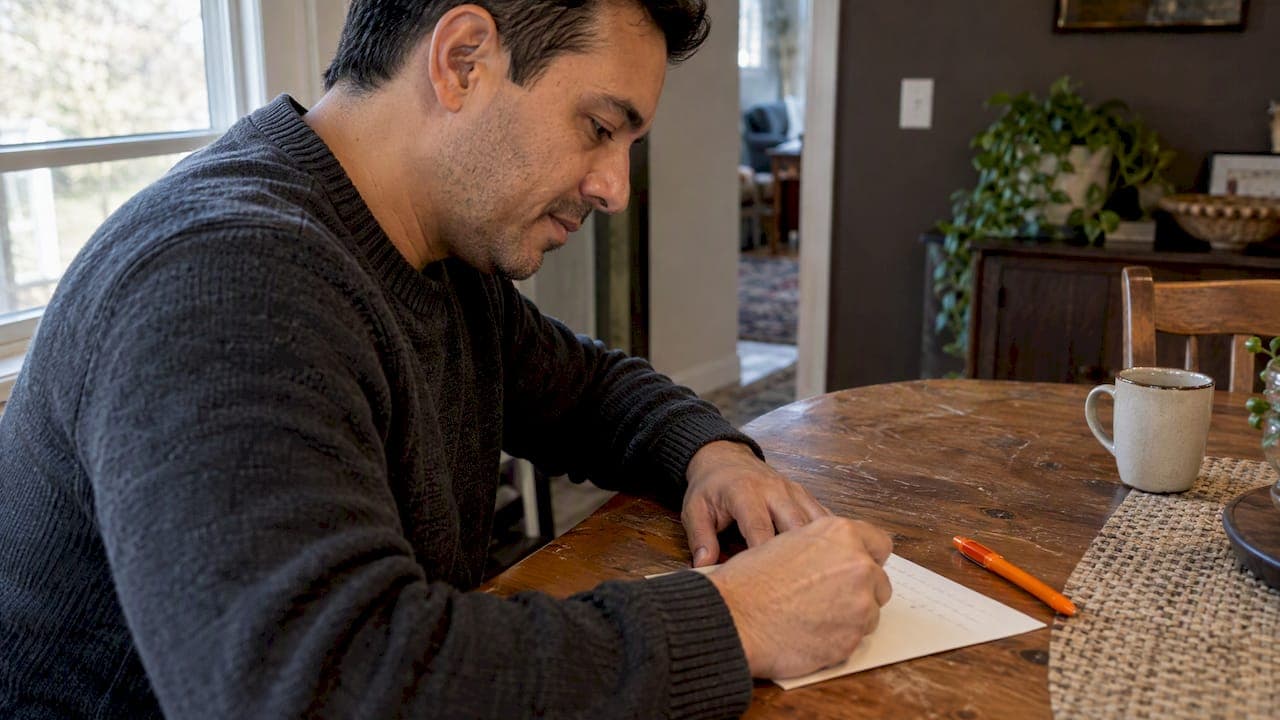
The best way to thank a band director is to be specific: name the rehearsal, the concert or the moment they changed something for you, and say it in your own words. Add a small, personal gesture, such as a handwritten card or a mug made just for them, and you have said thank you in a way they will keep. This guide covers what to write, how to organise a group thank you, which gifts suit, and what to check first if your director works in a UK school.
TL;DR
- A short, specific, handwritten note beats a long generic one. Mention a real moment, lesson or rehearsal.
- A group card or a recorded performance lets a whole ensemble say thank you without anyone being singled out.
- In UK schools, small tokens are normally fine, but gifts of significant value or regular gifts are not. Check the school's gift policy first.
- A personalised mug with their instrument, a joke from your section or a line of thanks is a modest, useful gift that fits that rule.
- Give your thanks when you think of it. Waiting is the usual reason it never happens.
Table of Contents
- Why a band director deserves more than a generic thank you
- Start with the note: what makes it work
- Thank-you messages you can adapt
- Thank-you ideas that cost little or nothing
- Organising a group thank you
- Before you give a gift in a UK school
- Gift ideas that suit a band director
- A mug as a band director thank you
- Our perspective: what we have learned about thank-you gifts for musicians
- Make it a mug: our personalised music range
- A simple plan for saying thank you
- FAQ
- Sources
Why a band director deserves more than a generic thank you
A band director rarely does one job. They teach technique, choose repertoire, manage a room full of different abilities, sort out instruments and music stands, run concerts and keep a group of people turning up week after week. Much of it happens before the first student arrives or after the last has left.
One music blogger writing about private teachers puts it plainly: music teachers may arrange exam dates, adapt to changing needs and find extra resources outside their paid hours. The same is true of anyone who runs a school band, a community wind band or a youth orchestra. The work you see on concert night is a fraction of the work that went into it.
That is why a thank you carries weight. It tells a person that the hours they could not put on a timesheet were noticed. It also does something for you: a good thank you makes you recall what you actually learned, which is a pleasant exercise in itself.
There is also a wider benefit. Music lessons and concerts can give parents a window into school life and help build closer links between parents and the school. A thank you from a parent, then, is not only kind; it strengthens the relationship that keeps a music programme going.
Start with the note: what makes it work
Before you think about gifts, think about words. A note costs nothing and is often the part that gets kept.
Be specific, not grand
Writing in Tes magazine in 2018, Caroline Spalding argued that public praise in a staff meeting can come across as procedural or gimmicky, and that personal, timely and specific thanks mean far more. That advice is aimed at teachers thanking colleagues, but it applies just as well when you are thanking a director.
Specific can mean very small. You do not need a paragraph about the importance of music education. You need one true detail:
- The rehearsal where the tricky passage finally clicked.
- The time they stayed late so the group could run the piece again.
- The way they handled a difficult room or an awkward timetable.
- What changed for you or your child: confidence, a first solo, a friendship, a decision to carry on playing.
A 2026 guide to thank-you messages for music teachers makes the same point: messages land best when they name a specific moment or lesson, and for a school ensemble they can acknowledge a constraint such as a difficult room or timetable. Naming the constraint tells the director you saw how hard the job was, not just the result.
Write it by hand if you can
A US band directors' blog encourages handwritten notes because, in a digital world, they show the sender took time to appreciate the recipient specifically. The same post offers a practical tip: write the card as soon as the thought occurs to you, because the longer you wait, the less likely you are to do it.
If handwriting is not possible, an email is fine. Tes guidance for UK teachers suggests that emailed thanks should reflect the specific personal cost or effort involved, rather than a formulaic template. The same guidance notes that a formal letter of thanks on headed paper can be stored on a teacher's professional file, which can help with career development. If you are a parent or a senior student and your director is in a school, consider copying the headteacher on a letter. It is a quiet but real kindness.

Write as yourself
The 2026 RecoCards guidance recommends writing as a parent or student rather than on behalf of the school, so that the thanks feels personal and genuine. Official-sounding language flattens the message. Write the way you would speak to them after a concert.
Thank-you messages you can adapt
Treat these as starting points. Swap in your own detail, because the detail is what makes them work.
From a student
- "Thank you for not giving up on the trombone section. I could not play that top line in September, and on Saturday I played it in front of everyone."
- "You made Thursday rehearsals the part of my week I looked forward to. Thank you for teaching me how to listen as well as how to play."
- "I joined band too shy to speak. Thank you for giving me a part to play and a reason to turn up."
From a parent or carer
- "Thank you for everything you do for the band. My daughter now practises without being asked, and that is entirely down to you."
- "We see the extra rehearsals, the lifts to concerts and the hours that never appear on a timetable. Thank you for giving our son somewhere he belongs."
- "Thank you for finding him a part he could be proud of. It changed how he sees himself."
From a community band or adult ensemble
- "Thank you for making Tuesday evenings the best two hours of the week. You somehow turned a room of busy amateurs into a band."
- "Thank you for choosing music we could grow into, and for being patient while we did."
For an end-of-year or leaving moment
- "Thank you for every rehearsal, every concert and every time you told us we could do better, and then helped us do it."
- "We are leaving school, but we are taking your ear for a good blend with us wherever we play."
A short, light-hearted line
Band directors tend to appreciate humour that shows you understood the job. Something like "Thank you for herding the percussion section" says more than a page of formal praise. Keep it kind and keep it short.
Thank-you ideas that cost little or nothing
Not every thank you needs a gift. A US music-technology company's 2025 guide to showing appreciation for music teachers lists a personal note, a student performance video, help with a specific task such as setting up for a concert, and a class appreciation board. The same guide treats offers to volunteer or help with concert setup as highly valuable gestures for music educators.
In practice, that gives you a short list:
- A card, handwritten. The simplest option, and often the most treasured.
- A recorded thank-you. A short video of the ensemble playing a favourite piece, or each player saying one line.
- Practical help. Offer to set out chairs, carry percussion, steward at the concert or sort the music library. Directors rarely ask, and almost always need it.
- A group card. One organiser collects a line or two from each player and puts them on one card. The RecoCards guidance calls this a natural way for an ensemble to thank a teacher.
- A planned surprise performance. Be careful here. A 2026 Days of the Year entry on National Band Director's Day (observed in the US) advises that surprise performances should be well planned and respectful of the teacher's time, not a chaotic ambush. Agree a time, keep it short, and tell the director's colleagues or the school office in advance.
If you are choosing one, choose the one that suits your relationship. A parent of a Year 7 trumpeter might write a card. A senior class might organise a video. A community band might pass a card around the tea break.
Organising a group thank you
Group gestures work well because no one has to carry the cost or the emotion alone. They also go wrong when nobody is in charge. A simple plan helps.
- Pick one organiser. One person collects messages, money (if any) and the date.
- Set a quiet deadline. Give people a week, no more. Messages written in a hurry are usually the most honest.
- Ask for one specific line each. "Write one thing you remember" gets better results than "write something nice".
- Keep any contribution voluntary and small. Nobody should feel pressured to pay, and nobody should be able to tell who did not.
- Choose the moment. The end of a concert, the last rehearsal of a term or a leaving event all work. Avoid anything that eats into rehearsal time.
- Keep the gift modest. In a school setting, see the next section.
Before you give a gift in a UK school
If your band director works in a school, spend two minutes on the rules before you buy anything. This is a point of courtesy, not alarm: the aim is to make sure your thanks does not put your director in an awkward position.
Guidance on safer working practice published for Oxfordshire schools (February 2022) says education settings should have policies on gifts given to pupils and received from pupils or their parents and carers, and that staff should understand what is expected of them. The same document says small tokens of appreciation from pupils or parents to staff are usually acceptable, but gifts of significant value or given regularly are not.
Practically, that means:
- Check the school's policy. Look on the website or ask the school office. Individual schools and trusts may set their own limits.
- Keep it small and occasional. A card and a low-cost token, given once or twice a year at natural moments, sits comfortably within the spirit of that guidance.
- Give it openly. A gift handed over at a concert or sent via the school office is fine. A private gift handed over out of sight is not a good habit for anyone.
- Prefer a group gift to a pile of individual ones. It is easier on the director and clearer for the school.
If you are thanking a private teacher or a community band conductor, school policy does not apply, but the same sense of proportion does. A thoughtful token tells them they matter. An expensive one can make them uncomfortable.
Gift ideas that suit a band director
Once the note is written, a small gift can sit beside it. The aim is something they will use, not another item for the cupboard of well-meant things.
Something for the desk or the rehearsal room
Plaques, desk signs and engraved keepsakes are popular for retirement or a leaving moment. They suit a formal send-off but can feel generic. For an everyday thank you, a practical item tends to go further: a good notebook, a pencil case full of the pencils directors always seem to lose, or a framed photo of the ensemble.
Something for the break room
Band directors drink a great deal of tea and coffee. A mug is useful, personal and low in value, which makes it a sensible fit with the "small token" principle above. It is also one of the few gifts that will be used in front of the people who gave it, every week.
Something for a different kind of thank you
Not every gift needs to be musical. If your director has a taste for scent or home comforts, a personalised perfume gift guide can help you think through what makes a fragrance feel personal. For a school setting, though, remember the policy point above and keep the value modest.
More ideas from us
We have written more on this elsewhere. Our gift ideas for music teachers guide covers a wider range, and personalised gift ideas that music teachers will actually use focuses on things that do not end up at the back of a cupboard.
A mug as a band director thank you

A mug sounds ordinary, and that is its strength. It is not a grand gesture, which is what makes it comfortable to give and easy to accept. What lifts it above a shop-bought gift is the personal part: a name, an instrument, a joke only your section would understand, a line of thanks.
Here are ways to make one feel like it was made for this particular director:
- Their instrument. A drawing of the trumpet, clarinet, euphonium or baton they love, so it is clearly theirs.
- A rehearsal in-joke. The phrase they say every week, turned into a line on the mug. Humour with a wink works better than humour with a shout.
- A message from the band. "Thank you for conducting us through [year] and keeping us in time." Short, warm and lasting.
- Their name or title. Simple, personal and appropriate in a school setting.
- A photo. A picture of the ensemble on stage makes a lasting keepsake, especially for a leaving gift.
- Music history or theory. For a director who loves a particular composer or enjoys a pun about time signatures, a design drawn from that world adds personality.
If you want inspiration, our posts on music note mugs, sheet music mug ideas and custom mug ideas for classes show how different designs read once they are printed. If your thanks is for a wider team of teachers, our back-to-school gifts for music teachers collection gives you a place to start.
Our perspective: what we have learned about thank-you gifts for musicians
We make personalised ceramic mugs for musicians, music teachers and the people who buy gifts for them, so we think about this question a lot. Our view is simple: the best thank-you gift is the one that shows you were paying attention.
A generic gift says "I needed to buy something". A personal one says "I know who you are". With a band director, that can be as small as getting their instrument right, choosing a line that sounds like them, or putting the group's names on the back. Sketch-style instrument drawings and quietly funny lines tend to work better than loud slogans, because they feel intentional rather than shouted.
We also think restraint matters. A mug is modest, and that is the point. It is something a director can use in the staff room without anyone raising an eyebrow, and it keeps the focus where it belongs, on the words you write alongside it. If you only have time for one thing, write the card. If you have time for two, add the mug.
— Lasse
Make it a mug: our personalised music range
If a mug sounds right for your director, our personalised music mugs collection brings together instrument designs, funny music lines, music theory patterns and personalised name mugs. You can add a name, a message or a photo to make it specific to the person you are thanking.

For an instrument-led gift, take a look at our instrument personalised sketch mugs. For a director who loves the classics, our composer and music history mugs are a good fit. If you are choosing for several people, our guide to the best personalised music mugs for gifts can help you narrow it down.
A simple plan for saying thank you
If you want a quick route from "I should say thank you" to "done", here is one.
- Today: Write down one specific memory of your director. A rehearsal, a concert, a remark.
- This week: Turn it into three or four sentences. Sign it with your own name.
- Check the context: If the director works in a school, check the gift policy before adding anything.
- Choose the gesture: Card only, card plus a small token, or a group effort.
- Pick the moment: After a concert, at the end of term or at a leaving event, not mid-rehearsal.
- Hand it over openly: In person or through the office. Keep it low-key.
The Tes advice on specific, timely thanks and the band directors' blog advice to write it straight away come to the same point: do it now, and make it real.
FAQ
What do you write in a thank-you card to a band director?
Name one specific thing: a rehearsal, a concert or a lesson that changed something for you. Say what it meant, in your own words, and sign with your own name. Two or three sentences with a real detail are worth more than a page of general praise.
Is it appropriate to give a band director a gift at a UK school?
Usually yes, if it is small. Guidance for Oxfordshire schools says small tokens from pupils or parents are usually acceptable, while gifts of significant value or given regularly are not. Check your school's own gift policy, and give openly, for example at a concert or through the office.
What is a good group gift for a band ensemble to give?
A group card with a line from each player is the easiest, and a short video of the ensemble playing is a lovely addition. If you want a physical item, keep it modest and useful, such as a personalised mug with the band's message on it. Appoint one organiser and keep any contribution voluntary.
Should a thank-you be written by hand or sent by email?
Handwritten notes stand out and show you took the time, so choose that if you can. An email is still welcome, as long as it is personal and specific rather than a template. For teachers in UK schools, a formal letter that can be kept on a professional file can also be valuable.
When is the best time to thank a band director?
As soon as you think of it. After a concert, at the end of a term or at a leaving event are natural moments, but a note on an ordinary Wednesday can be just as welcome. Avoid interrupting rehearsals or putting the director on the spot in front of the group.
Sources
- 10 Ways to Show Your Appreciation For Music Teachers, MakeMusic
- The Power of Thank You Notes, Band Directors Talk Shop
- You'll be grateful you said 'thank you', Tes Magazine
- 47 Thank-You Messages for a Music Teacher, RecoCards
- National Band Director's Day, Days Of The Year
- Professional and Personnel Relationships, Oxfordshire schools
- Do you tip your music teacher?, David Hendra Music
- An ode to the music teachers who are our nation's melody, inews
- What Is a Personalized Perfume Gift? Your 2026 Guide