

Musical instruments are the most popular motifs in personalised mug art, with the list of instruments for mug designs spanning acoustic guitars, pianos, violins, saxophones, clarinets, and harps. Each instrument carries a distinct visual identity and emotional weight, which makes it far more than decoration on a ceramic surface. When you pair an instrument silhouette with musical staff lines, floating notes, or a witty caption, you create something that feels personal rather than printed. Mugnificentdeals has built an entire brand around this idea, turning everyday mugs into small, meaningful expressions of musical identity.
The full list of instruments for mug designs
The most popular instruments featured in mug art include acoustic and electric guitars, pianos, violins, saxophones, clarinets, and harps, often paired with musical staff and note details. Design collections can run to 19 or more variations, each built around a different instrument's shape and cultural personality. That variety matters because the right instrument speaks directly to its owner.
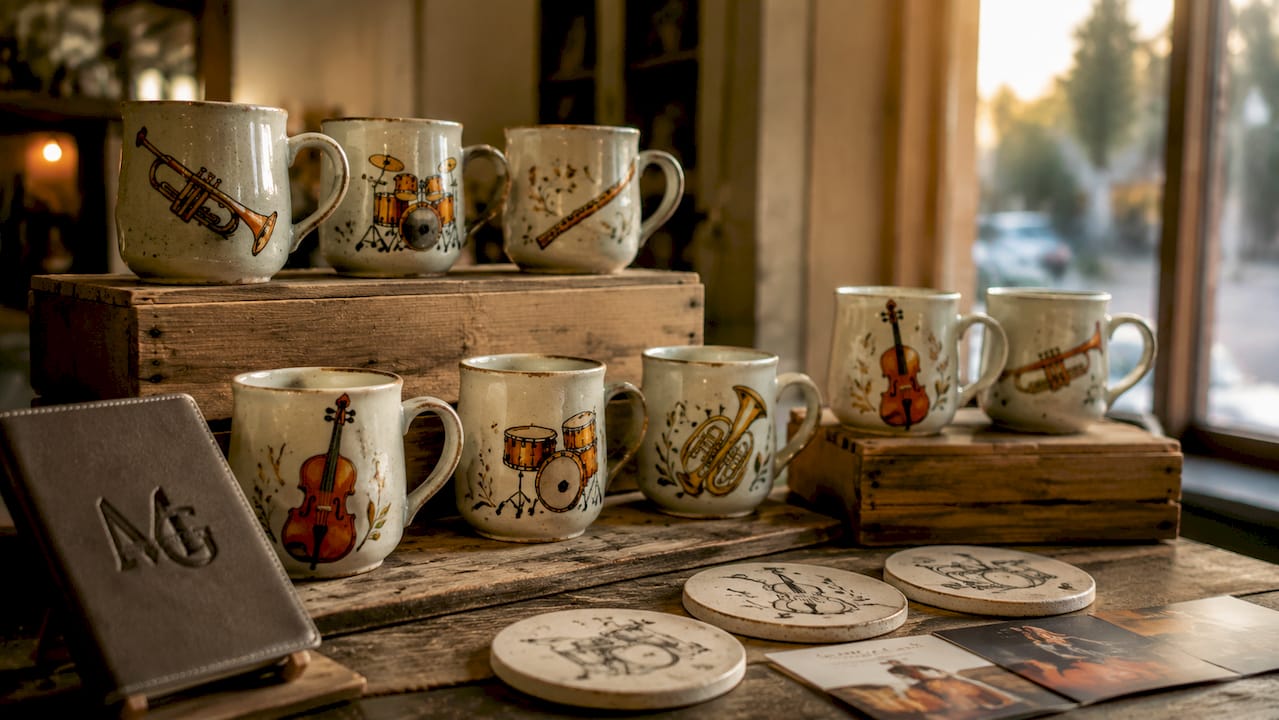
Acoustic guitar
The acoustic guitar is the most recognisable instrument in mug design. Its curved body wraps naturally around a cylindrical surface, and its strings translate beautifully into fine-line illustration. It suits both whimsical and classic styles.
- Visual strength: High. The silhouette is instantly readable even at small sizes.
- Design flexibility: Works as a full wrap, a centrepiece illustration, or a minimalist outline.
- Audience: Broad. Folk, rock, and country fans all connect with it.
Electric guitar
The electric guitar carries a bolder, more angular energy than its acoustic counterpart. Its body shapes, such as the Stratocaster or Les Paul outline, are iconic enough to work without any text at all.
- Visual strength: Very high. The shape alone signals a genre and attitude.
- Design flexibility: Excellent for modern, graphic, or humorous styles.
- Audience: Rock, metal, and pop musicians.
Piano or keyboard
The piano is the most architecturally complex instrument to render on a mug. A row of black and white keys wrapping around the circumference creates a striking, continuous pattern that rewards the viewer as they rotate the mug.
- Visual strength: High. The repeating key pattern is bold and geometric.
- Design flexibility: Works as a border, a full wrap, or a detail element.
- Audience: Classical musicians, jazz players, and music teachers.
Violin
The violin's elegant waist and f-holes make it one of the most visually refined instruments for mug art. It suits a sophisticated, classical aesthetic and pairs well with script typography.
- Visual strength: High. The shape is graceful and immediately recognisable.
- Design flexibility: Best as a centrepiece or paired with a bow.
- Audience: Orchestral musicians, music students, and classical enthusiasts.
Saxophone
The saxophone combines organic curves with mechanical detail, giving designers rich material to work with. Its brass colour translates well into warm-toned or monochrome illustrations.
- Visual strength: Very high. The silhouette is dramatic and distinctive.
- Design flexibility: Strong for jazz-themed or art deco inspired designs.
- Audience: Jazz and blues musicians.
Trumpet
The trumpet's bell and valves create a compact, punchy silhouette. It works particularly well in profile view and pairs naturally with jazz or big band themes.
- Visual strength: High. The flared bell draws the eye immediately.
- Design flexibility: Good for bold, graphic, or vintage poster styles.
- Audience: Jazz, brass band, and orchestral players.
Clarinet
The clarinet is a slender, vertical instrument that suits tall mug formats well. Its keys and barrel rings add fine detail that rewards close inspection.
- Visual strength: Moderate. Best when combined with other musical elements.
- Design flexibility: Works well in ensemble illustrations with other woodwind instruments.
- Audience: Orchestral and concert band musicians.
Drums and drum kit
A full drum kit is the most complex motif on this list. It rewards crafters who want a statement piece rather than a subtle accent. A single snare drum or hi-hat, however, works cleanly as a minimalist design.
- Visual strength: Very high for full kit; moderate for single elements.
- Design flexibility: Full kit suits humorous or bold styles; single elements suit minimalist designs.
- Audience: Drummers and percussionists.
Harp
The harp is an underused instrument in mug design, which makes it a strong choice for standing out. Its triangular frame and vertical strings create a naturally elegant composition.
- Visual strength: High. The shape is architectural and graceful.
- Design flexibility: Excellent for premium, gift-oriented designs.
- Audience: Orchestral harpists and classical music lovers.
Ukulele
The ukulele has grown significantly in popularity as a casual, cheerful instrument. Its small body and four strings make it ideal for playful, colourful mug designs.
- Visual strength: Moderate. The shape is charming rather than dramatic.
- Design flexibility: Best for whimsical, humorous, or gift styles.
- Audience: Hobbyists, beginners, and Hawaiian music fans.
Pro Tip: Combine two or three instruments in a single illustration to create an ensemble effect. A guitar, violin, and piano together on one mug appeals to music lovers who play multiple instruments or simply love the visual richness of a full band.
Essential equipment for mug printing and crafting
Essential tools for mug design include mug presses, convection ovens, high-resolution design software, and specialised pottery equipment such as turntables and moulds. The right combination depends on whether you are working with sublimation printing, vinyl transfers, or hand-thrown pottery. Each method produces a different result and requires a different investment.
-
Mug press. A mug press delivers consistent heat and pressure for sublimation transfers on standard cylindrical mugs. It is the fastest and most reliable option for flat-sided vessels. Mug press versus oven comparisons consistently show that presses win on consistency for standard shapes.
-
Convection oven. A convection oven suits irregular mug shapes that a press cannot grip evenly. It requires careful temperature and timing experimentation to avoid fading or ghosting on instrument details.
-
High-resolution design software. Vector-based programs such as Adobe Illustrator or Inkscape produce scalable instrument illustrations that resize without losing quality. Raster programs like Adobe Photoshop work well for painterly or textured designs.
-
Pottery turntable. A turntable is the foundation of wheel-thrown mug making. Hobbyists can start with budget-friendly manual turntables, while crafters scaling to professional selling need industrial electric wheels that handle sustained use.
-
Mug moulds. Slab-built mugs use moulds to achieve consistent shapes. Clay moisture management is critical here. Leaving a slab on a mould too long causes shrinkage and cracking, which destroys any surface design applied before firing.
-
Vinyl cutter. A vinyl cutter, such as a Cricut or Silhouette machine, cuts instrument outlines from adhesive vinyl for direct application to mug surfaces. This method suits crafters who want a tactile, raised design without sublimation printing.
-
Safety equipment. Pottery kilns reach temperatures that require heat-resistant gloves and eye protection. Sublimation printing releases fumes that need adequate ventilation. Neither step is optional.
Pro Tip: If you are starting out, a mug press and a vector design program cover 80% of use cases at a fraction of the cost of a full pottery setup. Scale up to pottery equipment only when demand justifies the investment.
Design techniques for printing instrument graphics on mugs
Print quality determines whether a guitar's strings look crisp or blurred after firing. 300 DPI is the minimum resolution for any instrument detail to survive the sublimation process cleanly. Lower resolutions cause fine lines, such as violin strings or clarinet keys, to merge into grey smudges.
Colour profiles matter as much as resolution. Use CMYK colour mode for sublimation printing, as RGB files shift colour significantly during the heat transfer process. Instrument illustrations in warm brass tones or deep mahogany browns are particularly vulnerable to this shift.
File format choices affect long-term flexibility. SVG and PNG files preserve transparency and scale without quality loss. Layered design files let you swap one instrument for another without rebuilding the entire composition. That single habit saves hours across a product range.
Key design considerations for curved mug surfaces:
- Handle clearance. Keep instrument details at least 1–2 inches away from the handle zone. Details placed too close distort during printing and become unreadable after firing.
- Wrap alignment. Designs that wrap fully around the mug must align precisely at the seam. A misaligned guitar neck or piano keyboard looks amateurish and reduces perceived value.
- Grayscale testing. Test every design in grayscale before printing. If the instrument details disappear, the contrast is insufficient for sublimation to render them clearly.
- Scalable compositions. Build instrument illustrations as modular elements. A guitar body, neck, and headstock as separate layers allow you to resize or reposition without distortion.
How to choose the right instrument for your mug design style
The instrument you choose should match both the design style and the intended recipient. A violin suits a premium gift mug with elegant typography. A drum kit suits a humorous mug with a bold caption. Matching motif to purpose is the fastest way to produce a design that feels intentional.
| Instrument | Design style | Visual impact | Best use case |
|---|---|---|---|
| Acoustic guitar | Classic, whimsical | High | Personal gifts, daily use mugs |
| Piano keys | Modern, geometric | Very high | Music teacher gifts, display pieces |
| Violin | Elegant, classical | High | Premium gifts, orchestral themes |
| Saxophone | Jazz, art deco | Very high | Niche gifts, collector pieces |
| Drum kit | Bold, humorous | Very high | Statement mugs, drummer gifts |
| Ukulele | Playful, colourful | Moderate | Casual gifts, beginner musicians |
| Harp | Refined, premium | High | Luxury gifts, classical enthusiasts |
Ceramic mugs suit detailed, multi-colour instrument illustrations because the surface holds ink well after firing. Pottery mugs with hand-applied designs benefit from simpler, bolder outlines that survive the glaze and kiln process. Digital print mugs on coated ceramic offer the sharpest results for fine-line instrument work, such as violin f-holes or clarinet key mechanisms.
For personalised gift mugs, the instrument choice becomes even more specific. A mug featuring the recipient's exact instrument, paired with their name, crosses from generic gift into something that feels commissioned. That specificity is what separates a memorable gift from a forgettable one.
Pro Tip: When designing for retail rather than personal gifts, choose instruments with the broadest audience recognition first. Guitars and pianos outsell niche instruments like harps or oboes. Build your core range around the familiar, then add specialist instruments as limited editions.
Key takeaways
The most effective instrument mug designs combine a visually strong motif, a 300 DPI print file, and a composition that respects the mug's curved geometry and handle zone.
| Point | Details |
|---|---|
| Instrument choice drives appeal | Match the instrument to the recipient's musical identity for maximum personal impact. |
| Resolution is non-negotiable | Use 300 DPI minimum to keep fine instrument details crisp after sublimation printing. |
| Handle clearance prevents distortion | Keep all critical design elements at least 1–2 inches from the handle zone. |
| Layered files save production time | Build instrument illustrations in separate layers to swap motifs without full redesign. |
| Equipment choice depends on scale | Start with a mug press for consistency; add pottery tools only when volume demands it. |
What I have learned from working with instrument mug designs
The guitar is always the safe choice. It sells, it photographs well, and almost everyone has a connection to it. But the most interesting mug designs I have seen come from crafters who went one step further and chose the instrument that actually belongs to the person receiving the mug.
A mug with a bassoon on it is a niche product. It is also the only mug that a bassoonist has ever seen made specifically for them. That specificity creates a reaction that a guitar mug simply cannot replicate. The lesson is that broad appeal and deep resonance are two different goals, and the best ranges serve both.
From a production standpoint, the single biggest mistake I see is ignoring the handle zone. Crafters spend hours perfecting an instrument illustration, then place the focal point directly behind the handle where it gets lost. Test your layout on a paper template wrapped around an actual mug before committing to a print run.
The instruments that translate best to mug sketching techniques are those with strong, clean silhouettes: guitars, violins, saxophones, and harps. Instruments with complex, symmetrical structures like organs or full drum kits require more compositional discipline to avoid visual clutter. Start with the silhouette, add one layer of detail, and stop before the design becomes busy.
Experiment with less common instruments. A cello, a French horn, or a banjo on a mug tells a story that a guitar cannot. The crafters who build loyal audiences are the ones who make musicians feel genuinely seen, not just catered to.
— Lasse
Music mugs made personal at Mugnificentdeals
Mugnificentdeals brings together a curated collection of music-themed mugs that go well beyond generic instrument prints. Each design is built around the idea that your mug should reflect your musical identity, whether you play violin, drum, or simply love the sound of a well-tuned piano.
The personalised music mug collection covers a wide range of instruments, from classic guitars to orchestral strings, with options to add names, captions, and personal touches that make each piece feel genuinely individual. For gift buyers, the best personalised music mugs selection takes the guesswork out of choosing. Browse the full range and find the instrument that speaks to the musician in your life.
FAQ
What instruments work best for mug designs?
Acoustic guitars, pianos, violins, and saxophones are the strongest choices because their silhouettes are instantly recognisable and translate clearly to curved ceramic surfaces. Collections featuring these instruments consistently attract the broadest audience.
What resolution do I need for mug printing?
300 DPI is the minimum resolution for instrument details to print cleanly via sublimation. Files below this threshold cause fine lines, such as strings or keys, to blur or merge after heat transfer.
Should I use a mug press or a convection oven?
A mug press suits standard cylindrical mugs and delivers consistent results with less experimentation. A convection oven handles irregular shapes but requires careful temperature and timing control to avoid print defects.
How do I avoid distortion around the mug handle?
Keep all critical instrument details at least 1–2 inches away from the handle zone. Testing your layout on a paper template wrapped around a physical mug before printing catches placement errors before they cost you materials.
What file format is best for instrument mug designs?
SVG and PNG formats preserve transparency and scale without quality loss. Layered files in either format let you swap instrument motifs quickly, which is particularly useful when building a range of designs around the same composition.