

Humour in music gifts is defined as the deliberate use of wit, wordplay, or shared comedy to transform a music-themed present into an emotionally resonant experience. Where a practical gift communicates utility, a humorous one communicates intimacy. It says, "I know you well enough to make you laugh." That distinction matters enormously in gifting, because the most memorable presents are rarely the most expensive. They are the ones that feel personal, specific, and alive with personality. Understanding the role of humor in music gifts means understanding why laughter is one of the most powerful social bonds we have.
How does humour enhance emotional connection in music gifts?
Shared laughter releases endorphins, accelerating social bonding and building trust between giver and recipient. This is not a soft, anecdotal claim. It is grounded in cognitive science, and it explains why a funny mug with a musician's inside joke can land harder than an expensive instrument accessory. The emotional charge of laughter makes the gift feel like a shared moment rather than a transaction.
Psychologists describe this through benign violation theory: humour works when teasing feels safe and affectionate rather than cutting. A gift that pokes fun at a drummer's tendency to speed up, or a guitarist's obsession with tone, signals deep familiarity. It says, "I have paid attention to you." That signal is far more powerful than any price tag.

Humorous gifts also act as emotional anchors, embedding memories that attach strongly to the physical object. Every time the recipient uses the gift, the original moment of laughter resurfaces. This is why funny music presents tend to be kept and displayed rather than quietly donated.
The contrast with purely practical or sentimental gifts is stark. A generic music stand is useful. A mug printed with "I don't make mistakes, I improvise" is useful and identity-affirming. The second gift does double duty.
Pro Tip: When selecting a humorous music gift, aim for a joke that references a specific behaviour or quirk of the recipient's musical life. Generic music puns are forgettable. Specific ones become legendary.
- Humorous gifts communicate familiarity, not just goodwill.
- Laughter triggers endorphins, making the gifting moment physically memorable.
- Benign violation theory explains why affectionate teasing works better than neutral humour.
- Emotional anchoring means funny gifts are revisited and cherished long after the occasion.
Why does British humour make music gifts so effective?
British gifting culture has a distinct personality. Sarcasm, understatement, and playful insults are not signs of rudeness here. They are signals of affection. A gift that teases a violinist about their obsessive tuning, or mocks a pianist's inability to stop practising scales, reads as a warm hug in British social context. This cultural nuance is what makes humorous music gifts particularly well-suited to UK gift buyers.
British dry wit functions as an intimacy signal, not just a joke. When a gift carries that tone, it communicates that the giver and recipient share a private understanding. That shared understanding is the real gift. The physical object is simply its vessel.
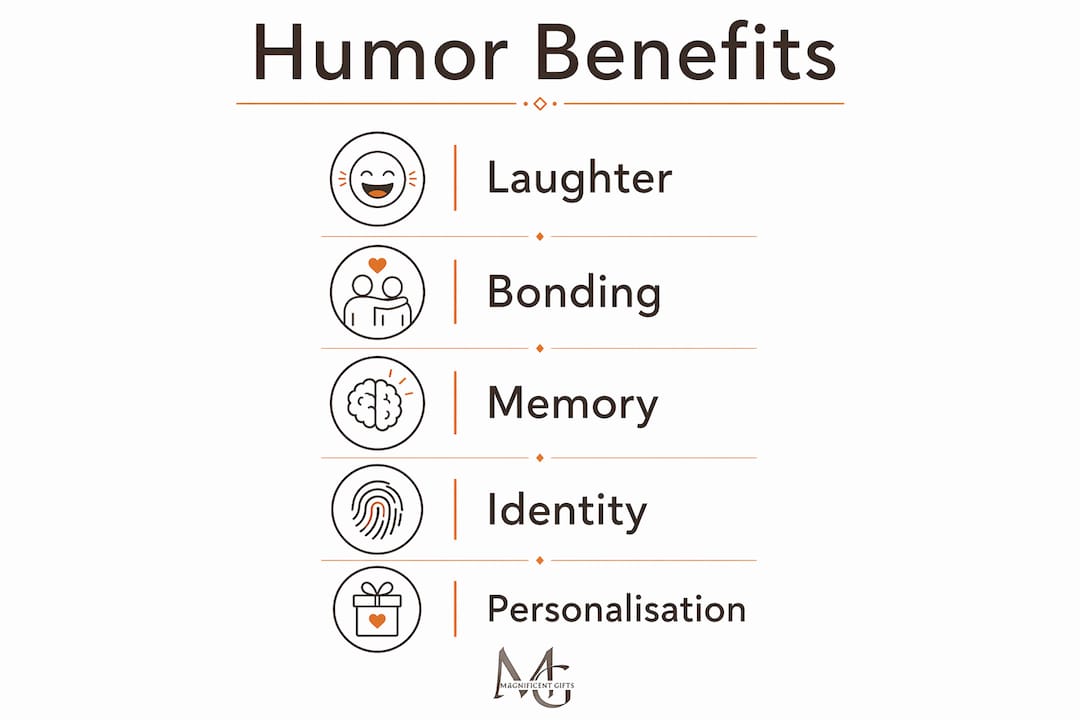
Humour also softens the emotional weight of gifting. Many British gift buyers feel uncomfortable with overtly sentimental presents. A funny music gift sidesteps that awkwardness entirely. It delivers genuine warmth without requiring anyone to be earnest about it.
Key traits of British humour that translate well into music gifts include:
- Understatement: "Reasonably competent guitarist" printed on a mug for someone who has played for twenty years.
- Dry wit: Deadpan observations about music practice that every musician recognises immediately.
- Affectionate teasing: References to a musician's specific habits, obsessions, or instrument-related quirks.
- Self-awareness: Humour that acknowledges the absurdity of musical dedication without diminishing it.
Cheeky gifts are perceived as affectionate rather than offensive when they are grounded in genuine knowledge of the recipient. The line between funny and tone-deaf is drawn by personalisation, not by the joke itself.
Why do inside jokes make humorous music gifts more powerful?
Personalised gifts produce higher gratitude and retain long-term emotional value better than generic alternatives. The reason is perceived effort. When a recipient sees that a giver has thought specifically about them, the gift feels commissioned rather than purchased. That perception transforms its emotional weight entirely.
Inside jokes take this further. An inside joke embedded in a music gift does not just personalise the object. It creates a private language between two people. A mug referencing the time a band member forgot the key change, or a print quoting a musician's favourite self-deprecating phrase, becomes a keepsake that no one else could replicate. That exclusivity is its own form of value.
Humour compensates for psychological distance in gifting, with personalised playful gifts outperforming generic luxury items in emotional satisfaction. This finding matters for gift buyers who worry that a mug cannot compete with a more expensive present. It can, and often does, when the humour is specific and the personalisation is genuine.
Repeated use of humorous gifts creates 'mere exposure' familiarity, turning the object into an identity signal and conversation starter. A musician who uses a personalised mug every morning is reminded daily of the person who gave it to them. That is a form of emotional presence that expensive gifts rarely achieve.
Here is how to embed personal touches effectively in a humorous music gift:
- Reference a specific musical memory. A shared concert, a rehearsal disaster, or a running joke about a particular song all work well.
- Use the recipient's own words. A phrase they say constantly, printed on a gift, feels uncannily personal.
- Match the humour style to the recipient. A classically trained musician may prefer dry understatement. A rock guitarist may prefer something more irreverent.
- Pair the joke with utility. A funny mug, a witty print, or a humorous tote bag all combine laughter with daily function.
Pro Tip: Ask yourself whether the joke would make sense to a stranger. If it would, it is probably not personal enough. The best inside jokes require context that only the giver and recipient share.
For gift buyers exploring personalised music gift ideas, the combination of humour and specificity is the single most reliable formula for a gift that gets kept.
How do you choose the right humorous music gift?
Only 4% of British adults prefer funny gifts as their first choice, which means humour works best when paired with utility or genuine personalisation rather than deployed as a standalone strategy. That statistic does not diminish the power of funny music presents. It simply clarifies that the humour must serve the recipient, not the giver.
The 'Giver's Paradox' is a well-documented pattern in consumer psychology: givers often prioritise their own humour style over the recipient's preferences. The result is a gift that amuses the giver but misses the recipient entirely. Avoiding this requires deliberate, recipient-focused thinking.
Mindful gifting research confirms that thoughtfulness outperforms price in gift satisfaction. A £15 mug with a perfectly chosen joke will outlast a £60 generic music accessory in the recipient's memory and affection.
The table below outlines the main categories of humorous music gifts and what each does best.
| Gift type | Strengths | Best suited for |
|---|---|---|
| Personalised mug with music humour | Daily use, identity signal, inside joke vehicle | Any musician or music lover |
| Funny music print or poster | Visual display, conversation starter | Home studio owners, music teachers |
| Humorous music-themed tote bag | Practical, portable, public humour | Gigging musicians, students |
| Witty instrument-themed pin or badge | Low cost, collectible, subtle humour | Younger musicians, collectors |
| Music candle with a funny label | Sensory gift, music-themed gifting beyond the obvious | Partners, friends of musicians |
A gift that is too gimmicky fails without personalisation. Inside jokes or specific shared history are what separate a gift that gets a genuine laugh from one that gets a polite smile. When selecting from any of the categories above, always ask whether the humour connects to the recipient's specific musical identity. For deeper guidance on matching gifts to musicians, the advice on instrument-themed gift selection is worth reading before you buy.
Key takeaways
Humour in music gifts works because it combines emotional anchoring, identity reinforcement, and shared laughter into a single object that recipients use and remember daily.
| Point | Details |
|---|---|
| Humour creates emotional bonds | Shared laughter releases endorphins, making funny music gifts more memorable than practical ones. |
| British humour has a distinct gifting style | Dry wit and affectionate teasing signal intimacy, making cheeky music gifts feel warm rather than rude. |
| Personalisation multiplies impact | Inside jokes and recipient-specific references produce stronger gratitude and longer-lasting emotional value. |
| Utility extends the joke's life | Humorous gifts paired with daily function, such as mugs, are used repeatedly and become identity signals. |
| Recipient focus prevents misfires | Prioritising the recipient's humour style over the giver's own preferences is the single most important selection rule. |
Why I think most people underestimate the funny music gift
Most gift buyers treat humour as a fallback. They reach for a funny present when they cannot think of anything "proper." That framing gets it completely backwards. In my experience, the gifts that generate the strongest reactions are almost always the ones that made someone laugh first. The emotion of laughter is not trivial. It is one of the fastest routes to genuine connection.
What I have observed repeatedly is that the gifts people keep for years, the ones that end up on desks and in display cabinets, are rarely the expensive ones. They are the ones that felt seen. A mug that references a musician's specific obsession, or a print that quotes their own self-deprecating joke back at them, does something no luxury item can replicate. It proves that the giver was paying attention.
The common pitfall is confusing funny with generic. A pun about music that applies to every musician on the planet is not a personal gift. It is a mass-produced sentiment in disguise. The real power of humour in gifting comes from specificity. The more niche the joke, the more powerful the gift. That is a counterintuitive truth that most gift guides never bother to state plainly.
My honest advice: spend less time worrying about whether a gift is "impressive enough" and more time thinking about what would make this specific person laugh. Get that right, and the gift will be remembered long after more expensive presents have been forgotten.
— Lasse
Personalised music mugs: where humour meets daily ritual
Mugnificentdeals designs personalised music mugs that sit at the exact intersection of humour, identity, and everyday utility. Each mug is built around the idea that a great gift should make someone smile every morning, not just on the day they receive it.

The personalised music mugs collection includes designs ranging from dry, understated instrument humour to bold, musician-specific phrases that feel genuinely commissioned rather than mass-produced. For gift buyers who want something that lands with a laugh and stays on the desk for years, the best personalised music mugs for gifts range is the most direct route to a present that gets it right. Every design is built around the principle that the best funny music gift is the one that feels like it was made for one person specifically.
FAQ
What is the role of humor in music gifts?
Humour in music gifts creates emotional connection by combining shared laughter with identity-specific references. It transforms a functional object into a personal keepsake that recipients use and remember repeatedly.
Why do inside jokes make music gifts more effective?
Inside jokes make music gifts feel exclusive and personally commissioned rather than generic. Research shows personalised gifts produce higher gratitude and longer-lasting emotional value than standard alternatives.
How do I choose a funny music gift without missing the mark?
Prioritise the recipient's humour style over your own, and pair the joke with a useful object such as a mug or print. A gift that is too gimmicky without personalisation tends to earn a polite smile rather than a genuine laugh.
Does British humour change how music gifts are received?
British humour's dry wit and affectionate teasing are read as intimacy signals rather than rudeness. Cheeky music gifts land particularly well in UK gifting culture because they communicate warmth without requiring overt sentimentality.
Are funny music gifts suitable for all occasions?
Humorous music gifts work across most occasions when the humour is grounded in genuine knowledge of the recipient. Pairing the joke with utility, such as a personalised mug, makes the gift appropriate for birthdays, Christmas, and informal celebrations alike.