
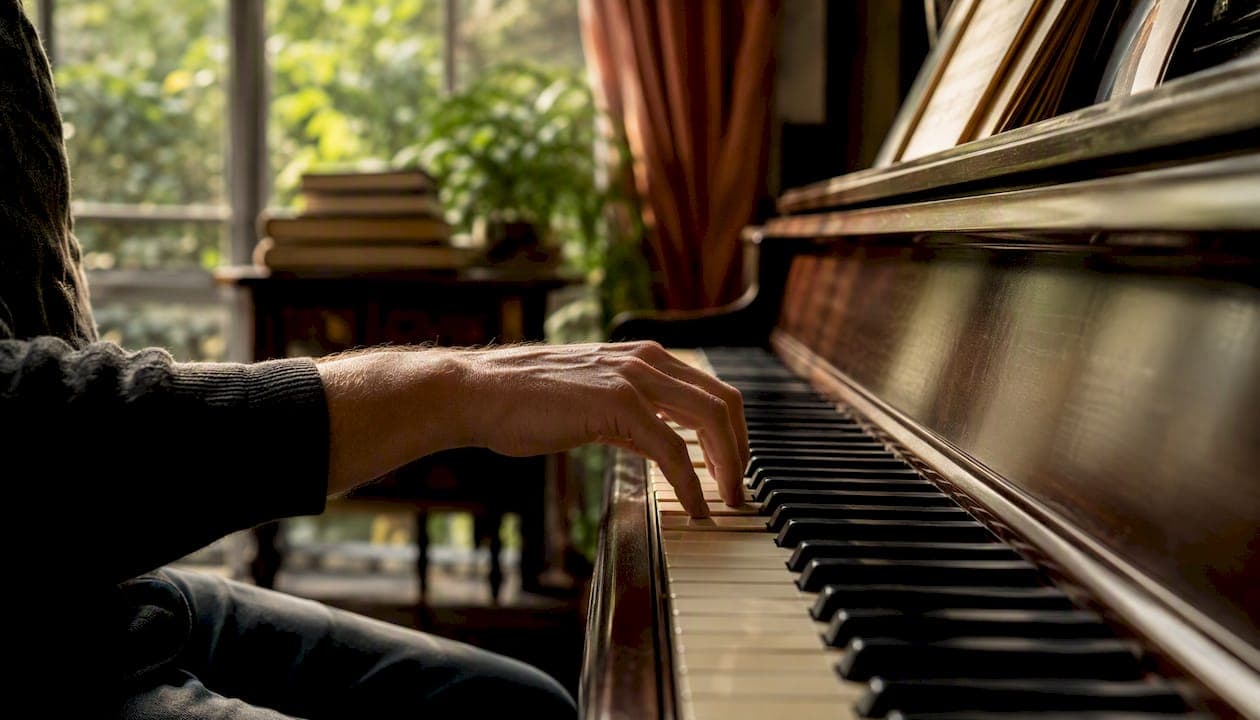
Yes, you can play piano with one hand. This is not a workaround or a consolation prize — it is a well-established musical tradition with a rich repertoire, dedicated pedagogy, and formal exam pathways in the UK. Yamaha's music education hub confirms that learning to play with one hand is possible across all ages and levels, and that teachers can use one-hand phases to sharpen articulation and keyboard geography in ways that two-hand practice sometimes obscures.
Three immediate next steps to get started:
- Try one simple piece today. "Ode to Joy" (right or left hand) or a simplified "Twinkle Twinkle Little Star" arrangement takes minutes to find and under ten minutes to attempt. The Skoove blog's one-hand piano pieces list is a practical starting point for beginner-friendly arrangements.
- Add one daily exercise. A five-finger warm-up pattern, played slowly with a metronome at 60 BPM, builds the muscle memory and reach control that one-hand repertoire demands.
- Find a graded score. IMSLP's indexed list of piano works for the left hand is free, searchable, and covers everything from simple teaching pieces to Ravel's concerto.
Key takeaways
Playing piano with one hand is musically valid, technically supported, and fully accessible within the UK's formal exam system, with a rich repertoire spanning beginner arrangements to Ravel's Concerto for the Left Hand.
| Point | Details |
|---|---|
| Start with a simple piece | "Ode to Joy" or a five-finger arrangement builds confidence and technique from day one. |
| Follow the 4–6 week plan | Daily warm-ups plus graded repertoire targets build reach, strength and musicality progressively. |
| Use IMSLP for free scores | The indexed left-hand and right-hand piano lists on IMSLP cover beginner to advanced repertoire at no cost. |
| Contact ABRSM for exam access | ABRSM offers one-hand repertoire lists and Access Arrangements for graded exams; apply before entering. |
| Teachers: learn the adapted piece | Demonstrating the adapted fingering and bench position yourself is the single most effective teaching tool. |
Table of Contents
- What can you actually play with one hand? A graded repertoire guide
- Essential technique for playing convincingly with one hand
- A 4–6 week practice plan to build reach, strength and musicality
- How to adapt two-hand music for one hand
- The performers and composers who built the one-hand repertoire
- Where to find sheet music, lessons and UK exam information
- Teacher and pedagogy insights: keeping students motivated and progressing
- How and when to reintroduce the other hand
- One hand is not half a performance
- Sources
What can you actually play with one hand? A graded repertoire guide
The range of music available for one-hand piano is broader than most players expect. Below is a curated list organised by level, with practical notes on why each piece works and where to find the score.
Beginner pieces (right or left hand)
- "Ode to Joy" (Beethoven, arr.) — The melody sits naturally in a five-finger position, making it ideal for a first week. Find free arrangements on IMSLP or via the Skoove blog. Use the sustain pedal lightly to connect phrases.
- "Twinkle Twinkle Little Star" (trad., arr.) — Repetitive structure means the hand learns position quickly. Useful for building thumb independence. Dozens of free one-hand arrangements exist online.
- "Lightly Row" (trad., arr.) — Stepwise motion with minimal leaps; excellent for practising smooth finger transitions. Available in most beginner method books adapted for one hand.
- "Für Elise" opening theme (Beethoven, arr.) — The famous opening motif can be arranged for one hand without losing its character. Focus on even tone between fingers 1 and 3.
- "Mary Had a Little Lamb" (trad., arr.) — Short phrases and predictable rhythm make this a confidence builder. Pair it with a simple left-hand bass if recovering the second hand later.
- Simple five-finger études (various) — Collections such as the Lotus Centre's Rainbow of Sound series offer graded one-hand method pieces specifically designed for stepwise progression.
Intermediate pieces
- Bach Prelude in C major (BWV 846, adapted) — The arpeggiated pattern translates well to a single hand with careful pedalling. The right hand alone captures the harmonic flow; use the sostenuto pedal to sustain bass notes.
- Chopin Nocturne Op. 9 No. 2 (melody only, arr.) — The singing right-hand line stands alone beautifully. Practise the ornaments slowly; wrist rotation is the key to the turns.
- Scriabin Prelude Op. 9 No. 1 for left hand — Written specifically for left hand alone; a genuine intermediate showpiece with a lyrical, expressive character.
- Brahms Chaconne (arr. for left hand) — Brahms arranged Bach's Chaconne for left hand alone as a study piece. Demanding but deeply rewarding for an intermediate-to-advanced student.
- "Clair de Lune" opening section (Debussy, arr.) — The opening theme in the right hand, with careful pedalling to sustain the implied harmony, is achievable at a solid intermediate level.
Advanced and canonical works
- Ravel Piano Concerto for the Left Hand in D major — Commissioned by Paul Wittgenstein after he lost his right arm in the First World War. The orchestral reduction for solo left hand is one of the most technically demanding works in the repertoire.
- Prokofiev Piano Sonata No. 6 (left-hand arrangement) — Prokofiev also wrote for Wittgenstein; the left-hand writing is characteristically percussive and rhythmically complex.
- Scriabin Prelude and Nocturne for the Left Hand, Op. 9 — Two contrasting pieces written when Scriabin temporarily lost use of his right hand. Both are on IMSLP and are frequently programmed in recitals.
- Britten Diversions for Piano (Left Hand) and Orchestra — Another Wittgenstein commission; the solo piano reduction is available through specialist publishers.
Score sources: IMSLP covers the public-domain works listed above at no cost. For contemporary arrangements and graded collections, specialist publishers such as Peters Edition and Faber Music carry one-hand editions. The YouTube playlist "One-Handed Piano Pieces" (search that phrase on YouTube) collects recordings and tutorial videos that double as listening references and learning aids.
Essential technique for playing convincingly with one hand
Good one-hand piano technique is not simply two-hand technique with one hand removed. Several physical and musical adjustments make the difference between playing that sounds thin and playing that sounds complete.
Seating and positioning
Shift the bench slightly towards the side of the playing hand so the arm can travel freely across the full keyboard without twisting the spine. For left-hand-only playing, sitting slightly left of centre gives the arm a natural arc from bass to treble. This single adjustment reduces fatigue and prevents the shoulder tension that causes overuse injuries.
Fingering strategies
Re-finger passages specifically for one-hand use rather than adapting two-hand fingering. The thumb carries far more melodic responsibility in one-hand playing — particularly in left-hand repertoire where the thumb often takes the upper voice. Practise thumb legato exercises separately: play a scale using only the thumb, focusing on even tone and smooth lateral movement across the keys.
For reach, use wrist rotation rather than stretching the fingers apart. A gentle rotation towards the little finger extends reach by roughly a semitone without straining the tendons. Instrument Insight's guide to one-hand piano highlights octave displacement and arpeggiation as practical strategies when a chord is too wide to play simultaneously.
Pedal use
The damper pedal becomes a second hand in one-hand playing. Use it to sustain bass notes while the hand moves to the treble, creating the illusion of two independent voices. The sostenuto pedal (the middle pedal on most upright and grand pianos) can hold a single bass note or chord while the hand plays freely above — a technique central to the Ravel Concerto and Scriabin Op. 9. Change the damper pedal on the beat rather than after it to avoid blurring harmonies.
Pro Tip: When teaching a one-hand student, learn and demonstrate the adapted piece yourself before the lesson. OHMI Trust's case study on one-hand learners recommends that teachers actively model the adapted fingering and bench position — it produces clearer demonstrations and builds the student's confidence far more effectively than verbal instruction alone.
The Lotus Centre's research-to-practice guide also notes that dropping doubled notes and re-fingering for reach are the two most repeatable adaptations teachers apply across different students and repertoire.
A 4–6 week practice plan to build reach, strength and musicality
A structured plan prevents the common trap of practising the same passage repeatedly without progress. The schedule below assumes 20–30 minutes of daily practice; adjust the minutes column to your availability.
Daily warm-up exercises (5 minutes every session)
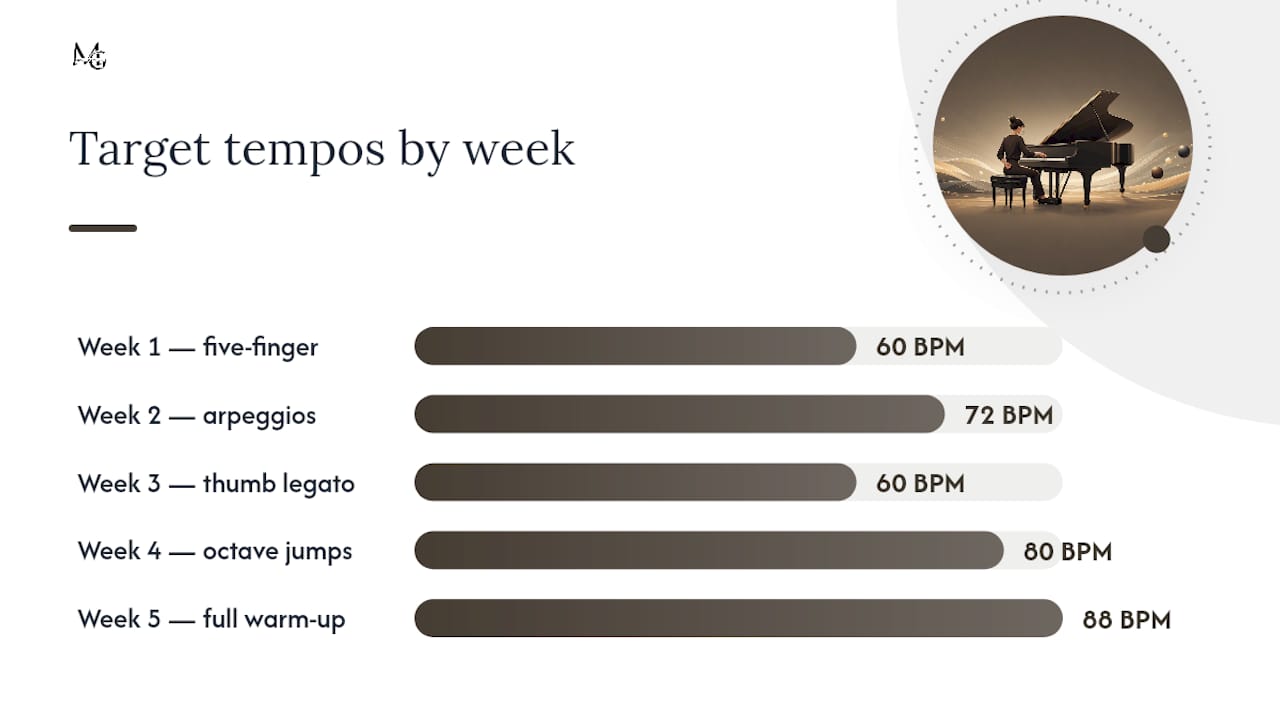
- Five-finger pattern — Play C–D–E–F–G and back, slowly (60 BPM), focusing on even tone. Repeat in every key.
- Arpeggio reach drill — Play broken chords (C–E–G–C) across two octaves, using wrist rotation on the wider intervals.
- Thumb legato exercise — Play a five-note scale using only the thumb, aiming for connected, even tone.
- Octave jumps — From middle C, jump to the octave above and back, landing cleanly without tension. Increase speed gradually over the weeks.
Weekly schedule
| Week | Daily focus | Target tempo | Goal |
|---|---|---|---|
| 1 | Five-finger patterns + one beginner piece | 60 BPM | Clean finger independence; learn the piece hands-separately |
| 2 | Arpeggio drills + beginner piece polished | 72 BPM | Smooth arpeggios; perform the beginner piece from memory |
| 3 | Thumb legato + introduce intermediate piece | 60 BPM | Even thumb tone; sight-read the first page of the intermediate piece |
| 4 | Octave jumps + intermediate piece sections | 80 BPM | Confident leaps; hands-free performance of first section |
| 5 | Full warm-up routine + intermediate piece complete | 88 BPM | Expressive dynamics; add pedalling throughout |
| 6 | Sight-reading new one-hand pieces + review | Varied | Musical fluency; introduce a second intermediate or early advanced piece |
Sight-reading one new short piece per week, even imperfectly, builds keyboard geography faster than repeating familiar repertoire. Set a metronome, read through once without stopping, then note the two or three passages that need attention.
How to adapt two-hand music for one hand
Arranging a two-hand piece for one hand is a practical skill that opens up almost any repertoire. The process follows a clear priority order.
- Keep the melody intact. The melody is what listeners recognise and what gives the music its character. Never sacrifice it for the sake of including more harmony.
- Drop inner voices first. In a four-voice texture, remove the alto and tenor lines before touching the soprano or bass. The outer voices carry the harmonic skeleton.
- Use octave displacement. If a bass note and a melody note cannot be played simultaneously, move the bass note down an octave and sustain it with the damper pedal while the hand moves to the melody. This is the central technique in most one-hand arrangements.
- Arpeggiate wide chords. A chord spanning more than an octave can be broken (arpeggiated) from bottom to top, with the pedal catching the lower notes. This is standard practice in the Ravel Concerto and Scriabin Op. 9.
- Preserve musical intent. Simplification should serve the music, not just make it easier. If a passage loses its character entirely when reduced, consider transposing it to a register where the hand can manage it more naturally.
A short example: Take a two-bar passage in C major with a right-hand melody (E–D–C) and a left-hand bass (C–G–C). For one hand, play the bass C as a low octave, sustain it with the pedal, then move the hand up to play E–D–C as the melody. The pedal bridges the gap. This two-step pattern (bass note, pedal down, move to melody) is the foundation of most beginner one-hand arrangements.
Useful tools for arranging:
- IMSLP — source scores for public-domain works you want to adapt.
- MuseScore — free notation software where you can paste a two-hand score, delete one staff, and edit the remaining line for one-hand playability. The playback function lets you hear the arrangement before committing to it.
- DAW transpose features — if you use a digital audio workstation or a keyboard with a transpose function, you can audition a passage in a different register to find the most comfortable hand position before writing it out.
The performers and composers who built the one-hand repertoire
The one-hand piano tradition has a specific, fascinating origin point. Paul Wittgenstein, the Austrian-British pianist and brother of philosopher Ludwig Wittgenstein, lost his right arm during the First World War. Rather than abandoning his career, he commissioned new works from the leading composers of the day — and in doing so created the core of the advanced one-hand repertoire.
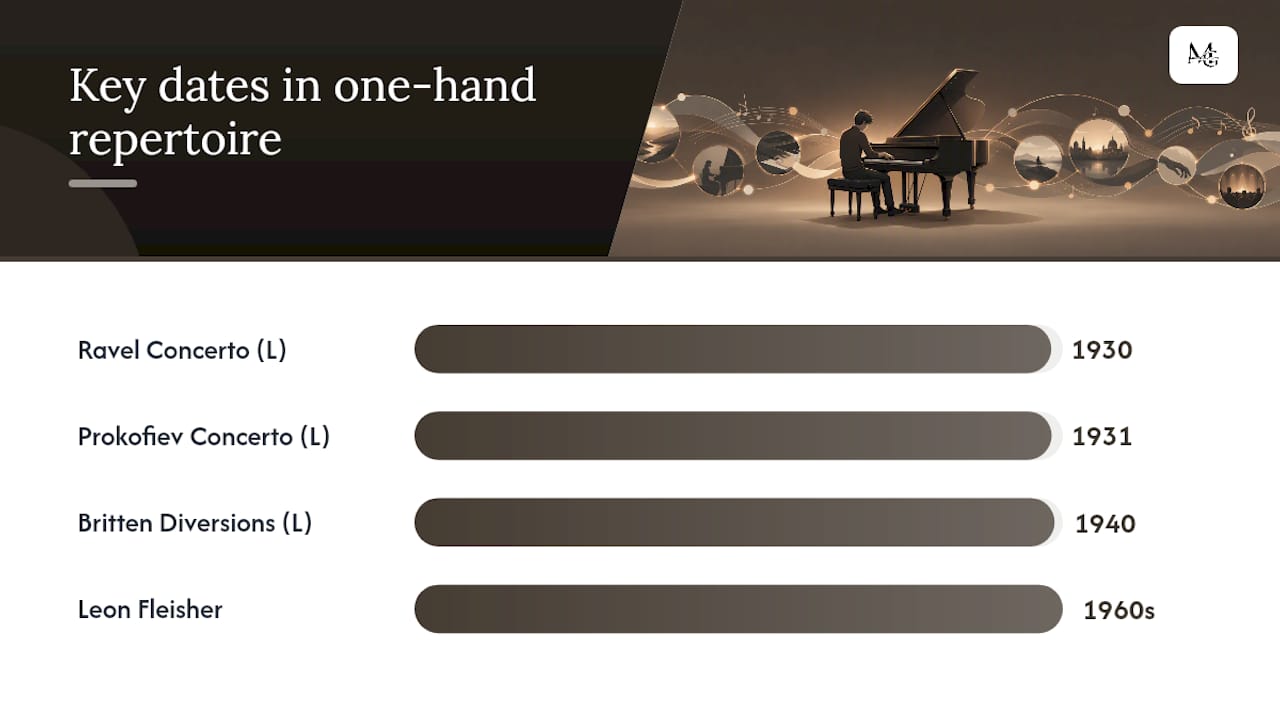
- Maurice Ravel's Piano Concerto for the Left Hand in D major (1930) — Wittgenstein's most celebrated commission. Ravel wrote a single-movement work of orchestral scale, with the left hand covering bass, melody, and inner voices simultaneously. It remains the benchmark of advanced left-hand writing.
- Sergei Prokofiev's Piano Concerto No. 4 for the Left Hand (1931) — Also commissioned by Wittgenstein, though he reportedly disliked it and never performed it publicly. It received its premiere only in 1956.
- Benjamin Britten's Diversions for Piano (Left Hand) and Orchestra (1940) — A set of variations commissioned by Wittgenstein; the solo reduction is available through publishers and is occasionally programmed in UK recitals.
- Leon Fleisher — The American pianist lost the use of his right hand in the 1960s due to focal dystonia and spent decades performing and recording exclusively left-hand repertoire. His recordings of the Ravel Concerto and the Brahms-Bach Chaconne arrangement are essential listening. Fleisher eventually regained partial use of his right hand through Botox treatment, but his advocacy for one-hand repertoire shaped the modern understanding of the tradition.
- Modern advocates — Several contemporary pianists, including Nicholas McCarthy (the first one-handed pianist to graduate from the Royal College of Music in London), have expanded the repertoire and raised its profile in the UK. McCarthy's recordings and public performances have done much to normalise one-hand piano at a professional level.
For listening and learning, search "One-Handed Piano Pieces" as a playlist term on YouTube. You will find recordings of the Ravel Concerto, Scriabin Op. 9, and a range of beginner-to-intermediate arrangements with tutorial commentary.
Where to find sheet music, lessons and UK exam information
Score sources
- IMSLP — The largest free repository of public-domain sheet music. The dedicated left-hand piano list is searchable by composer and difficulty. Right-hand-alone works are indexed separately.
- Lotus Centre for Special Music Education — Publishes graded one-hand collections including the Rainbow of Sound series, designed specifically for students with limb differences or injuries.
Finding a teacher in the UK
Specialist one-hand piano teachers are rare but findable. The OHMI Trust (One-Handed Musical Instrument Trust) maintains resources and contacts for musicians with limb differences and can point you towards teachers experienced in adapted technique. The Incorporated Society of Musicians (ISM) directory allows filtering by specialism. Online platforms such as Lessonface and Superprof list teachers who offer one-hand or adaptive piano tuition.
ABRSM exams and accommodations
The ABRSM (Associated Board of the Royal Schools of Music) has made significant progress on one-hand piano access. In a widely reported case, a UK teenager passed Grade 8 using only the left hand, and ABRSM subsequently expanded its dedicated one-hand repertoire lists to cover higher grades. This development means that candidates at all levels can now find appropriate repertoire within the official syllabus.
To request exam accommodations, contact ABRSM directly through their Access Arrangements process before entering for an exam. The board considers requests for adapted repertoire lists, extended preparation time, and modified performance conditions. Their website lists the current one-hand syllabus options; for 2025–2026 exams, check the ABRSM website directly for the most current repertoire lists, as these are updated periodically.
Teacher and pedagogy insights: keeping students motivated and progressing
Teaching a one-hand student well requires a different mindset as much as a different technique. The risk of demoralisation is real, particularly for students recovering from injury who are used to playing with two hands.
Colourful Keys' guide to teaching injured students is direct on this point: avoid repetitive technical drills as the primary activity. Students who spend most of their lesson time on mechanical exercises lose motivation quickly. Instead, give clear, realistic musical assignments with expressive goals — "play this phrase so it sounds like a question" is more motivating than "repeat bars 1–4 ten times."
- Set short, achievable targets. A student who finishes a lesson having learned eight bars of a recognisable piece feels progress. One who has only done scales does not.
- Learn the adapted piece yourself. The OHMI Trust's case studies are consistent on this: teachers who learn and demonstrate the adapted fingering and bench position give far clearer guidance than those who instruct verbally. It also signals to the student that the teacher takes the repertoire seriously.
- Use duet pathways. A teacher playing the bass or accompaniment while the student plays the melody keeps the music sounding full and maintains ensemble skills. Duet arrangements for one-hand student and two-hand teacher are available through specialist publishers. The Secret Garden piano and violin duet guide is one example of how ensemble playing can be maintained even when one player's range is limited.
- Assign non-playing tasks during recovery. Score study, listening analysis, and rhythm clapping keep the musical mind active when the hand cannot play. These tasks also build musicianship that transfers directly back to playing.
- Adjust the bench and posture at every lesson. Bench placement shifts as students grow or as the playing hand changes. Check it at the start of each session rather than assuming last week's position still works.
- Celebrate milestones explicitly. A student who completes a piece, passes an exam, or masters a difficult passage deserves recognition. Small, thoughtful gestures — a personalised music-themed gift for a student who passes their ABRSM exam, for instance — reinforce that progress is real and worth marking.
How and when to reintroduce the other hand
Not every one-hand pianist is working towards two-hand playing, but for those who are — whether recovering from injury or building coordination after a period of one-hand study — the reintroduction needs to be gradual and deliberate.
Signs you are ready to reintroduce the other hand:
- The recovering hand has full, pain-free range of motion across the keyboard.
- A clinician (physiotherapist, hand specialist, or GP) has confirmed that playing is safe.
- The one-hand repertoire feels comfortable and musical, not effortful — this baseline strength makes coordination work easier.
A short progression plan:
- Stage 1 — Hands separately, same piece. Take a piece you already know with one hand and learn the other hand's part separately, at a slow tempo (50–60 BPM). Do not combine them yet.
- Stage 2 — Simple coordination drills. Play a single bar with both hands together, very slowly. Focus on rhythmic alignment rather than tone or dynamics. Use a metronome.
- Stage 3 — Short passages, hands together. Extend to four bars, then eight, adding tempo gradually. Return to hands-separately practice whenever coordination breaks down.
- Stage 4 — Full two-hand repertoire. Choose a new, simpler piece to learn from scratch with both hands rather than forcing the old one-hand piece into a two-hand arrangement.
A note on pacing: overuse injuries are the most common setback at this stage. Keep sessions short (15–20 minutes maximum initially), take breaks every 10 minutes, and stop immediately if there is any pain or tension. Progress measured in weeks is sustainable; progress forced in days often is not.
One hand is not half a performance
There is a tendency, even among experienced musicians, to treat one-hand piano as a lesser form of the art. The repertoire argues otherwise. Ravel's Concerto for the Left Hand is not a simplified version of a two-hand concerto — it is a complete, demanding, and deeply expressive work that happens to use one hand. Scriabin wrote his Op. 9 pieces not as exercises but as concert music. Wittgenstein performed them on the world's great stages.
For students and teachers navigating injury, limb difference, or simply a period of one-hand study, the musical possibilities are genuinely wide. The practical resources are there: IMSLP's free scores, ABRSM's expanding one-hand syllabus, the OHMI Trust's teacher guidance, and a growing body of tutorial content online. The tradition is serious, the pedagogy is established, and the music is worth playing for its own sake.
At Mugnificentdeals, music is at the heart of everything — from the instrument illustrations on the mugs to the belief that every musician's story deserves to be celebrated, whatever form their playing takes.

Marking a milestone in one-hand piano — a passed exam, a first performance, a piece finally mastered — deserves something that lasts beyond the moment. Mugnificentdeals' personalised music mugs are designed for exactly this: a custom illustration, a name, a quote that means something. Whether you are a teacher looking for a thoughtful end-of-term gift or a student treating yourself after a hard-won achievement, a personalised mug from Mugnificentdeals turns a quiet moment of pride into something you can hold in your hands every morning.
Sources
- One Arm Will Do on the Piano - Yamaha Music
- One-Hand Piano: Teaching Injured Students – Colourful Keys
- Introducing OHMI’s latest Music-Maker The story of Roshan
- List of piano works for the left hand — IMSLP
- Research to Practice: One Hand and a Piano - Lotus Centre for Special Music Education
- Can you play piano with one hand? - Instrument Insight