
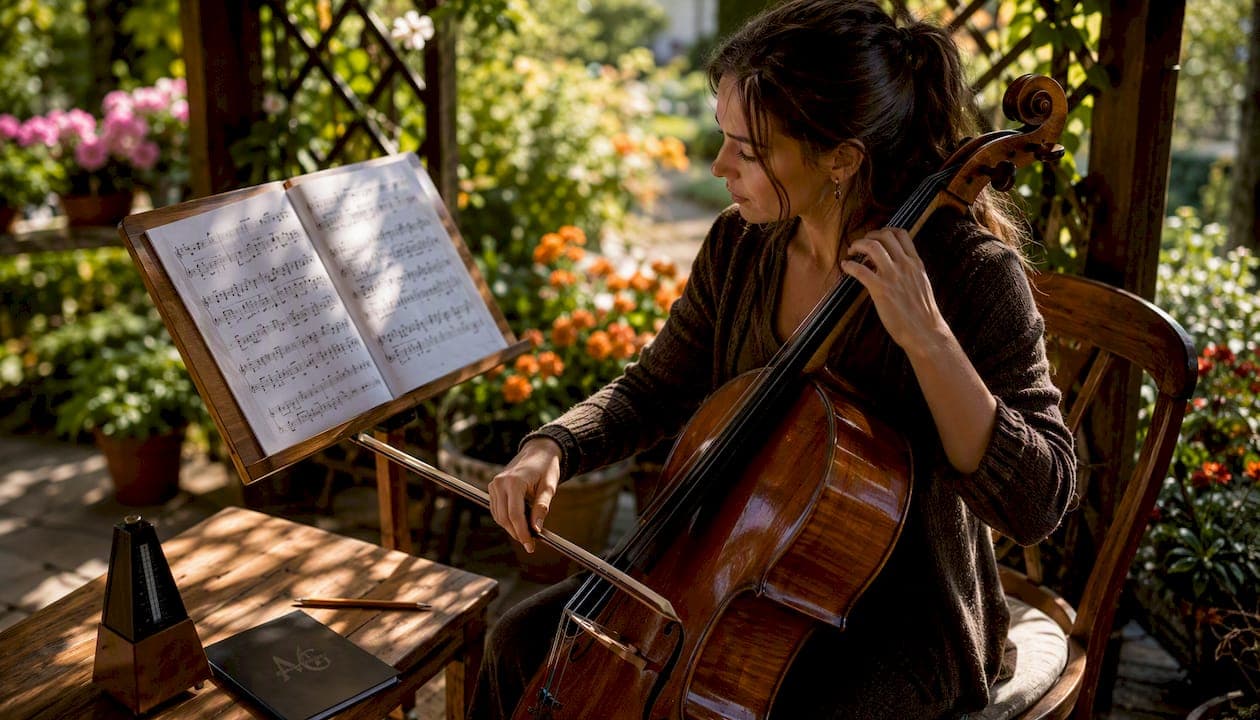
William Henry Squire's Tarantella, Op.23 sits at ABRSM Grade 7 and is widely regarded as one of the most rewarding intermediate showpieces in the cello repertoire. Here is what you need to know before you open the score:
- Where to get the score: Free scans and community uploads are available on IMSLP and MuseScore. For exam or recital use, print editions published by Stainer & Bell and Carl Fischer are the standard UK commercial choices.
- Difficulty: Intermediate, commonly aligned with ABRSM Grade 7. The piece sounds harder than it plays, largely because Squire wrote idiomatically for the instrument.
- Top practice priority: Isolate shifting passages and fast left-hand coordination drills before attempting any full-tempo run-throughs. Cementing errors at speed is the single most common setback with this piece.
Table of Contents
- Where can you find reliable sheet music for the Squire Tarantella?
- What is Squire's Tarantella, Op.23?
- How do you tackle the hardest technical passages?
- How do you shape a musical, confident performance?
- Which edition or arrangement should you choose?
- How should you use recordings in your practice?
- Key takeaways
- A teacher's perspective on tackling the Tarantella
- Celebrate the milestone
- Useful sources
Where can you find reliable sheet music for the Squire Tarantella?
The score is available through several routes, each with different trade-offs in terms of editorial quality and cost.
| Source | Format | Cost | Best for |
|---|---|---|---|
| IMSLP | PDF scan (public domain) | Free | Quick access; verify edition before printing |
| MuseScore | Community transcription | Free | Sight-reading reference; check for notation errors |
| Stainer & Bell | Print, cello and piano | Paid | Exam and recital use; clean editorial markings |
| Carl Fischer | Print, cello and piano | Paid | Historical standard edition; widely available |
| C. Harvey Publications | Practice edition (PDF/print) | Paid | Study use; includes preparatory exercises and performance copy |
IMSLP hosts the Tarantella, Op.23) under public domain, with the first publication dating to around 1896. The scans are generally clean, but edition variations do exist, so check clef usage and any optional treble-clef passages before committing to a print run.
MuseScore uploads are community-created and occasionally contain transcription errors or simplified fingerings. They work well as a first look, but cross-reference against a commercial edition before an exam.
For exam preparation, a Stainer & Bell or Carl Fischer edition gives you editorially verified fingerings and bowing markings. The C. Harvey Publications practice edition goes further, bundling preparatory exercises, a duet part, and a clean performance copy in one volume.
Pro Tip: Download the IMSLP scan first to confirm the key, metre, and approximate length. Then purchase a practice edition for study and keep a clean performance copy for the recital.
What is Squire's Tarantella, Op.23?
William Henry Squire (1871–1963) was a British cellist and composer who also served as an ABRSM adjudicator. That background explains why his short works map so neatly onto graded syllabi: Squire understood exactly what examiners and teachers needed, and he wrote accordingly.
The Tarantella, Op.23 is set in D minor and written in a fast 6/8 metre, capturing the breathless, spinning energy of the Southern Italian tarantella dance. A typical performance runs a few minutes at tempo, making it a compact but high-impact recital piece. The fast compound metre drives the piece forward almost relentlessly, with recurring semiquaver figures that demand both left-hand agility and consistent bow control.
Its place in the teaching repertoire is well established. Squire's works appear across Suzuki volumes, ABRSM lists, and pedagogy compilations, and the Tarantella specifically is frequently cited as Grade 7 repertoire. For an intermediate cellist, it functions as a genuine showpiece: technically demanding enough to stretch technique, yet musical enough to hold an audience's attention.
How do you tackle the hardest technical passages?
The Tarantella has four distinct technical hotspots, and each one responds to a different type of drill.
The main challenges:
- Rapid shifts across positions, particularly in the semiquaver runs
- Fast left-hand coordination requiring clean finger placement at tempo
- Long slurred phrases alternating with detached bowing, demanding bow-arm flexibility
- String crossings within fast passages
- Double-stops near the end, sometimes with optional thumb-position work
A step-by-step practice plan
- Identify the three hardest bars. Mark them in pencil before your first full read-through. These become your daily micro-practice targets.
- Run isolated shifting drills. Practise each shift in the piece as a standalone two-note exercise: departure note, shift, arrival note. Slow the metronome to a tempo where the arrival pitch is clean every time.
- Apply rhythmic augmentation. Take any fast semiquaver motif and practise it as dotted rhythms, then straight, then triplet subdivisions. This locks in finger placement without tempo pressure, a technique Cassia Harvey recommends specifically for this piece.
- Loop short segments. Work in four-bar units. Repeat each unit five times cleanly at a slow tempo before moving on. Never increase the metronome until five consecutive clean repetitions are achieved.
- Targeted string-crossing etudes. Practise the string-crossing figures from the piece as open-string exercises first, focusing on bow-arm economy.
- Compound rhythm practice. Once individual segments are secure, link two adjacent units together. Gradually extend the chain until you can play through a full section without stopping.
- Full run-throughs last. Only attempt a full-tempo run once individual sections are secure. Repeating full-speed errors consolidates mistakes rather than fixing them.
A practical weekly structure might involve several days of targeted drill work on the hardest passages, some days of section-linking at moderate tempo, and a day of a musical run-through at less than target tempo. Keep sessions short and focused rather than long and unfocused.
Carolyn Hagler notes that the piece is designed to be enjoyable rather than purely technical, which makes it particularly well suited to adult learners who need motivation alongside challenge. Building finger-pattern fluency first, before chasing tempo, is the approach both Harvey and Hagler advocate.
Pro Tip: Check the edition notes on the double-stops near the end. Many study editions simplify these using adjacent open strings or barred positions. Learn the simplified version first, then decide whether the full double-stop fingering is necessary for your performance context.
How do you shape a musical, confident performance?
Technical control is the foundation, but the Tarantella rewards players who commit to its character. The dance origin matters: the 6/8 pulse should feel propulsive, not mechanical.
Phrasing and dynamics are your primary tools. Shape the recurring semiquaver figures with a slight lean into the first beat of each bar, and use dynamic contrast between repeated phrases rather than playing every repetition at the same volume. A sudden piano before a forte return creates exactly the kind of surprise that holds an audience.
Tempo choices require honesty. A common mistake is setting a target tempo from a professional recording and then practising at that speed too early. A more reliable approach: identify the tempo at which you can play the hardest passage cleanly, and set that as your current performance tempo. Increase it gradually using a metronome, in increments of two to four beats per minute.
When working with a pianist, balance is straightforward to manage. Keep your bow speed consistent and avoid pressing into the string to project over the piano. A slightly faster bow speed with lighter contact carries further than a heavy, slow bow. Discuss dynamic levels with your accompanist in the first rehearsal rather than leaving it to chance on the day.
Common pitfalls to avoid:
- Starting too fast in the first rehearsal and then struggling to slow down for drilling
- Neglecting articulation clarity at tempo, particularly in the detached bowing passages
- Arriving at the double-stop section unprepared because it comes near the end and gets less practice time
Which edition or arrangement should you choose?
The Tarantella exists in several formats, and the right choice depends on your purpose.
- Cello and piano (standard edition): The original format, available from Stainer & Bell and in historical Carl Fischer printings. Suitable for recitals and exams once the piece is learned.
- Practice edition with preparatory exercises: — The C. Harvey Publications version includes marked study notes, a duet practice part, and a clean performance copy. This is the most practical choice for the learning phase.
Before buying or printing any edition, check three things. First, confirm the clef usage: most editions keep the piece largely in bass clef, with only a few optional treble-clef measures. Second, check whether thumb position is marked as optional or required. Third, look for editorial fingerings: a well-marked edition saves significant lesson time.
The practical rule is simple: use a practice edition for study, and switch to a clean performance copy for the recital. Mixing the two creates confusion under pressure.
How should you use recordings in your practice?
Recordings are a study tool, not a template. The goal is to develop your own informed interpretation, not to copy someone else's.
The Naxos catalogue is a reliable starting point for finding professional recordings of Squire's works. Conservatoire recital recordings and commercial releases also surface regularly on streaming platforms. When you listen, focus on three things: the tempo the performer chooses for the opening, how they handle the articulation in the fast passages, and where they apply rubato.
A productive listening method: play a phrase from the recording, pause it, and sing the phrase back. Then play it on the cello at a slow tempo. This active engagement transfers interpretive ideas into muscle memory far more effectively than passive background listening.
Stream recordings for reference, but follow along with your score rather than listening away from the instrument. Mark any tempo or articulation choices that feel achievable and worth adopting. Avoid matching a professional's tempo until your technical work genuinely supports it.
Key takeaways
Squire's Tarantella, Op.23 is an ABRSM Grade 7 intermediate showpiece best learned through targeted drilling of shifts and left-hand agility before any full-tempo attempts.
| Point | Details |
|---|---|
| Locate a reliable score | Use IMSLP or MuseScore for quick access; choose a Stainer & Bell or C. Harvey practice edition for exam or recital use. |
| Confirm edition details | Check clef usage, editorial fingerings, and whether thumb position is marked optional before beginning study. |
| Prioritise targeted drills | Isolate shifting and fast left-hand passages using rhythmic augmentation before attempting full-tempo runs. |
| Use recordings actively | Follow the score while listening on Naxos or streaming platforms; mark tempo and articulation choices worth adopting. |
| Practise short and often | Daily focused sessions outperform infrequent long ones for building clean technique at tempo. |
A teacher's perspective on tackling the Tarantella
The Tarantella tends to get underestimated in the planning stage and overestimated in the first week of practice. Students hear the fast 6/8 and assume they need months of preparation. In reality, the piece is well within reach for a committed Grade 7 player who is willing to work methodically rather than impatiently.
What makes the difference is not raw speed but finger-pattern security. Squire wrote with the cello's natural geography in mind, so the shifts and string crossings fall where the hand wants to go. Once a student trusts that, the piece stops feeling like an obstacle and starts feeling like an opportunity.
The advice to use a practice edition during study and a clean copy for performance is not just administrative tidiness. Switching to a clean score in the final weeks before a recital removes the visual clutter of pencil markings and forces the player to rely on internalised knowledge rather than written reminders. That transition is itself a confidence-building exercise.
Set a realistic tempo goal for the end of each week, not the end of the month. Small, measurable progress keeps motivation intact. And when the piece finally comes together at performance tempo, it genuinely sounds impressive, which is exactly what Squire intended.
Celebrate the milestone
Finishing a piece like the Tarantella deserves more than a tick in a practice diary. If you are looking for a thoughtful way to mark the achievement, or to thank the teacher who guided you through it, Mugnificentdeals creates personalised music mugs with custom instrument illustrations, names, and music quotes. They are the kind of gift that sits on a desk and quietly says "you belong here" every morning.

For more ideas on celebrating musical milestones, the gift guide for music teachers is a good place to start.
Useful sources
- Tarantella, Op.23 (Squire, William Henry) on IMSLP — public domain score scans and publication history
- Free preparatory exercises for the Squire Tarantella — C. Harvey Publications blog — Cassia Harvey's drill recommendations and shifting exercises
- The Squire Tarantella for Cello Practice Edition — C. Harvey Publications — practice edition with preparatory exercises, duet part, and performance copy
- Tarantella for Cello by W. H. Squire — Cello Discovery — Carolyn Hagler's pedagogical commentary on the piece's design and suitability
- William Henry Squire's out-of-print works for cello and piano — academic analysis — analysis of Squire's role as ABRSM adjudicator and his works' place in syllabi
- Stainer & Bell / Carl Fischer edition listing on eBay UK — reference for standard commercial print editions available in the UK