
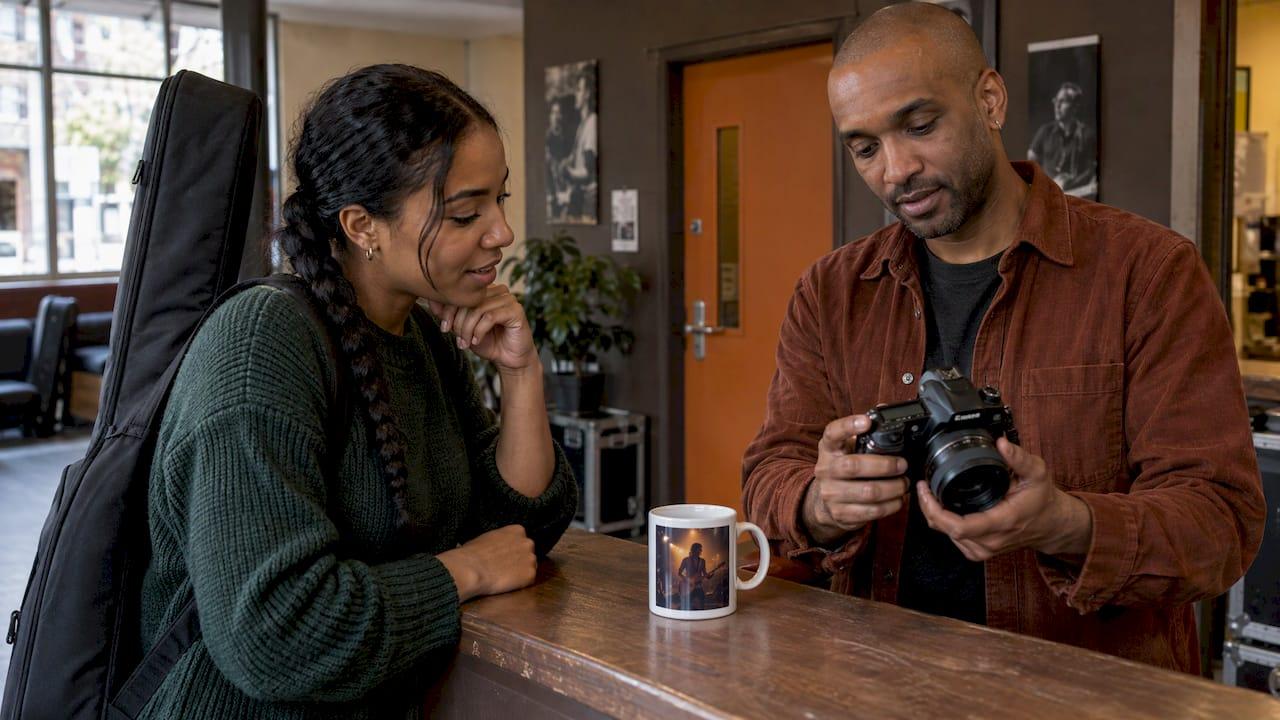
You can put your own photo on a mug without asking anyone. If someone else took the photo, you need their permission first, because the photographer usually owns the copyright. If the photo shows a person, that person's consent matters too. Below we explain how to check each point before you order, and how to do it with a music mug in mind.
TL;DR
- The person who pressed the shutter usually owns the copyright, whether they are a professional or used a phone, so a photo someone else took needs their permission.
- A photo from a website, social media or a search is almost certainly protected, so it is not free to print.
- Permission is best in writing, and it should cover mugs and the way you plan to use them.
- A photo of a recognisable person raises a second question: has that person agreed to it being used this way?
- Photos you took yourself, of your own band, pupils or pet, are the simplest route to a mug that is safe to order.
Table of Contents
- Who owns the copyright in a photograph?
- When you do not need anyone's permission
- Photos from the internet
- Checking a licence before you print
- Photos of people: a second layer of permission
- A gift for one person versus a product you sell or promote
- Private property and permission to photograph
- Other things that appear in your photo
- Moral rights: crediting the photographer
- Before you order: a checklist
- Perspective
- Choosing a photo mug for a musician
- FAQ
- Sources
Who owns the copyright in a photograph?
Copyright is the legal right to control who copies a creative work. In the UK it arises automatically when the work is created, with no registration. GOV.UK explains that photographs are generally protected as artistic works, so you usually need the owner's permission to copy one, and the creator is generally the first owner.
Three situations change that picture:
- Taken at work. If the photo was made in the course of a job, the employer generally owns it.
- Commissioned photos. DACS states that for a commissioned photograph the photographer owns the copyright unless it was assigned or sold to the person who commissioned it. So the wedding or band photos you paid for may not be yours to print.
- Older photos. For photographs taken between 1 July 1912 and 31 July 1989, DACS notes that the owner of the material, such as the negative, also owned the copyright. For later photographs, the photographer generally holds it for their life plus 70 years.
The BIPP Guide to Using Images, from a UK professional photographers' association, makes the same point plainly: whoever took the photograph usually owns the copyright, and printing it on mugs, t-shirts or mousemats counts as a use that needs permission.
A quick rule of thumb
Ask one question: who took this picture? If the answer is you, carry on. If it is a friend, a hired photographer, a venue or a website, you need their permission.
When you do not need anyone's permission
Some common cases are straightforward:
- You took it. A photo from your own phone or camera is yours to print, subject to the point about people below.
- You own the copyright. GOV.UK says a transfer of copyright must be in a written agreement signed by the owner. Once you own it, you can use it as you like, while respecting the creator's moral rights.
- The owner has said yes. A friend who photographed your recital and agrees to a mug for a gift is giving you permission. A short message is useful evidence.
The exceptions that GOV.UK lists, such as private study or research, criticism and review, and teaching, are narrow. They do not stretch to printing a mug, and the official guidance says commercial use generally needs permission.
Photos from the internet
It is tempting to save a lovely concert shot and send it off. GOV.UK warns that most images online are likely to be protected. Safe use needs a specific licence, website terms that allow it, expired copyright or a permitted act. Some Creative Commons licences allow non-commercial use only.
For a gift mug, the practical advice is simple. Do not take a picture from a search result, a band's page or someone's social feed unless the owner has told you that you may print it. Ask them. Most photographers, including fans who shot the gig, are happy to say yes to a personal gift, and a yes in writing settles it.
Checking a licence before you print
Sometimes permission comes as a licence, which is a permission to use a work in set ways. GOV.UK notes that a licence may be limited to particular purposes, times or places, and that a limited licence needs a fresh one for a different use. Before you rely on one, read it for these points:
- Product. Does it cover printing on physical items such as mugs, or only digital use?
- Purpose. Is it for personal use, or for sale and promotion?
- Duration and place. Does it expire, and does it cover the UK?
- Number of owners. The BIPP guide says that where more than one rights-holder exists, permission is needed from each one.
- Form. Keep it in writing.
Artquest's licensing guide explains the same idea: a licence covers a specific use, over a specific period, for a specific purpose.
Photos of people: a second layer of permission
Many photo mugs show faces, such as a child with a first violin or a band on stage. Copyright from the photographer is one question. The person pictured is another.
Sprintlaw UK explains that using an identifiable image can involve the photographer's copyright permission, the consent of the person shown, and data protection rules, because a recognisable image may be personal data. For public or marketing use, it says written permission is often the safest approach.

There is no single UK law on image rights. Bristows, a UK law firm, notes that individuals rely on routes such as passing off, which applies only where goodwill, misrepresentation and damage are established. That is why the sensible approach is to treat consent as part of the job. A celebrity's face on a product is a clear example: Rocket Lawyer's UK guide says it needs the celebrity's or their agent's permission, not just the photographer's.
In practice for a gift
- A photo of the recipient, taken by you, given to them privately, is the simplest case.
- A photo of a group, such as an ensemble or a class, is best with a quick yes from those pictured.
- Photos of other people's children need a parent's agreement. For a music teacher, that means asking before putting any pupil's face on a mug, even a gift for them.
- A model release covers the person's likeness, but Sprintlaw's guide to model agreements points out that the photographer may still own the copyright, so check both sides.
A gift for one person versus a product you sell or promote
The rules on ownership are the same, but the risk is not. A private gift made from your own photo is low risk. If you plan to sell mugs, promote a studio, or print for a school fundraiser, you are using the image commercially. GOV.UK says commercial use generally needs permission and usually a higher fee. If you run a teaching business or a band shop, get a written licence that names mugs and sale.
The BIPP guide goes further for printers. It advises that a business printing customer-supplied photos should ask for written confirmation that the customer owns the copyright or has permission. It also says the legal responsibility for permission sits with the business using the image. That is why you may be asked to confirm your rights when you order a photo mug.
Private property and permission to photograph
Taking a picture somewhere with the owner's blessing, such as a rehearsal room, a venue or a church hall, does not by itself give you the right to reproduce someone else's photo. It also does not make you the owner of a photo someone else took there. The photographer holds the copyright, and the venue's permission to enter is a separate matter. If you took the photo yourself, you own it. If you are using a venue's own promotional shot, ask the venue.
Other things that appear in your photo
A photo can contain more than one protected work. A poster, a painting on the wall, sheet music or a logo in the background may belong to someone else. The official guidance says permission must come from all owners where an image has several rights-holders or embedded works. Keep your photo clean: crop busy backgrounds, and if your mug will carry lyrics or a quote alongside the picture, our guide to music quotes and copyright in the UK explains what you can print.

Moral rights: crediting the photographer
Photographers also hold moral rights, including the right to be named as the creator if they have asserted it. GOV.UK suggests that when in doubt, giving a sufficient acknowledgement is the safe course. On a gift mug, a small line of credit along the bottom edge, with the photographer's agreement, is a tidy way to do it.
Before you order: a checklist
- Find the photographer. Was it you, a friend, a professional or a website?
- Get a yes in writing. An email or message naming mugs is enough for a gift.
- Check the people. Ask those pictured, and parents for children.
- Check the background. Look for logos, artwork or posters that are not yours.
- Check the file. Practical quality matters too. Our guide to custom mug photo resolution covers sizes, placement and checks.
- Check the mug and the text. If words go next to the picture, see how text and photo mugs work together.
Perspective
We make personalised music mugs, and the best photo mugs we see begin with a photo the giver took themselves: the lesson-room snapshot, the first gig, the pet next to the cello.
Rights questions sound heavy, but they come down to knowing where the picture came from. Our view is that a mug is a small, personal object, and the more personal the source, the better it feels. A sketch of an instrument, a name and an inside joke say a great deal without borrowing anyone else's work.
That is why we focus on music themes, personalisation and careful print quality. Your own photo, with the right permission, turns an everyday mug into something a musician will reach for each morning.
Lasse
Choosing a photo mug for a musician
Once your permissions are clear, the fun part begins. Our best personalised photo mugs for music lovers collection is a good place to start. We make personalised music-themed ceramic mugs with custom instrument illustrations, music quotes, names, photos and gift messages, for musicians, teachers, students and music lovers.
If you would rather skip a photo altogether, our instrument sketches and name mugs are a good fit. Browse the personalised music mugs collection, or see the instrument sketch mugs for hand-drawn designs.
FAQ
Can I put a photo I found online on a mug?
Not unless the owner agrees. GOV.UK says most online images are likely to be protected by copyright, and commercial use generally needs permission. Ask the photographer, and keep the reply.
Who owns a photograph taken at a wedding or gig I paid for?
Usually the photographer, unless the rights were assigned to you in writing. DACS says that for commissioned work the photographer owns the copyright unless it was assigned or sold. Ask for permission to print mugs, or for a licence.
Is it legal to use someone's image without their permission in the UK?
There is no single UK image-rights law, so several rules can apply, including copyright, data protection and passing off. A recognisable person in a photo is best treated as needing their agreement, ideally in writing, and a parent's for a child.
Do I need permission to print my own photo?
Not for the copyright, because you own it. If other people are clearly shown, a quick yes from them is a good habit, especially for pupils or children.
Sources
- Using somebody else's intellectual property: Copyright (GOV.UK)
- Copyright notice: digital images, photographs and the internet (GOV.UK)
- Photographs (DACS)
- The BIPP Guide to Using Images
- Licensing (Artquest)
- Image Rights in the UK (Sprintlaw UK)
- Model Photo Agreements for UK (Sprintlaw UK)
- Who gave you permission to use my name and face? (Bristows)
- Image rights (Rocket Lawyer)