
Tenor clef is the C clef with middle C placed on the fourth line of the staff, and yes, every serious trombonist needs to read it fluently. Treat it as a register marker that tells you the music sits in the tenor tessitura, not merely as a device to avoid ledger lines.
- Do: build direct reading fluency by naming notes relative to the fourth line and singing before you play.
- Don't: transpose mentally from bass clef. That habit costs you seconds in rehearsal and compounds under pressure.
- Why it matters: authoritative pedagogues including Vladislav Blazhevich, Brad Edwards, and Christian Dickinson all treat clef fluency as a non-negotiable professional skill, not an optional extra.
Pro Tip: Pin a small note to your stand: "4th line = middle C." That single anchor point is all you need to navigate the entire tenor staff.
Table of Contents
- How to read tenor clef on the trombone without mental gymnastics
- When and where you will encounter tenor clef as a trombonist
- Mapping common tenor clef pitches to slide positions
- Daily and weekly drills that build genuine sight-reading fluency
- Common mistakes trombonists make with tenor clef and how to fix them
- Recommended études, study books, and orchestral excerpt types
- Key takeaways
- Why tenor clef is worth more than most players give it
- Useful sources and further reading
How to read tenor clef on the trombone without mental gymnastics
Tenor clef notation places middle C on the fourth line from the bottom of the staff. From that anchor, the lines read D–F–A–C–E (bottom to top) and the spaces read E–G–B–D. Spend two minutes writing those out before your first practice session and you will never need to count ledger lines again.
The practical reading method works in four short steps. First, locate the fourth line and confirm it as middle C. Second, read up and down from that anchor using the interval relationships you already know from bass clef. Third, sing the line aloud before touching the slide. Singing locks the pitch in your ear and removes the hearing–playing gap that trips up most intermediate players. Fourth, place the slide position mentally as you sing, so the physical gesture follows the musical thought rather than preceding it.
Think of the tenor staff as a window shifted upward from the bass staff. The music inside that window sits in the tenor tessitura, roughly G#3 to D5, which is where the trombone sings most expressively. Reading the clef as a register indicator rather than a notation convenience changes how you approach phrasing and tone colour from the first note.
Christian Dickinson and other educators recommend alternating singing and playing to build the hearing–playing connection. Sing the melody in tenor clef, play it, then sing again. That loop closes the gap between reading a symbol and producing a sound faster than any purely visual drill.
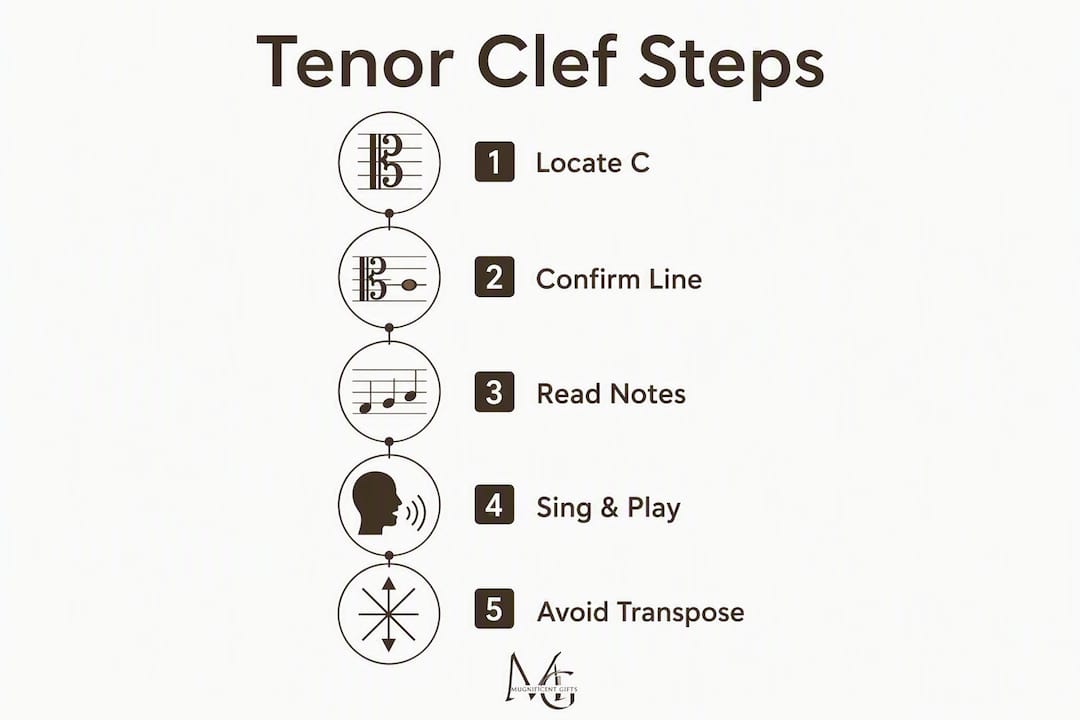
Pro Tip: Never transpose. If you catch yourself thinking "this note in tenor clef equals that note in bass clef," stop and name the note directly from the fourth-line anchor instead. Transposition is a crutch that breaks under tempo.
When and where you will encounter tenor clef as a trombonist
Tenor clef appears across a wider range of contexts than many players expect when they first encounter it. Knowing where it lives helps you prioritise your practice time.
- Orchestral first and second trombone parts: the majority of standard orchestral repertoire moves between bass and tenor clef as the tessitura rises. Passages in the upper register almost always shift to tenor clef to keep the notation clean for the player and the conductor.
- Classical solo repertoire: concertos, sonatas, and recital pieces written for tenor trombone frequently use tenor clef for extended lyrical passages.
- Chamber music: brass quintet and trombone quartet writing often sits in the tenor register, making clef fluency a prerequisite for ensemble playing.
- Conservatoire audition excerpts: many UK conservatoire audition lists include orchestral excerpts that contain tenor clef passages. Candidates who cannot read them fluently are at an immediate disadvantage.
- Some published editions: older and scholarly editions of Baroque and Classical works sometimes use tenor clef even for passages that modern editions might notate differently.
Composers choose tenor clef to signal tessitura, not just to tidy up the page. As Thomas Goss notes at Orchestration Online, the clef carries information about orchestral balance and expressive register that a conductor reads at a glance. For the player, that context shapes how you approach tone and dynamics before you play a single note.
Mapping common tenor clef pitches to slide positions
The table below pairs the most frequently encountered tenor clef pitches with their primary slide positions and F trigger alternatives on a standard Bb/F tenor trombone.
| Note | Tenor clef position | Primary slide position | F trigger option |
|---|---|---|---|
| D4 (middle D) | 4th line (one step above middle C) | — | — |
| E4 | 4th space | 4th | T4 |
| F4 | 5th line | — | T3 |
| G4 | Above staff (— ledger line space) | 4th | — |
| Bb4 | 3rd ledger line above | — | — |
| C5 | 4th ledger line above | 3rd | — |
| B3 | 3rd space | — | — |
| A3 | 3rd line | — | — |
| G3 | — space | 4th | T4 |
A few conventions worth noting:
- Multiple positions for the same pitch are normal. Choose the position that best serves phrasing. A legato phrase benefits from positions that minimise large slide movements; a technical passage may favour the F trigger to keep the slide compact.
- Intonation varies by position. Sixth position on most instruments runs slightly sharp; adjust your air and embouchure accordingly rather than accepting the pitch as fixed.
- F trigger choices in the upper register (above Bb4) are less common but useful when a passage descends rapidly into the lower register immediately after.
Printable slide position charts tailored to tenor clef and F trigger use are available at Trombonetools and are worth keeping at the stand during early practice stages.
Daily and weekly drills that build genuine sight-reading fluency
A short, consistent routine outperforms occasional long sessions. The goal is automaticity: you want to read a tenor clef line and hear it internally before the slide moves.
Daily routine (10–15 minutes):
Start with two minutes of note-naming. Open any tenor clef page and name each note aloud without playing. Speed matters less than accuracy at this stage. Then sing a four-bar phrase from the same page, keeping the tempo slow enough to hear every interval. Finally, play the phrase immediately after singing it. The sequence — name, sing, play — is the core loop that builds direct recognition.
Weekly progression:
In weeks one and two, work with short, stepwise melodies that stay close to middle C. Side-by-side bass and tenor clef comparisons, where the same excerpt appears in both clefs on the same page, accelerate recognition by letting you link familiar bass clef material to its tenor clef equivalent. This approach is endorsed by several pedagogues as a low-friction entry point.
From week three, introduce interval leaps and begin sight-reading short orchestral-style phrases at a slow tempo. Add a metronome and increase the tempo by a small increment each session. A realistic benchmark: after four to six weeks of daily work, most intermediate players can sight-read a short lyrical orchestral excerpt at a comfortable rehearsal tempo without stopping to work out individual notes.
Pro Tip: Record yourself sight-reading a new excerpt each week. Listening back reveals hesitations and pitch errors that you miss in the moment, and the recordings become a concrete record of progress.
Common mistakes trombonists make with tenor clef and how to fix them
Most players hit the same handful of obstacles. Recognising them early saves weeks of frustration.
- Mental transposition from bass clef. The fix: stop counting intervals from a bass clef reference point. Name the note directly from the fourth-line anchor. Pedagogues consistently advise against transposition tricks; interval and context training produce faster sight-reading gains.
- Over-reliance on ledger lines. Players who learned bass clef by counting ledger lines tend to do the same in tenor clef. The fix: memorise the five lines and four spaces as a complete system, not as extensions of the bass staff.
- Ignoring interval relationships. Jumping to individual note names without hearing the interval from the previous note slows reading. The fix: practise singing intervals in tenor clef before playing them.
- Skipping the singing step. Many players go straight to the instrument and then wonder why their reading feels mechanical. Singing first, even quietly, connects the visual symbol to a heard pitch.
- Choosing awkward slide positions. A note that sits comfortably in one position may disrupt phrasing if a large slide movement follows. The fix: scan two or three notes ahead and choose positions that keep the slide path logical.
Pro Tip for teachers: In a lesson or sectional, ask the student to name three consecutive tenor clef notes aloud before playing. If they hesitate or count from bass clef, that is the diagnostic signal. Redirect to the fourth-line anchor immediately and repeat the naming exercise until it is automatic.
Recommended études, study books, and orchestral excerpt types
The most effective progression moves from structured method books to musical excerpts, with singing integrated throughout.
Introductory to intermediate:
Simplest Route to Tenor Clef by Steve Thompson (available from all-sheetmusic.com) is a 24-page method designed specifically for bass clef players making the transition. Brad Edwards' Introductory Studies in Tenor and Alto Clef provides graded exercises that build interval recognition before introducing full melodies.
Intermediate to advanced:
Christian Dickinson's A Concise Method for Learning Tenor Clef on Trombone is structured around the singing-and-playing loop and is appropriate for advanced secondary school through conservatoire level. Vladislav Blazhevich's Clef Studies remains the standard advanced resource, covering both tenor and alto clef with demanding musical material.
Orchestral excerpts:
Seek out lyrical first trombone solos from the Romantic orchestral repertoire, as well as rapid technical passages that sit in the tenor tessitura. UK conservatoire audition lists published by institutions such as the Royal Academy of Music and the Royal Northern College of Music are reliable guides to which excerpts appear most frequently. IMSLP carries many full orchestral scores in which you can locate and extract tenor clef passages for targeted practice.
Side-by-side editions that show the same passage in bass and tenor clef are particularly useful in the early stages, as they let you cross-reference familiar material rather than decoding an entirely new visual language from scratch.
Key takeaways
Tenor clef fluency is a professional standard for trombonists, built through direct note recognition from the fourth-line anchor, daily singing-and-playing routines, and progressive exposure to orchestral and étude material.
| Point | Details |
|---|---|
| Anchor on the fourth line | Middle C sits on the fourth line; all other pitches follow from that single reference. |
| Sing before you play | Alternating singing and playing closes the hearing–playing gap faster than visual drills alone. |
| Avoid mental transposition | Name notes directly from the tenor staff; transposition habits slow sight-reading under tempo. |
| Use a slide position chart | Keep a printable tenor clef position chart at the stand during early practice stages. |
| Progress through graded material | Move from Thompson or Edwards to Dickinson, then Blazhevich, adding orchestral excerpts weekly. |
Three concrete next steps:
- Memorise the lines and spaces of the tenor staff this week (D–F–A–C–E; E–G–B–D).
- Start a 10-minute daily sing-and-play routine using any graded method book.
- Add one orchestral excerpt in tenor clef to your weekly practice from week three onwards.
Why tenor clef is worth more than most players give it
The conventional view treats tenor clef as a technical hurdle to clear before the real music begins. That framing gets it backwards. Tenor clef is a register indicator, and reading it fluently tells you something musically meaningful before you play a note: the line sits in the expressive heart of the instrument, where the trombone's tone is warmest and most projecting.
From a teaching perspective, I sequence tenor clef skills early in a student's conservatoire preparation, not late. Students who encounter it first in an audition context are already behind. The singing-and-playing loop, drawn from Dickinson's method, is the single most effective tool I have seen for removing the reading-to-playing delay. It works because it forces the student to hear the line as music, not as a sequence of symbols to decode.
There is also a practical bonus that rarely gets mentioned: tenor clef fluency accelerates the ability to read transposed treble parts, including Bb treble clef. Players who cover multiple parts in a brass ensemble or pit orchestra find that the interval relationships they built reading tenor clef transfer directly. One skill, two applications.
For educators looking to mark a student's progress through this milestone, a personalised music-themed mug from Mugnificentdeals makes a quietly thoughtful gift that says "you earned this" without ceremony.
Useful sources and further reading
The resources below are vetted starting points for players and teachers working through tenor clef at any level.
| Resource | Type | Notes |
|---|---|---|
| Trombonetools: Clefs | Teaching blog + printable charts | Printable slide position charts and pedagogical commentary; free to access |
| Mountain Peak Music: Dickinson Method | Purchasable PDF method book | Singing-and-playing approach; suitable for advanced secondary through conservatoire |
| All Sheet Music: Steve Thompson | Purchasable printed method | 24-page introductory method for bass clef players transitioning to tenor clef |
| Orchestration Online: Trombone Wars | Pedagogical blog series | Orchestrational rationale for tenor clef; useful for teachers explaining the "why" |
| The Eighth Position: Introducing Tenor and Alto Clef | Teaching blog post | Practical classroom strategies; free to access |
| PlayingBrass: Tenor Clef Crash Course | Blog article | Covers transposition benefits and quick-start reading tips |
| IMSLP (imslp.org) | Free score library | Full orchestral scores for locating and extracting tenor clef excerpts |
| UK conservatoire audition lists | Institutional documents | Royal Academy of Music and Royal Northern College of Music publish repertoire lists online |
Blazhevich's Clef Studies and Edwards' Introductory Studies are available through specialist music retailers and conservatoire libraries across the UK. If your institution does not hold a copy, the British Library catalogue and interlibrary loan services are practical next steps.