
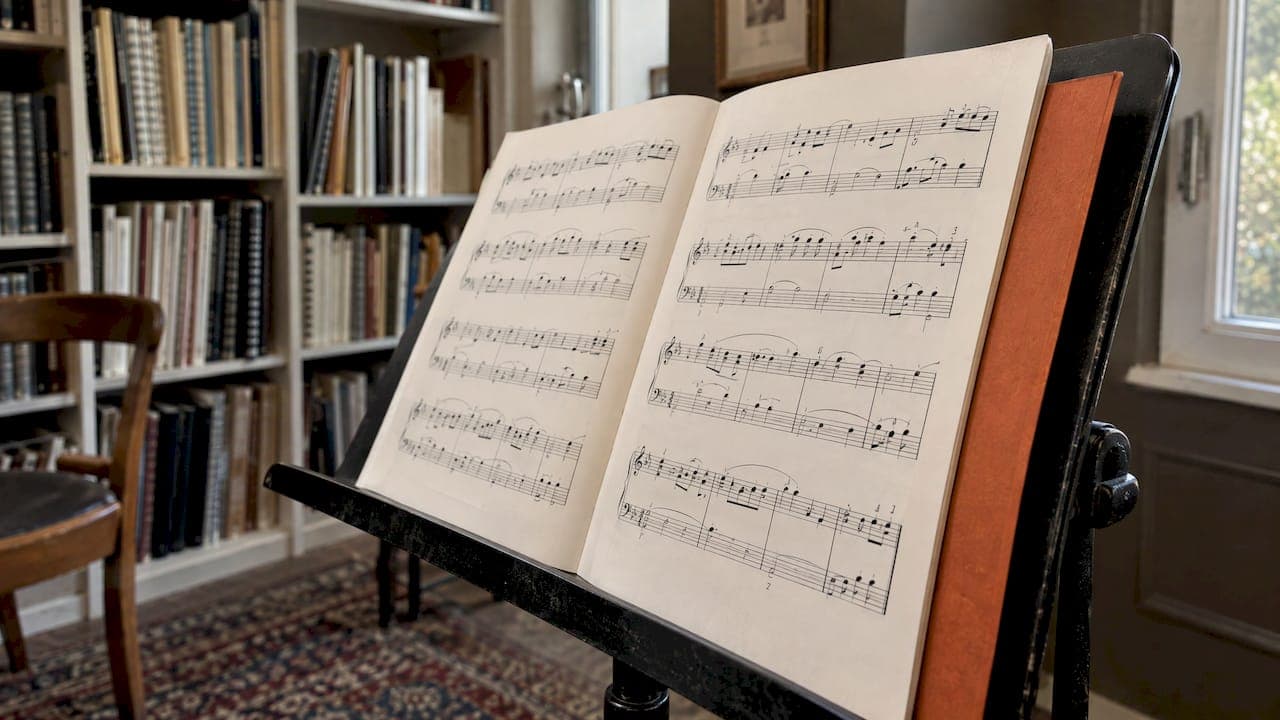
Music symbols are the written language of a score. Each one answers a single question: which note, how long, how loud, how fast, or where to go next. Learn the clef, the note shapes, the time signature and the key signature, and most of a beginner's page starts to make sense. This guide covers them in the order you meet them on the stave, using British names (crotchet, quaver, stave) with the American equivalents alongside.
TL;DR
- The clef at the start of each stave tells you which pitches the lines and spaces stand for. The treble clef is for higher notes, the bass clef for lower ones.
- A note's position shows its pitch and its shape shows its length. A rest shows how long to stay silent.
- The time signature gives the beats in each bar and which note value counts as one beat. The key signature shows which notes are sharp or flat throughout.
- Dynamics (p, f, crescendo) tell you how loud to play, and repeat signs tell you where to go next.
- Read left to right, and check clef, key, time and tempo before the first note.
Table of Contents
- The stave and the clef: where every note lives
- Notes and their values
- Time signatures: counting the bar
- Accidentals and key signatures
- Dynamics and tempo: loud, soft, fast, slow
- Repeat signs and other marks you will meet
- A quick music symbols chart
- How to read a bar in six steps
- Making the symbols stick
- Our perspective
- Find a mug that speaks your notation
- FAQ
- Sources
The stave and the clef: where every note lives
Music is written on a stave (called a staff in American English): five horizontal lines with four spaces between them. Each line and space stands for a note named with the letters A to G. Moving upwards, the letter names run alphabetically through alternating lines and spaces, so higher on the stave means higher in pitch.
The stave alone does not say which note is which. That is the clef's job. A clef is the symbol at the beginning of a line of music that shows how high or low the notes are. It fixes one pitch on one line, and every other line and space follows from that.
Treble clef meaning
The treble clef is the swirling symbol most people picture when they think of music. It is also called the G clef, because the curl at its centre loops around the second line from the bottom and marks it as G. The symbol evolved from a script letter G written on the stave, which explains the shape.
You will find the treble clef on flute, violin, saxophone and trumpet parts, on high voice parts and on the piano's right hand. The notes on the lines, from bottom to top, are E, G, B, D, F, remembered as Every Green Bus Drives Fast, and the spaces spell FACE.
Bass clef symbol meaning
The bass clef is the F clef. It shows that the F below middle C sits on the fourth line from the bottom, and the two dots sit either side of that line. It is used for lower instruments such as cello, bassoon, trombone and bass guitar, and for the piano's left hand. The bass clef notates pitches below middle C and is the partner of the treble clef.
The lines of the bass clef, from bottom to top, are G, B, D, F, A (Great Big Dogs Frighten Albert), and the spaces are A, C, E, G (All Cows Eat Grass), according to BBC Bitesize.
Alto and tenor clefs
You may meet a third kind of clef, the C clef, which marks middle C. The alto clef is mainly used for viola, and the tenor clef for bassoon, cello and trombone when the notes would sit too high to read comfortably in bass clef. If you play trombone, our practical guide to the tenor clef for trombone walks through it.
Where the two main clefs meet
Piano music uses both clefs at once. The treble and bass clefs meet at middle C, the note that joins the two staves. As a rule, notes on the treble clef are usually played with the right hand and those on the bass clef with the left.
Notes and their values

A note has two parts of meaning. Its vertical position gives the pitch, and its shape gives the duration. The head is the oval, the stem is the line attached to it, and a flag or beam on the stem shortens the note.
British names are used in UK schools and exams, while American English numbers the notes as fractions of a whole. A semibreve lasts four crotchet beats, a minim two, a quaver half a crotchet and a semiquaver a quarter. Dolmetsch's chart of musical symbols lists the matching American names.
| British name | American name | Length in crotchet beats |
|---|---|---|
| Semibreve | Whole note | 4 |
| Minim | Half note | 2 |
| Crotchet | Quarter note | 1 |
| Quaver | Eighth note | 1/2 |
| Semiquaver | Sixteenth note | 1/4 |
The table assumes the crotchet is the beat, which is the case in the most common time signatures. The note value that counts as one beat is set by the time signature, covered below.
Rests
Silence is written too. Rests show how long to stay silent, and each note value has a matching rest of the same length. A semibreve rest and a minim rest look similar, but the semibreve rest hangs below a line and the minim rest sits on top of one. A quick way to keep them apart is to think of the semibreve rest as a heavy object hanging down.
Time signatures: counting the bar
The two stacked numbers after the clef are the time signature. The top number gives the beats in each bar, and the bottom number says which note value counts as one beat. A 3/4 signature means three crotchet beats per bar, which is the pulse of a waltz. A 4/4 signature means four crotchet beats.
Bar lines are the vertical lines that divide the music into bars, so the pulse stays easy to follow. A double bar line marks a new section, and a thick final bar line closes the piece.
Sometimes the numbers are replaced by a letter. Common time, a C where the time signature would be, is simply another way of writing 4/4. A C with a vertical line through it is cut time, which stands for 2/2: two beats in each bar, each a minim long.
Accidentals and key signatures
The stave's lines and spaces map to the white keys of a piano. To reach the black keys, music uses accidentals. A sharp raises a note by a semitone, a flat lowers it by a semitone, and a natural cancels an earlier sharp or flat. An accidental written beside a note normally lasts until the end of that bar.
If a piece uses the same sharps or flats again and again, writing them each time would clutter the page. A key signature solves this. It appears after the clef and shows which notes are sharp or flat throughout a piece or section. One sharp usually means G major or E minor, and one flat usually means F major or D minor, according to the same guide.
The same source gives the order in which sharps are added as F, C, G, D, A, E, B, and the order of flats as the reverse: B, E, A, D, G, C, F. Knowing the order lets you count the sharps or flats in a key signature and work out the key.

Dynamics and tempo: loud, soft, fast, slow
Notes and rhythms tell you what to play. Dynamics tell you how. They are usually written in italic Italian abbreviations beneath the stave.
- p (piano): soft
- mp (mezzo-piano): moderately soft
- mf (mezzo-forte): moderately loud
- f (forte): loud
- pp and ff: very soft and very loud
These meanings are set out in this notation reference, which also explains that a crescendo, drawn as a widening hairpin, means getting gradually louder, and a diminuendo, a narrowing hairpin, means getting gradually softer.
Tempo marks, often Italian words above the first bar, set the speed. Together with notes, time signature, key signature and dynamics, tempo is one of five key elements of musical notation in the BBC's primary music materials.
Repeat signs and other marks you will meet
Once you can read pitch, rhythm, key and volume, a handful of navigation and performance marks cover most of what is left.
- Repeat signs: two dots beside a double bar line tell you to go back and play a section again. Herts Music Service's infographic lists the repeat sign and the 'to coda' sign alongside the clefs and dynamics.
- First and second time bars: numbered brackets over the last bars of a repeated section. Play the first bracket on the first pass and the second on the repeat. Singers hear them in rehearsal when a conductor asks them to watch a particular note in the second time bar, and even choir members who do not read fluently benefit from knowing what the symbols mean.
- 8va: a passage should be played one octave higher than written; it sits above the staff and a dashed line shows where it ends.
- Ties and slurs: curved lines. A tie joins two notes of the same pitch into one longer sound, and a slur joins different notes into a smooth phrase.
- Dots: a dot after a note lengthens it by half. A dotted minim lasts three beats.
A quick music symbols chart
Keep this table beside your music stand until the symbols become automatic.
| Symbol | Name | What it tells you |
|---|---|---|
| Swirl on the G line | Treble clef | Higher notes; the curl marks G |
| F-shaped sign with two dots | Bass clef | Lower notes; the dots surround F |
| Oval with a stem | Note | Pitch by position, length by shape |
| Squiggle or block | Rest | Silence of a set length |
| Two stacked numbers | Time signature | Beats per bar and the beat value |
| Sharps or flats after the clef | Key signature | Notes altered throughout |
| Hash, b, or boxed sign | Sharp, flat, natural | Raise, lower or cancel a note |
| p, mf, f | Dynamics | How loud to play |
| Widening or narrowing hairpin | Crescendo, diminuendo | Gradually louder or softer |
| Dots by a double bar | Repeat sign | Play the section again |
How to read a bar in six steps
When all the symbols appear at once, a fixed order stops the page from feeling busy.
- Check the clef. It tells you which note each line and space means.
- Read the key signature. Note which letters will be sharp or flat.
- Read the time signature. Decide how you will count each bar.
- Look at the tempo and dynamics. Know the speed and the volume before you begin.
- Read left to right, with a note's height giving pitch and its shape giving duration.
- Scan for navigation marks such as repeats and codas, so you know the route before you play.
MuseScore's beginner guide boils the skill down to four things: stave, clef, note names and note values. Once those are secure, the page starts to read as music rather than as dots.
Making the symbols stick
Little and often beats long, occasional sessions. Pick two or three symbols a week, find them in a piece you are already playing, and say their meaning aloud as you meet them. Mnemonics help: Every Green Bus Drives Fast and FACE for the treble clef are classics because they work.
Singing is a good test of how well the symbols have stuck, because you have to hear the pitch before you produce it. If you sing, a short daily routine is enough, and this piece on building sight-reading for singers shows how ten minutes a day can add up.
If you like a bit of humour with your theory, our music theory jokes, explained turn symbols such as rests and key signatures into punchlines, and a joke you have understood is a symbol you are unlikely to forget.
Our perspective
We spend our days drawing instruments, clefs and quotations onto mugs, so we have seen how people feel about music symbols. A treble clef is not just a sign to a violinist. It is a small badge of belonging.
That is why we think learning the symbols and loving them go together. A student who can name every sign on a page tends to be proud of it, and that pride deserves a place on the desk, the piano lid or the kitchen counter.
Our mugs are designed for that feeling: instrument sketches, theory patterns, composer portraits and jokes that only a musician will get, all of which can carry a name or a message. A mug with a bass clef and a teacher's name on it says more than a generic thank-you ever could. For ideas on what works, see our sheet music mug ideas.
Lasse
Find a mug that speaks your notation
If you are learning the symbols yourself, or buying for someone who is, a mug is a gentle daily reminder. We make personalised ceramic music mugs with instrument illustrations, music quotes, names, photos and gift messages, for musicians, teachers and students.

Browse our personalised music mugs for instrument designs, funny music mugs, music theory and pattern mugs, and name mugs. For a hand-drawn look, try the instrument personalised sketch mugs, or the composer and music history mugs. Buying for a class? Our guide to music classroom gift ideas may help.
FAQ
What are the five basic symbols of music notation?
The BBC's primary music materials list notes, time signature, key signature, tempo and dynamics as five important parts of notation. Notes give pitch and duration, the time signature gives beats per bar, the key signature gives the sharps and flats, tempo gives the speed, and dynamics give the volume.
What does the treble clef mean?
The treble clef, or G clef, shows that the second line from the bottom of the stave is G. It is used for higher-pitched instruments and voices, and for the piano's right hand. The curl at its centre loops around that G line.
What does the bass clef symbol mean?
The bass clef, or F clef, shows that the F below middle C is on the fourth line from the bottom. It is used for lower pitches, such as the piano's left hand, cello and bass guitar.
How do I read music symbols as a beginner?
Read left to right and begin with the clef, key signature and time signature at the start of the stave. Then use each note's position for pitch and its shape for length. Learn a few symbols at a time rather than the whole chart at once, and practise them on music you already play.
Sources
- How to Read Music: Notes, Clefs & the Stave (UK Terms)
- Pitch, Clefs, and Intervals tutorial, Comprehensive Musicianship
- List of musical symbols
- BBC Bitesize KS2 Music glossary
- BBC Bitesize Edexcel GCSE Music: Notation
- Cambridge Dictionary: bass clef
- The National Academy: Understanding bass clef
- BBC Music Magazine: What is a clef?
- Dolmetsch Online: Chart of Musical Symbols
- 60 Music Symbols and Their Meanings Explained
- Music Symbols and Meanings for Piano Players
- Notation & Symbols: A Complete Guide to Reading Written Music
- Music Notation Symbols: What Each One Means
- BBC Bitesize KS2: Writing music
- Herts Music Service: Rests, signs & symbols
- The Singers Guide to Reading Music
- How to Read Sheet Music: A Beginner's Guide
- Sight-reading for singers