
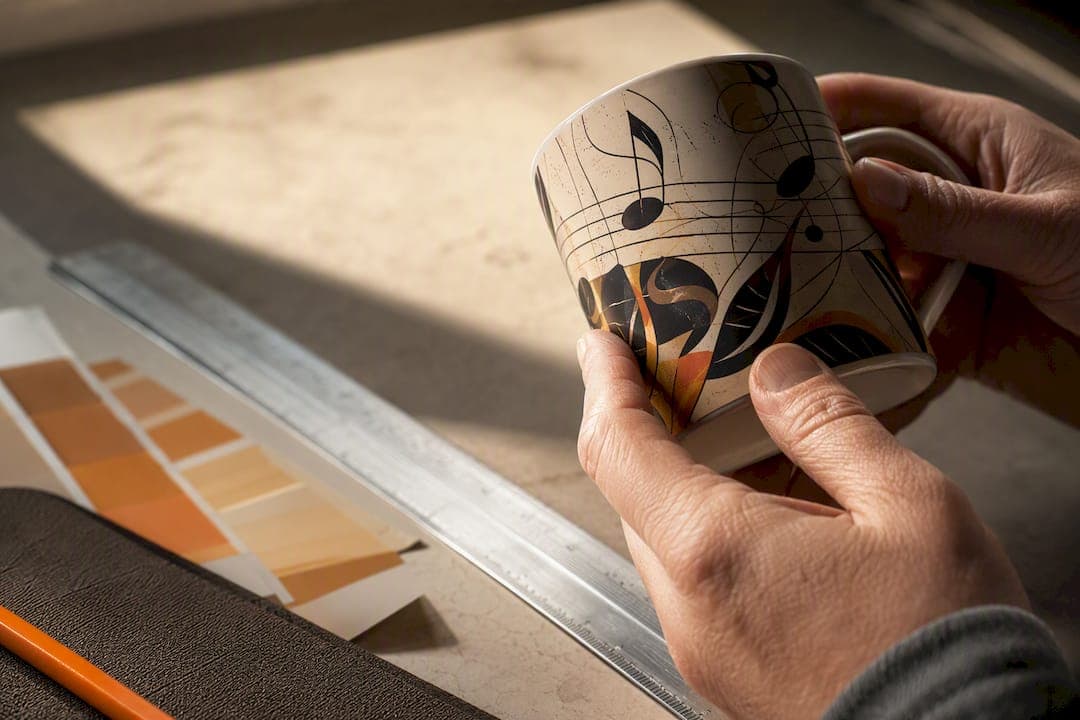
Pick one theme, one personal detail, and stick to it: a musician's mug works best when it says one clear thing rather than five muddled ones. Choose a focal idea (an instrument silhouette, a lyric, a name paired with a clef), personalise it to the actual person receiving it, and then apply a handful of basic printing rules so the design survives the curve of a ceramic surface. This article walks through concrete music mug design ideas, the print specs that keep them legible, and how to package the result so it feels like a proper gift rather than a novelty afterthought.
TL;DR:
- Most effective designs feature one clear focal point, such as a bold instrument silhouette or a short, high-contrast lyric snippet, to maintain legibility.
- Files must be supplied at 300 DPI and consider the printable area's size to ensure images and text remain sharp when wrapped around the mug.
- For personalisation, using specific details like a recipient's instrument, name, or inside joke creates a memorable gift that feels tailored rather than generic.
- Simplicity in design outperforms clutter, since ceramic printing struggles with tiny details and crowded layouts, especially on curved surfaces.
- Order timelines include design approval, a curing period for the print, and buffer days for proof review, making early planning essential for specific dates.
Table of Contents
- Music mug design ideas that actually work
- Getting the artwork right: rules that keep designs print-ready
- Choosing the right mug type for the design
- Making the gift feel considered, not generic
- What makes a music mug feel personal, not generic
- Budgeting for a custom music mug
- How long does a custom music mug take to make?
- Why simplicity beats cleverness on a music mug
- Order a personalised music mug that gets it right first time
- Sources
- FAQ
Music mug design ideas that actually work
Good music-themed mug designs share one trait: restraint. A single strong image reads better across a room than five clever details crammed onto 11 ounces of ceramic. Here are the concepts worth building on.
-
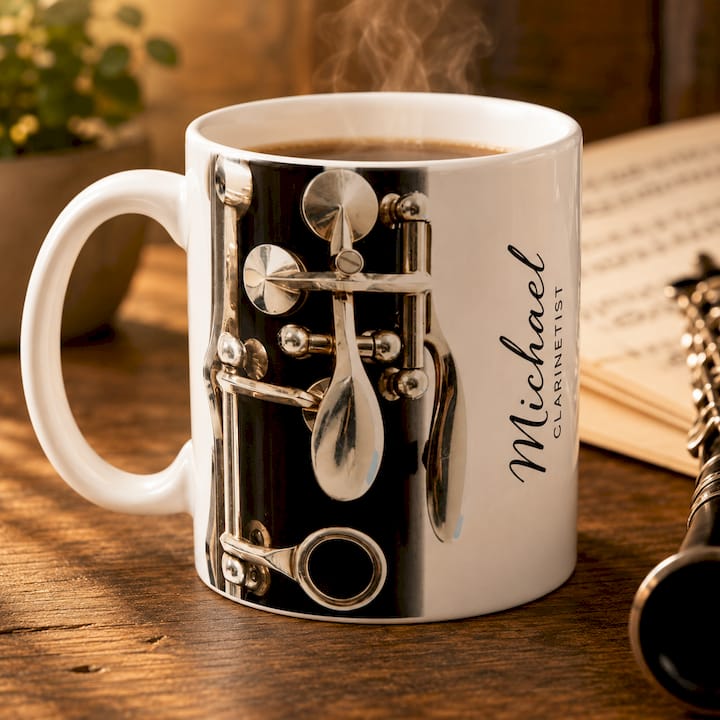
Instrument silhouettes. A violin, trumpet, or drum kit rendered as a clean black outline reads instantly, even at a glance over breakfast. Place the silhouette front and centre, and personalise it by adding the recipient's name curved along the base or tucked beneath the instrument's body.
-
Notation and motif snippets. A few bars of sheet music, a treble clef, or a short rhythm pattern make elegant, understated designs. Pick a recognisable phrase (the opening notes of a favourite song, a scale the recipient has practised a thousand times) and keep the staff lines bold enough to survive shrinking onto a curved surface. If you're using a snippet from a copyrighted song, stick to visual notation rather than reproducing full sheet music, since commercial arrangements often carry their own licensing restrictions.
-
Lyrics and quotes. Short phrases beat full verses every time. Three to six words in a bold serif or hand-lettered script, set in high contrast against the mug's base colour, will still be readable from across a kitchen. Anything longer starts to shrink and blur, and anything pulled from a well-known chart hit deserves a quick check on usage rights before it goes to print.
-
Typographic monograms. Pairing initials with a treble clef or a subtle staff line gives a design that feels bespoke without needing a photo. This works particularly well for teacher gifts or graduation presents, where the recipient's name matters more than any illustration.
-
Photo-based designs. A candid photo from a recital or gig, layered with a simple graphic overlay (a clef, a burst of confetti, a quote), turns a mug into a keepsake. Crop tightly around the subject and check that the image still looks sharp when scaled to the mug's actual print area, not just on a laptop screen.
-
Novelty shapes and handles. Guitar-shaped handles or drum-style mugs look fantastic on a shelf but are worth choosing with eyes open. They're often better suited to display or occasional use than daily dishwasher cycles, since unusual geometry tends to be more fragile at the joins.
Pro Tip: If you're torn between two ideas, pick the one that says something specific about the recipient, not music in general. A trumpet mug is nice; a trumpet mug with "Second Chair, 2019" underneath is a gift someone keeps for a decade.
Getting the artwork right: rules that keep designs print-ready
Ceramic printing punishes clutter. Designs with one clear focal element and strong contrast reproduce far better than busy compositions, and PromotionChoice's guidance on ceramic mug artwork makes this point directly: crowded layouts and tiny text are among the most common reasons a design disappoints once it's fired.
A few technical rules make the difference between a mug that looks professional and one that looks like a smudged photocopy:
- Keep text large. Anything smaller than about 18pt at final print size tends to blur once it wraps around a curved surface.
- Avoid placing critical artwork directly behind or beside the handle. Front-centred placement stays visible whichever hand holds the mug.
- Supply files at 300 DPI at the actual print size. For a standard 11 oz mug, RareCustom's beginner guide notes the printable area runs roughly 3.5 by 8 inches, so photos need to hold detail at that scale, not just on screen.
- Use PNG files with a transparent background for photos and logos, and SVG for vector line art, since vectors scale cleanly without pixelation.
- Choose gloss for vivid colour reproduction, matte for a softer, premium feel, and reserve colour-change finishes for reveal effects, since coatings can mute contrast slightly.
Before finalising anything, run a 3D preview or a paper mock-up wrapped around a real mug. Technicalinterest's step-by-step guide recommends this specifically to catch seam misalignment, since a design that looks perfect flat can shift oddly once it wraps around a handle.
Choosing the right mug type for the design
The mug shape you pick first will decide how much room your design actually has, so it pays to choose the format before finalising artwork. VistaPrint's design guidance makes this point clearly: mug style determines printable area, which in turn shapes layout decisions.
- 11 oz standard mugs suit most designs and are the easiest to gift, wash, and stack.
- 15 oz mugs give a bigger canvas for detailed illustrations or longer quotes, useful for photo collages or busier notation designs.
- Enamel mugs carry a rugged, vintage look that suits festival-themed or retro band branding.
- Travel tumblers fit commuting musicians heading to lessons or rehearsals, though they usually print via wrap decals rather than full sublimation.
- Flat bases and larger handles reduce tipping risk, a small but genuinely useful feature for anyone likely to be juggling a music stand or gig bag while holding a hot drink.
- Standard ceramic mugs are typically dishwasher and microwave safe, while novelty shapes and handle designs are often better reserved for display or occasional use.
- Sublimation printing suits full-colour photo designs; screen printing holds up well for bold solid shapes; decals work best for small, limited-run orders.
Making the gift feel considered, not generic
A well-designed mug still benefits from thoughtful presentation, since packaging and pairings genuinely shift how a gift is perceived on unwrapping.
- Bundle it. A small bag of speciality coffee, a printed setlist card, or a laminate-style pass turns a single mug into a curated set.
- Choose your packaging tier. Tissue paper in a kraft box feels warm and handmade; a branded box with a foam insert feels closer to a considered purchase.
- Add an occasion detail. An engraved date for a graduation, or a teacher's name and the term dates for an end-of-year gift, makes the mug specific to that moment.
- Finish with the practical touches. Include a short printed message and basic care instructions, so the gift feels complete the moment it's opened.
A self-stirring magnetic mug accessory makes an unusual add-on for a gift bundle if you want something a little different from the usual coffee-and-biscuits pairing.
What makes a music mug feel personal, not generic
This music-themed mug guide focuses on musicians, teachers, and music lovers, which sharpens the advice considerably: the detail that makes a mug memorable is rarely the biggest or boldest element on it. It's the specific one. A name paired with an instrument, a private joke between a teacher and a graduating student, a favourite band's font style recreated by hand. That specificity is what separates a mug someone keeps on their desk for years from one that ends up at the back of a cupboard.
A design that reflects a precise detail, an instrument, a role, a favourite lyric, feels considered rather than mass-produced, and that's what makes a mug a daily object instead of a one-off novelty.
Personalisation options typically include names, chosen instruments, and short inside jokes or messages, all built around instrument illustrations rather than stock clip art.
Pro Tip: Ask the recipient's instrument teacher, bandmate, or family member for one specific detail nobody else would think of. It almost always beats a generic music note.
Budgeting for a custom music mug
Custom mug pricing generally scales with three things: the mug type, the complexity of the artwork, and the order quantity. A single personalised mug with a name and a simple silhouette sits at the lower end of most custom pricing, while photo-based designs, larger 15 oz formats, or premium finishes like enamel or colour-change coatings tend to push the price up.
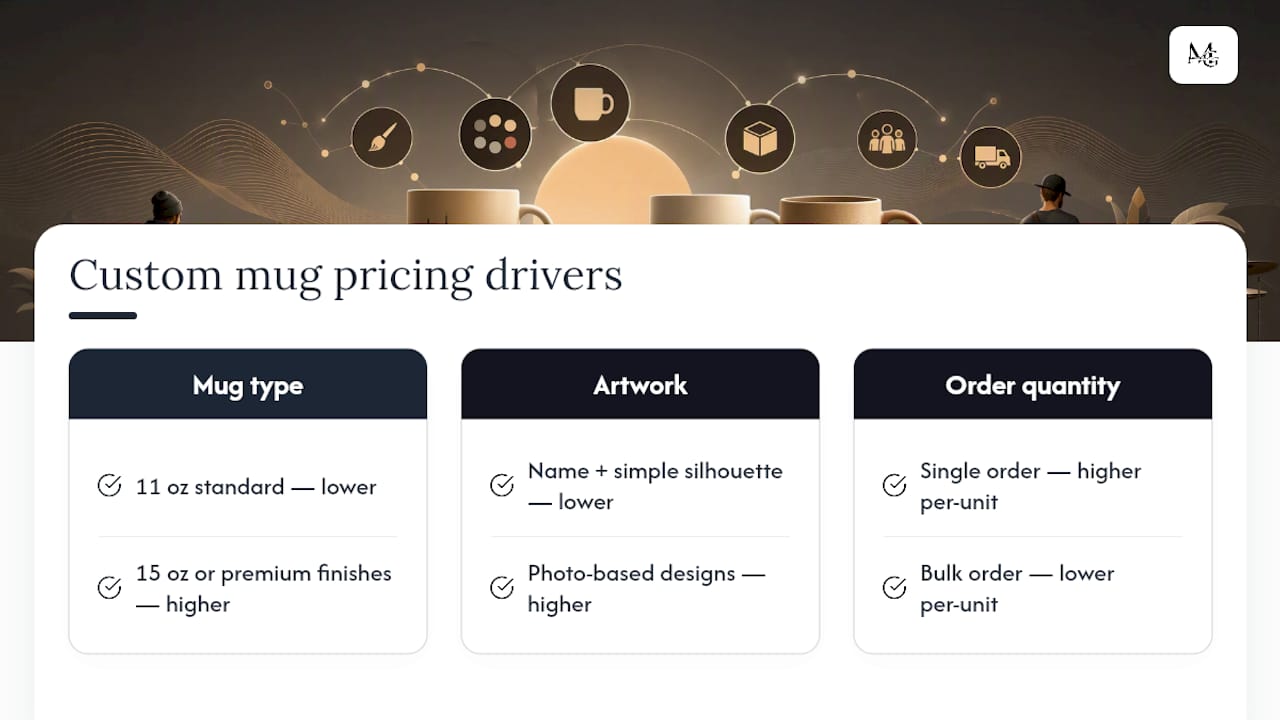
Ordering in bulk, for an entire ensemble, a graduating class, or a choir, usually brings the per-unit cost down noticeably compared with single orders, since setup costs get spread across more mugs. If you're buying for one person, factor in packaging too: a kraft gift box with tissue paper adds relatively little to the total, while a branded box with a foam insert sits closer to premium retail packaging.
It's worth budgeting separately for the mug itself and the presentation around it. A £15 mug in a scruffy plastic bag reads very differently from the same mug in a proper box with a printed note tucked inside. If you're working from a fixed gift budget, spending slightly less on the mug format (an 11 oz standard rather than a 15 oz) and reallocating that toward packaging or a small bundled item often produces a more memorable result than maxing out the mug specification alone.
Rush production, express shipping, or last-minute proof approvals can also add cost, so building in a few extra days generally saves money as well as stress.
How long does a custom music mug take to make?
Custom mug timelines typically break into three stages: design and approval, production, and delivery. Design usually moves fastest since most personalisation, a name, an instrument choice, a short message, can be finalised within a day or two once you've supplied clear instructions or a reference image.
Production itself, the actual printing and firing, tends to take a few working days once artwork is approved, since ceramic printing involves curing time that can't be rushed without risking print quality. Delivery then depends on your shipping choice, with standard shipping adding several more days on top.
The stage most people underestimate is proofing. Reviewing a digital proof or 3D preview before approving final production is the single most effective way to catch a misspelled name, a cropped photo, or a colour that looks different on ceramic than it did on screen. Building a day or two into your timeline specifically for reviewing and approving that proof avoids the most common cause of reorders.
If you're ordering for a specific date, a graduation, a birthday, a recital, it pays to work backwards from that date and add a buffer of at least a few days beyond the stated delivery window. Gift-buying under time pressure is where most design mistakes creep in, whether that's skipping the proof stage or approving a photo that looked fine thumbnail-sized but pixelates once printed at full scale.
Why simplicity beats cleverness on a music mug
The instinct with a music-themed gift is to pack in everything the recipient loves: their instrument, their favourite band, a lyric, maybe a photo too. That instinct is usually wrong. The strongest designs in this category do one thing well rather than five things adequately, and that's not a stylistic preference, it's a function of how ceramic printing actually reproduces detail at a small scale.
Where most advice on personalised gifts falls short is treating "more personal details" as automatically better. It isn't. One precise detail, correctly chosen, communicates more thought than three generic ones stacked together. A graduation date under a saxophone silhouette says more than a saxophone, a treble clef, and a lyric competing for space on the same mug.
If there's one thing to prioritise above all else, it's choosing the detail before choosing the decoration. Know who the mug is for and what makes them specifically them, then build the simplest design that expresses it. The technical rules around contrast, file resolution, and safe zones matter, but they're solving a problem that good editing would have prevented in the first place.
— Lasse
Order a personalised music mug that gets it right first time
Some personalised music-themed mugs are built around the ideas covered here: instrument illustrations, names, short messages, and photo-based designs, each produced with the print rules above already applied.
Ordering starts with the basics: pick your mug type first (11 oz, 15 oz, or one of the specialty finishes), then supply the details that make it personal, an instrument, a name, a short inside joke, or a high-resolution photo if you're going the photo route. Browse the personalised music mugs collection for instrument-specific designs, or head to the gift-focused collection if you're buying for a teacher, graduate, or bandmate rather than yourself. Every order includes a proof step before production, so you can check spelling, cropping, and colour before anything goes to print. If you're still deciding on style, the range of unique ceramic mug options is worth a browse before you commit to a final design.
Sources
Before finalising any design, it's worth cross-checking a couple of technical guides against whatever printer or platform you're using. PromotionChoice's artwork rules cover safe zones and common mistakes in detail, while VistaPrint's design walkthrough explains how mug type affects file formats and layout. Always run a paper mock-up or 3D preview before approving final production.
- Ceramic Mug Printing: Artwork Rules, Design Tips & Common Mistakes
- How To Make Custom Mugs: A Step-by-step Guide | VistaPrint US
- How to Design Custom Mugs: The Complete Beginner's Guide | RareCustom Blog
- Technicalinterest
FAQ
What are some creative ideas for personalised mugs?
Instrument silhouettes paired with a name, short lyric snippets in high contrast, notation motifs, and photo-based designs with a graphic overlay all work well for music-themed personalised mugs.
What are some easy designs for mugs?
A single bold silhouette or a short monogram with a clef motif are the easiest designs to get right, since they need minimal text and print reliably even on a curved surface.
Where can I find music-themed coffee mugs?
Specialist personalised gift retailers such as Mugnificentdeals focus specifically on music-themed mugs, offering options like personalised music mugs built around instrument illustrations and custom names.
What are common mug design mistakes?
The most common mistakes are cramming too much detail onto a small canvas, using text that's too small to survive printing, and placing key artwork too close to the handle where it gets cut off or hidden.