
Most sellers cap short name fields at 7 to 12 characters, and full messages at 20 to 40 characters per line, depending on font and mug size. On a standard 11oz mug, a single line of a practical number of characters is the safe rule of thumb. But the real limit isn't a number at all: it's the printable area and the font size you choose within it, which is why counting letters only gets you halfway to a design that actually prints well.
TL;DR:
- Character limits vary significantly between template fields and open message areas, with names often confined to 7 characters and messages up to 40 characters.
- Printable areas are determined by mug size, with 11oz mugs offering about 200mm by 96mm of usable space, while 15oz mugs allow for taller or stacked text.
- Font choice, size, and line arrangement critically affect how much text fits and remains legible, especially on curved surfaces.
- Testing mockups, character counting, and requesting proofs before ordering can prevent design errors and wasted prints.
- Most common mistakes involve improper text shape or size, with bold, simple fonts surviving the printing process better than fine, script styles.
Table of Contents
- What is the typical mug character limit vendors set?
- How does mug size affect the printable text area?
- How do you count characters and test your mug text before ordering?
- How do font size and line breaks change how much text fits?
- What do real examples look like on different mug sizes?
- What should you check before you place your order?
- What a mug maker sees go wrong most often
- Order a personalised music mug with confidence
- Sources
What is the typical mug character limit vendors set?
Sellers rarely publish one universal figure because their character limits map to product templates, not to any agreed printing standard. A name field on a "mug with a cartoon avatar and first name" design might allow just 7 characters, because the illustration has a fixed slot the letters must sit inside without overlapping the artwork. A free-text message field on a plainer mug format, by contrast, might stretch to 40 characters or more across one or two lines.
The distinction matters because these two field types behave completely differently.
- Strict template fields (names under a graphic, initials on a handle) rarely flex. What you see in the preview is what you get.
- Open wrap-area fields (a quote, a message, a greeting) are usually more forgiving and often come with a proof before printing.
- Multi-line message boxes trade characters-per-line for total characters, since you can break text across two or three rows instead of forcing one long string.
Curved ceramic surfaces also legitimately limit legibility. Text that wraps around a handle-side curve distorts more than text centred on the flat front panel, so sellers build in margin even when the physical print area technically has room for more letters.
How does mug size affect the printable text area?
Printable area, not mug volume, decides how much text fits, and the two aren't always the relationship you'd expect. An 11oz mug, the closest thing the industry has to a standard personalised mug size, typically measures around 95mm tall with an 83mm diameter and holds roughly 330ml. Its printable area commonly runs 200mm wide by 96mm tall, which gives you a comfortably wide but not especially tall canvas.
Move up to a 15oz mug and the width barely changes, but the height does. That extra vertical space is what lets 15oz bodies carry a second or third line of text, or a taller instrument illustration stacked above a name, without cramming everything into one strip.
| Mug format | Approx. printable area | Best suited to |
|---|---|---|
| 11oz standard | approximately 200mm × 96mm | Single line or short two-line phrase |
| 15oz standard | approximately 210mm × 103mm | Stacked text, extra lines, larger artwork |
| Slim/tapered (latte) | Flat template morphed to a fitted shape | Requires vendor's fitted proof, not flat measurements |
Tapered and latte-style mugs need extra care because print providers apply a "flat" design file that gets digitally morphed onto the cone shape once it's fitted. Text that measures perfectly on the flat template can look stretched or squeezed once wrapped, so treat the flat dimensions as a starting point, never a guarantee.
To translate width into characters per line, look at your chosen font's average character width at your intended point size, then divide the printable width by that figure. It's a rough calculation, but it stops you guessing blind.
How do you count characters and test your mug text before ordering?
Testing your wording before checkout takes minutes and saves a wasted print run. Here's a practical sequence:
- Count every character, including spaces and punctuation. "Happy Birthday, Sam!" is 20 characters, not 17, because vendors typically include the comma, the exclamation mark, and every space.
- Build a scaled mockup using the vendor's printable-area template, or sketch one yourself at the mug's actual millimetre dimensions.
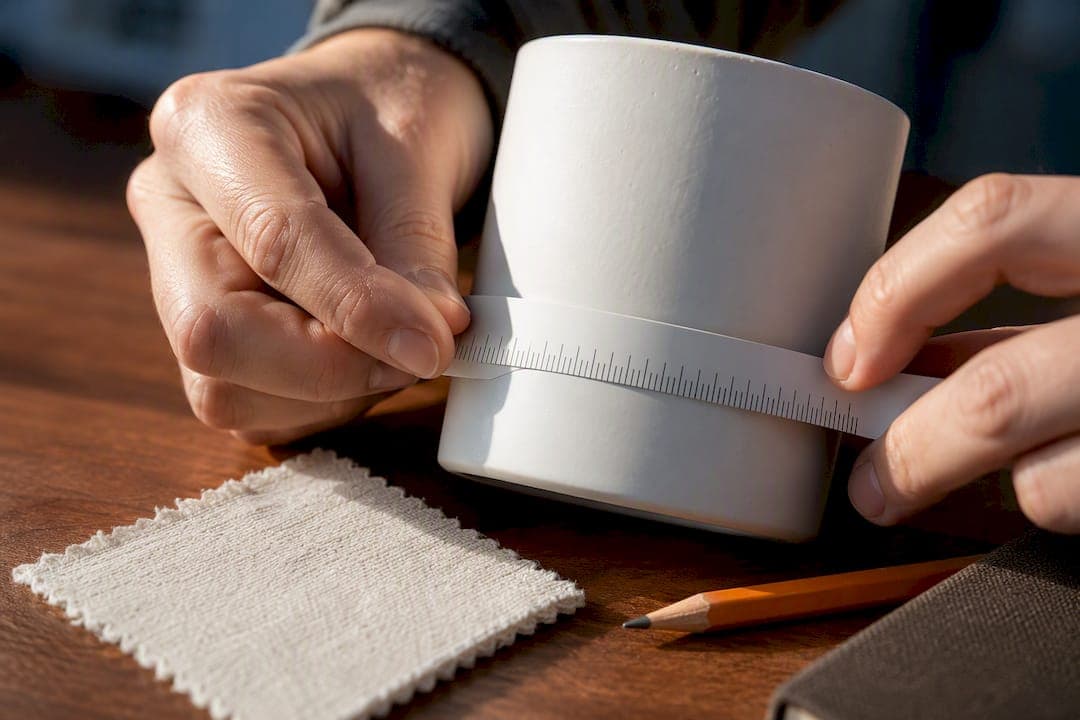
- Measure a real mug if you're unsure of the shape. Take the interior diameter and multiply by pi (π) to get the circumference, which gives you a realistic flat width for your mockup.
- Request a proof whenever the wording is borderline. Most sellers who offer an editable wrap area will show you a preview before production.
Pro Tip: If your text is right on the edge of a line limit, order a single sample mug before committing to a batch of gifts. A £10 test run is far cheaper than reprinting six.
How do font size and line breaks change how much text fits?
Character limits shift dramatically with font choice, because a limit is really a space budget, not a fixed number. Readable mug text generally needs to sit at the visual equivalent of 12 to 14 point size once scaled up to print dimensions. Drop below that and text becomes hard to read from arm's length, which defeats the purpose of a personalised gift.
- Condensed or script fonts pack in more characters but sacrifice legibility, especially on curved surfaces where letters already distort slightly.
- All-caps text takes up noticeably more horizontal space than mixed case, which quietly eats into your character allowance.
- Balance line lengths across two lines rather than leaving one line long and one line short with a lonely orphan word trailing beneath it.
A single cramped line of 40 characters at a tiny point size will almost always look worse than two relaxed lines of 20 characters each. When in doubt, choose the two-line layout: it protects legibility more reliably than any character count on its own.
What do real examples look like on different mug sizes?
Seeing actual phrases against actual limits makes the abstract maths click. On an 11oz mug printed in a standard sans-serif font:
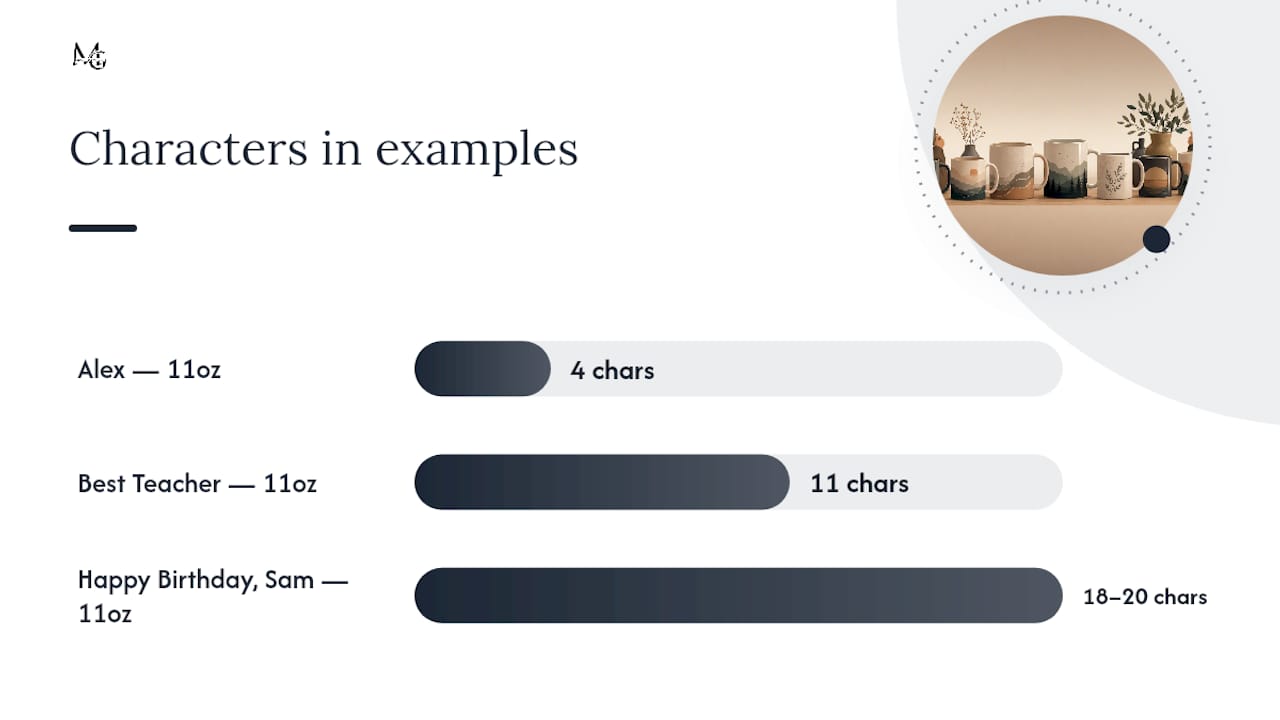
- A single name like "Alex" (4 characters) has plenty of headroom, even in a large point size.
- A short phrase like "Best Teacher" (11 characters, including the space) sits comfortably on one line.
- A greeting like "Happy Birthday, Sam" (18 to 20 characters) still fits on one line but starts to test the font size.
On a 15oz or tall mug, that extra vertical space lets you stack a musician's name above an instrument icon and a short line beneath it, something an 11oz body's shorter height struggles to accommodate cleanly. For inspiration on wording that reads well at small sizes, browsing clever musician mug sayings is a useful starting point before you finalise your own line.
Emojis, accented letters (à, é, ñ) and heavy punctuation all affect spacing differently depending on the font, and vendors don't count them consistently. Always check the specific policy rather than assuming an emoji counts as one plain character.
What should you check before you place your order?
A short checklist at checkout can help prevent most personalisation disappointments:
- Request a visual proof if the vendor offers one, especially for wraparound or multi-line text.
- Confirm whether spaces, emojis, and punctuation count towards the character limit, since policies vary between product pages even within the same shop.
- Check the font options and whether substitutions happen automatically if your requested style doesn't support certain characters or accents.
- Confirm the returns policy for personalised items, since most retailers treat custom prints as non-returnable unless there's a printing fault.
- Ask about turnaround time when a proof is involved, as approval adds a day or two before production starts.
What a mug maker sees go wrong most often
The most common mistake isn't an oversized message. It's a message that's the right length but the wrong shape: one long line crammed at a tiny point size instead of split sensibly across two. That's a free fix, not a redesign, and it's the first thing worth trying before trimming a single word.
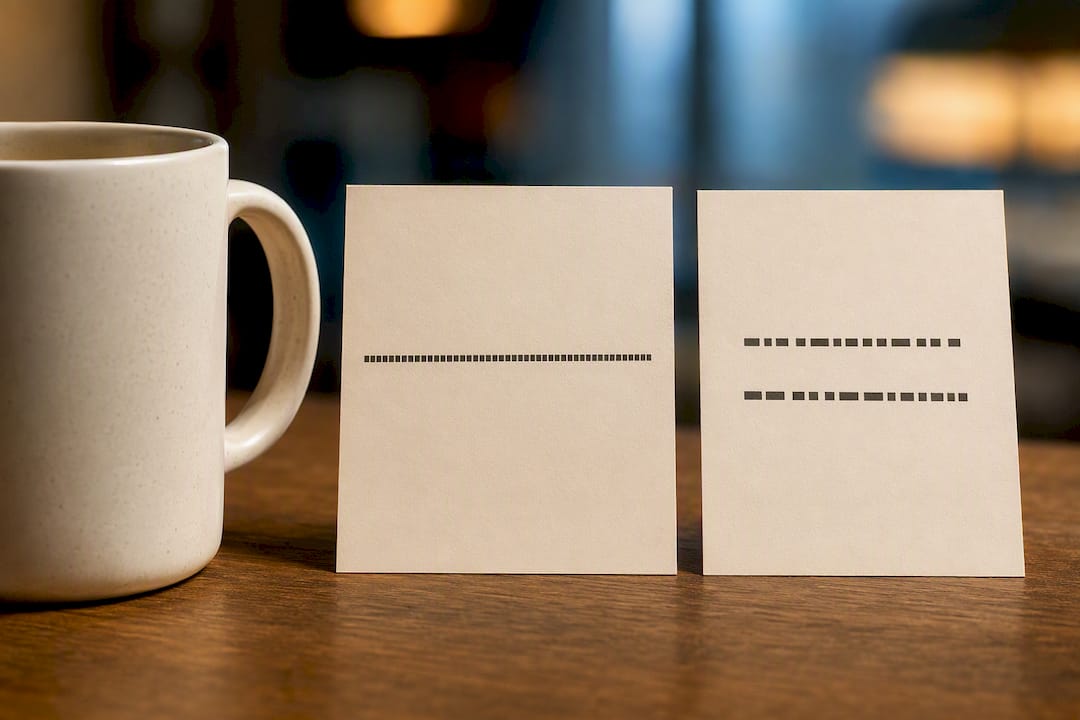
Font weight causes almost as much trouble. A thin, elegant script might look beautiful in a mockup on screen, then vanish into the ceramic glaze once printed at actual size. Bolder, simpler letterforms survive the print process far better, particularly for anything under 12 point.
Custom shops often treat custom orders consistently: they confirm the printable area for the chosen format, show a proof before production, and suggest line breaks if the wording is fighting the space rather than fitting it. Readers wanting a head start on wording can browse the blog's collection of ready-made phrases before typing their own.
— Lasse
Order a personalised music mug with confidence
Getting your wording right shouldn't mean guesswork or a wasted print run. Popular mug formats like the 11oz and 15oz bodies often come with a proofing step built into the ordering process for custom text, so you see exactly how your message sits before it ever touches ceramic.

For musician-themed orders, teams sometimes help fit names, quotes, and instrument icons together, adjusting line breaks and font weight to balance the design for readability. That balancing act is exactly what separates a mug that looks good on screen from one that reads well across a kitchen table. Browse the personalised music mugs collection to see current formats and start building your own design, with a proof to check before it goes to print.
Sources
For readers who want to double check dimensions before ordering, the Gelato printable-area guide lists exact millimetre specifications for common mug formats, while the standard 11oz mug dimensions guide confirms typical height and diameter figures. Always download your chosen vendor's own template before finalising artwork, since figures can shift slightly between suppliers.
- How Many mL In a Mug? A UK Guide to Mug Capacities, Conversions and Practical Measuring - Ratatouie
- What is the printable area for mugs - Gelato support
- What Size Is a Standard Personalised Mug? Full Dimensions Explained - Utterly Printable