

Three reward approaches consistently outperform gold stars and league tables: mastery milestones (skills and badges), autonomy-supporting choices (letting students pick their own reward), and personalised keepsakes that mark real progress. Each does a different job, and knowing which one fits which moment matters more than the reward itself.
Pro Tip: Match the reward type to the setting: badges for structured progression, choice-based rewards for weekly lessons, keepsakes for milestones worth remembering.
- Weekly lessons – small, frequent tokens or a student-chosen reward keep momentum without fuss.
- Term or exam milestones – a badge, certificate, or pin marks a genuine leap in skill, much like Durham Music Service's Secondary Framework does with its Bronze, Silver, and Gold pins.
- End-of-year or standout effort – a personalised keepsake, such as a music-themed mug from Mugnificent Deals or a postcard scheme like Sutton Music Trust's "Note Home", gives the moment weight.
Key Takeaways
Autonomy-supportive, mastery-focused rewards, delivered privately and paired with occasional personalised keepsakes, build stronger, longer-lasting motivation than public ranking systems.
| Point | Details |
|---|---|
| Prioritise mastery over ranking | Link rewards to skill growth, not peer comparison, to encourage deliberate practice. |
| Use a simple levels system | A Bronze, Silver, Gold structure with badges scales from one pupil to a whole department. |
| Present rewards privately | Avoid league tables; offer choices and specific praise tied to real behaviours. |
| Measure practice and enjoyment | Track logging frequency and informal enjoyment check-ins rather than exam scores alone. |
| Mark milestones with keepsakes | A personalised mug from Mugnificentdeals gives lasting recognition for genuine progress. |
Table of Contents
- Why mastery- and autonomy-supporting rewards beat public ranking
- Creative reward ideas for every budget and occasion
- How to build a levels-based reward scheme in one term
- How to present rewards without killing intrinsic motivation
- How to tell if your reward scheme is working
- Turning a milestone into something worth keeping
- Frequently asked questions
- Sources
Why mastery- and autonomy-supporting rewards beat public ranking
Students who receive autonomy-supportive teaching, meaning choices, explanations, and encouragement rather than control, show measurably higher intrinsic motivation. Bonneville-Roussy and colleagues found that autonomous motivation explained roughly 60% of the variance in practice quality among the university musicians they studied. That is not a marginal effect. It suggests how a reward is framed matters more than what it costs.
The mechanism runs in a fairly simple line: autonomy support builds autonomous motivation, autonomous motivation improves practice quality, and better practice quality sustains itself without constant external pushing. Research on adolescent instrumental learners in England backs this up directly, finding that rewards tied to mastery goals, personal skill growth rather than beating classmates, produce more deliberate practice.
Two UK examples show this working at real scale:
- Durham Music Service runs a three-level progression system (Bronze, Silver, Gold) mapped to school years, with pin badges marking each milestone rather than a class ranking.
- Sutton Music Trust's "Note Home" rewards effort across seven categories, including collaboration and ambition, using postcards that students themselves helped design.
Neither scheme ranks pupils against each other. Both reward growth.
Creative reward ideas for every budget and occasion
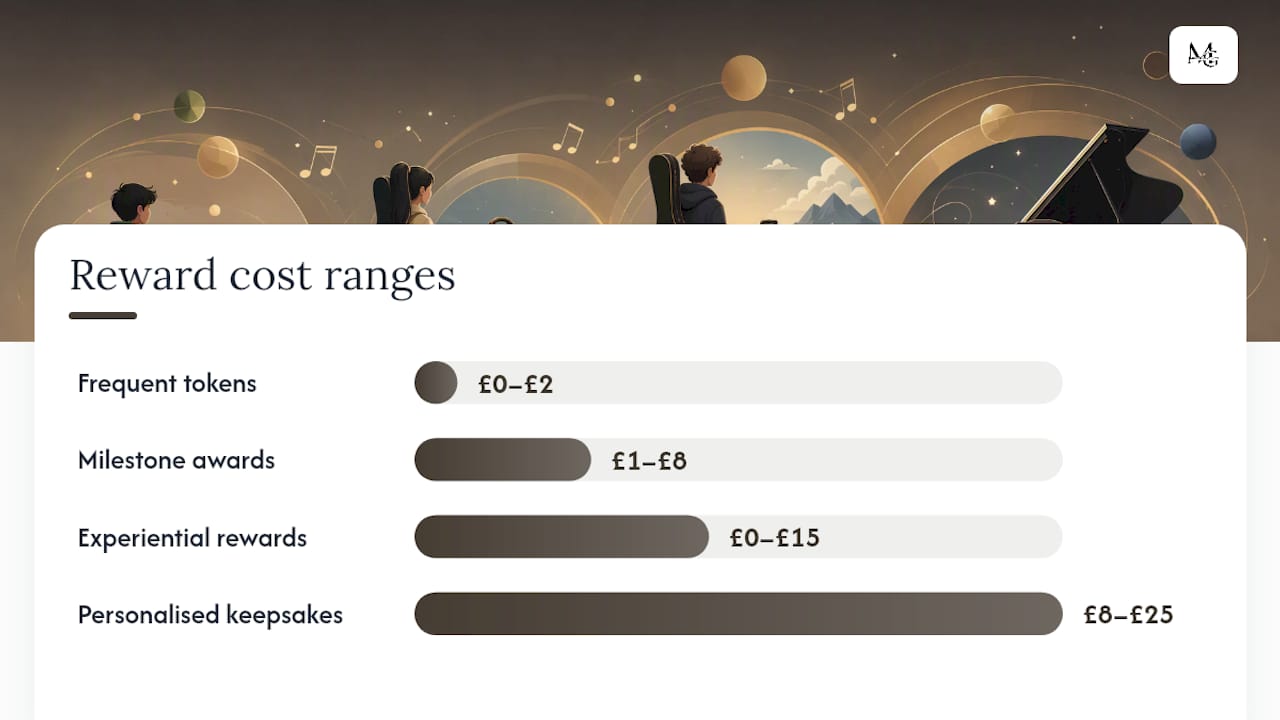
Reward ideas fall into four natural groups, each solving a different motivational problem. Frequent low-cost tokens keep weekly momentum going. Milestone awards mark real skill jumps. Experiential rewards give students something to look forward to. Personalised keepsakes make progress feel permanent.
Frequent, low-cost tokens (roughly £0 to £2 per student):
- Practice charts with stickers for each session logged
- A "sound of the week" shout-out for a specific technique nailed
- Choice of warm-up exercise or piece for the next lesson
- Printable certificates for consistent attendance
- A token system redeemable for a small prize later in term
Milestone awards (roughly £1 to £8):
- Pin badges for grade completions, echoing the Durham Music Service model
- Merit certificates for scale mastery or sight-reading progress, similar to schemes such as Milly Holroyd Music's merit system
- Wristbands or non-competitive milestone markers, as seen in Sweet Symphony Quest
- A "level up" wall chart students update themselves
Experiential rewards (roughly £0 to £15, often free within a lesson slot):
- A mini-recital slot for family or peers
- Studio recording time to capture a finished piece
- First go on a new instrument during a group session
- Choosing the next ensemble piece for the class
Personalised keepsakes (roughly £8 to £25):
- Engraved plectrums or tuning forks
- Music-themed tote bags
- A personalised music mug with the student's name, instrument, or a favourite lyric
- Postcard-style notes home, in the spirit of Sutton Music Trust
A personalised mug earns its place at milestone moments rather than every week: a Grade 5 pass, the last lesson of term, or a teacher's own thank-you gift to a class. It works because it outlasts the lesson, sitting on a kitchen shelf as daily proof of what was achieved, which is exactly the kind of keepsake covered in this guide to affordable gifts for music students.
How to build a levels-based reward scheme in one term
A simple levels-based scheme takes surprisingly little to set up, and it scales from one pupil to a whole department. Durham Music Service proves the model works from single lessons to secondary-wide programmes.
- Define the objective – decide whether you are rewarding practice consistency, technical progress, or ensemble participation.
- Set milestone criteria – three levels (Bronze, Silver, Gold, or similar) tied to clear, observable skills.
- Choose rewards per level – tokens for early levels, a badge or certificate for mid-level, a keepsake for the top tier.
- Create tracking materials – a simple chart or card, nothing that needs a spreadsheet.
- Launch and celebrate – announce it plainly, show the physical badges or cards, and explain the "why."
- Review after the pilot – check what worked before rolling it out further.
| Week | Milestone | Deliverable |
|---|---|---|
| 1–2 | Launch scheme, explain criteria | Tracking cards distributed |
| 3–6 | First-level progress checks | Bronze-equivalent tokens or badges issued |
| 10 | Mid-pilot review | Adjust criteria if uptake is low |
| 12 | Milestone celebration | Certificates, badges, or keepsakes awarded |
Pro Tip: A two-week mid-pilot review catches criteria that are too vague or too strict before the whole term is spent, without adding heavy bookkeeping.
How to present rewards without killing intrinsic motivation
Presentation decides whether a reward builds confidence or breeds comparison. A literature review on motivating music students warns that public evaluation and social comparison undermine intrinsic motivation, recommending autonomy-supportive alternatives instead.
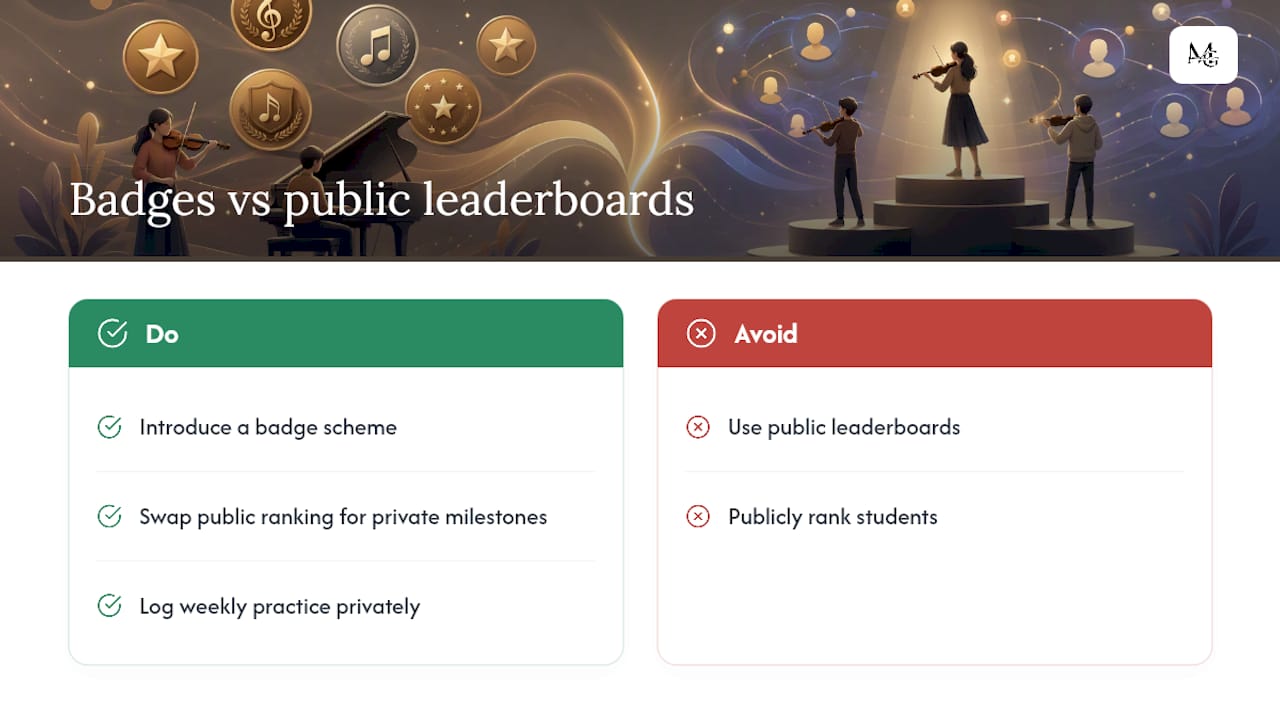
Do:
- Offer a choice between two or three reward options
- Present milestone rewards privately or in small groups, not as a class-wide ranking
- Explain specifically what behaviour earned the reward ("your bowing arm has really steadied")
- Let older students help design their own criteria
Don't:
- Post league tables or "student of the month" rankings
- Compare one student's progress to another's out loud
- Reward outcomes only (competition wins) while ignoring effort
Try phrases like: "You've kept your metronome practice consistent for three weeks, well done," rather than "You're better than most of the group now." Younger students respond well to visual badges and enthusiastic delivery; teenagers often prefer a quieter, more specific acknowledgement of skill gained.
Pro Tip: For teenagers, drop the fanfare and lead with the specific skill improved. Public praise can feel more like exposure than encouragement at that age.
How to tell if your reward scheme is working
Track simple, honest indicators rather than waiting for exam results to judge success: practice frequency, lesson attendance, and how students describe their own enjoyment.
- Weekly practice log completion rate
- Attendance consistency across the pilot period
- A quick, informal "how are you finding lessons" check-in
Run two small experiments: present the same reward publicly with one group and privately with another, and offer a fixed reward to one group against a choice-based reward to another. Watch which produces steadier practice logs.
At the end of the pilot, ask three questions: Did practice frequency improve? Did students seem to enjoy the process more? Did any part of the scheme feel like competition rather than growth? Adjust the weakest answer first.
A practical note from small UK music settings
A badge scheme in one small studio setting, similar in spirit to Durham's model, noticeably lifted weekly practice logging once badges replaced a public leaderboard. The lesson: swap ranking for private milestones this term and watch attendance steady.
Turning a milestone into something worth keeping
A badge fades into a drawer. A certificate gets filed away. A personalised keepsake sits on a shelf and gets used, which is exactly what makes it stick as a marker of progress long after the lesson ends.
Mugnificentdeals designs personalised music mugs around the details that matter to a young musician: their instrument, their name, even a lyric from the piece they finally nailed. Three things make them work well as a reward: full customisation for each student, ceramic built for daily use rather than a display shelf, and quick turnaround so a mug can mark a milestone while it is still fresh. Save the mug for the moments that deserve to last, a grade pass, an end-of-term send-off, a teacher's thank-you to a class, and keep the weekly tokens for the smaller wins in between. Browse the full collection of music-themed mug designs and pick one that fits the milestone you are celebrating.
Frequently asked questions
What are the best creative rewards for music students? Mastery-linked badges, student-chosen rewards, and personalised keepsakes for milestones tend to outperform generic prizes because they reinforce skill growth rather than competition.
How often should rewards be given? Small tokens work weekly; badges or certificates suit termly milestones; keepsakes fit rarer, bigger achievements like exam passes or end-of-year send-offs.
Do rewards ever backfire? Yes, when presented publicly as rankings. Research on motivating music students shows social comparison can undermine intrinsic motivation, so private or choice-based recognition works better.
Are personalised gifts appropriate for music students? A personalised mug or keepsake suits milestone moments, like grade passes or term completions, rather than everyday practice rewards, which are better served by low-cost tokens.
Sources
- DMS Secondary Framework
- Understanding the achievement goals of adolescent instrumental learners
- Motivating music students: a review of the literature
- The support of autonomy, motivation, and music practice in university music students
- Note Home reward scheme