
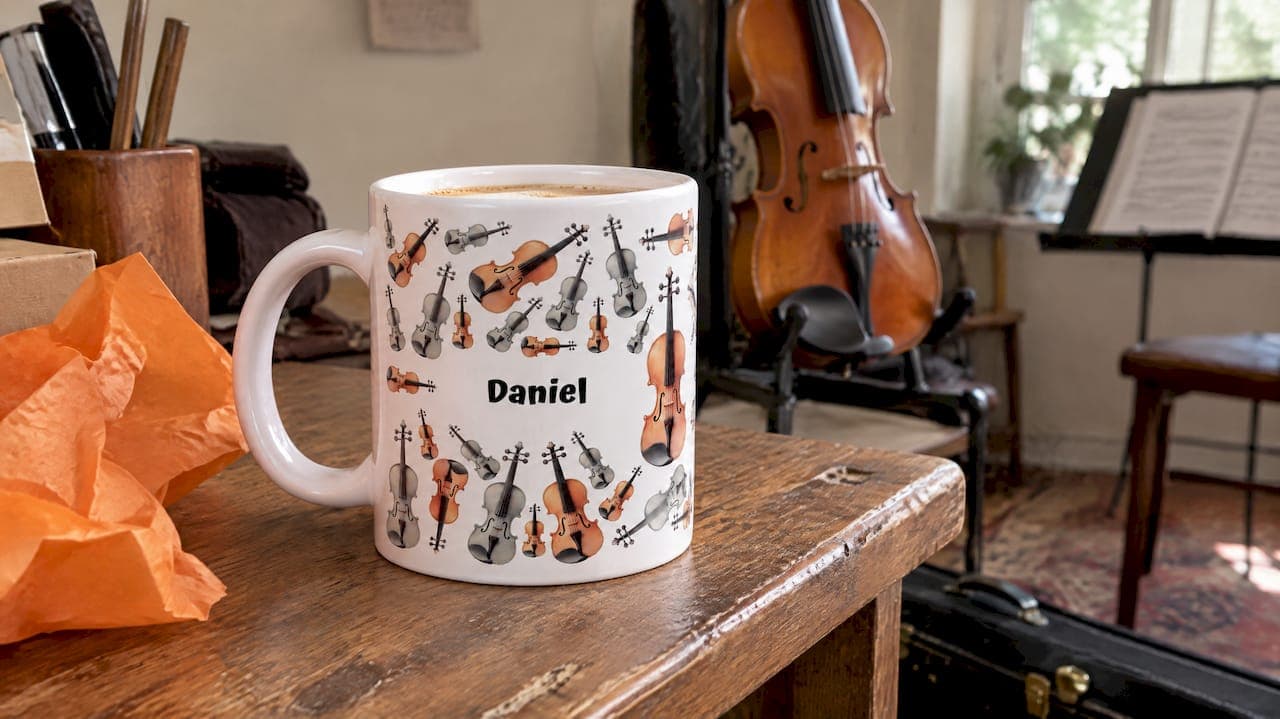
This page gathers inspirational, funny and short violin quotes, each one properly attributed, so you can use them with confidence on captions, cards or personalised gifts. Every line here comes from a named violinist or a traceable, reputable source rather than an uncredited internet rumour. We have also added simple guidance on choosing and using a quote well, whether it is going on a recital card or a mug.
TL;DR:
- Use Menuhin’s daily practice maxim for routine, Kopatchinskaja’s expectation of a miracle for performance nerves, and Benedetti’s advice for student encouragement.
- Keep mug or small card wording to roughly ten to twelve words, use one short phrase, and pair it with a simple instrument sketch.
- For named quotations, credit the performer; label original humorous lines as original instead of assigning them to a famous violinist.
- Use brief quotes with accurate wording for personal gifts, but check copyright before printing them at scale or offering them for resale.
Table of Contents
- 1. Inspirational violin quotes worth remembering
- 2. Funny violin quotes and playful lines
- 3. Short quotes for captions, cards and small gifts
- 4. Famous violinist quotes with context: why they work
- 5. How to choose and use a violin quote for a gift, caption or mug
- 6. Why accurate attribution matters for musician gifts
- 7. The historical significance of famous violin quotes
- 8. What composers have said about the violin
- 9. Quotes about the technical demands of playing the violin
- 10. Our take: attribution matters more than polish
- 11. Where to order a personalised violin-quote mug
- FAQ
- Sources
1. Inspirational violin quotes worth remembering
Inspirational violin quotes tend to work best when they talk about feeling, voice and connection rather than technique alone. Nicola Benedetti's advice to young players, recorded in a BBC feature on her teaching, is a strong example: she encourages players to "be as expressive and natural as you can be," and warns against lessons that "squash" a student's intuition. That pairing, expressive freedom alongside a caution against over-correction, gives the quote real staying power on a gift or card.
Several other performers echo this emotional framing shaped by diverse experiences. Alina Ibragimova and fellow violinists describe the violin as the player's own "voice," a line that resonates with anyone who has ever felt music speak for them when words failed. The same interview captures the idea that the instrument exists to make an audience "smile, laugh, cry," a phrase borrowed from contemporary player Emma Arizza's own reflections on performing for different crowds.
A short list of attributable inspirational lines, ready to use:
- "Be as expressive and natural as you can be." (Nicola Benedetti)
- The violin as "your voice," a recurring idea among performers including Alina Ibragimova.
- Music that makes an audience "smile, laugh, cry," echoing Emma Arizza's view of performance.
- "One has to play every day." (Yehudi Menuhin, recalled by Daniel Hope)
- "Every time, I'm expecting a miracle." (Patricia Kopatchinskaja)
These lines suit a graduation card, a teacher's thank-you gift or a mug a student keeps on their desk during exam season.
2. Funny violin quotes and playful lines
Humour is where unattributed quotes cause the most trouble, since jokes about instruments circulate online with no real source behind them. We favour verified anecdotes over guesswork. Stéphane Grappelli's interviews, archived by the National Jazz Archive, offer the kind of playable, good-natured humour that comes from decades of real performing rather than a recycled meme.
Where no verified joke exists, a short original line inspired by genuine playing experience is safer than attributing something to a performer who never said it. A few options for a lighter gift or caption:
- "I improvise, not mistakes." (a self-aware original line, suited to a practice mug)
- Grappelli's playful stage manner, often recalled fondly in jazz history circles, supports captions about joy rather than perfection.
- "Practice makes imperfect, but at least it's loud." (a light original quip for a student gift)
- "My violin and I have an understanding: it screeches, I apologise." (best for a beginner's card)
Keep humour for informal gifts, practice-room mugs or cards between friends rather than formal recital programmes.
3. Short quotes for captions, cards and small gifts
Short lines earn their place on small surfaces because they stay legible at a glance. Below, each is marked as attributed (credit the source) or generic (safe to use without a name).
- "One has to play every day." Attributed to Yehudi Menuhin. Best for a practice-focused gift.
- "Be as expressive and natural as you can be." Attributed to Nicola Benedetti. Best for a student's recital card.
- "Every time, I'm expecting a miracle." Attributed to Patricia Kopatchinskaja. Best for a performance-day gift.
- "Your voice, your violin." Generic, inspired by player interviews on the instrument as personal expression. Best for a gift tag.
- "Music first, perfection later." Generic. Best for a beginner's mug.
- "Four strings, one feeling." Generic. Best for a social caption.
- "I improvise, not mistakes." Generic. Best for a humorous gift.
- "Smile, laugh, cry: that's the job." Generic, drawing on performer reflections about audience connection. Best for a thank-you card.
- "Play like no one's listening, then play like everyone is." Generic. Best for a confidence-boosting gift.
- "The bow does the talking." Generic. Best for a short caption.
- "Practice is the quiet part of a loud dream." Generic. Best for a student's mug.
- "Every scratch today is tomorrow's sound." Generic. Best for a learner's encouragement card.
4. Famous violinist quotes with context: why they work
Quotes from working violinists carry more weight than anonymous lines because they come from people whose relationship with the instrument is a matter of public record. A handful stand out for both authenticity and versatility.
- Nicola Benedetti's call to stay "expressive and natural" suits encouragement for students who worry too much about technical correctness.
- Alina Ibragimova's framing of the violin as a personal "voice" fits audience-facing captions about emotional communication.
- Yehudi Menuhin's maxim that "one has to play every day," recalled by Daniel Hope, works well for gifts meant to encourage daily routine.
- Patricia Kopatchinskaja's admission that she "expects a miracle" in every performance speaks to performance-day courage rather than rehearsed perfection.
- Emma Arizza's reflections on making audiences feel something make her perspective a good match for recital-facing captions.
One interview from the Guardian's 2024 feature on Patricia Kopatchinskaja captures the idea that a performance should hold space for surprise rather than flawless repetition, a useful reminder for anyone choosing a quote meant to calm pre-concert nerves.
Each of these lines suits a different moment: Menuhin for daily practice, Kopatchinskaja for performance nerves, and Benedetti or Ibragimova for anything audience-facing.
5. How to choose and use a violin quote for a gift, caption or mug
A good quote earns its place when it matches the occasion, fits the space available and credits its source honestly.
- Match the purpose first: practice encouragement, performance nerves, or a simple thank-you.
- Keep it to one line where possible; mugs and small cards rarely hold more than ten to twelve words well.
- Credit the performer by name when the quote is directly attributed, and label original lines as such.
- Check that a short quoted phrase, rather than a full passage, is what you are reproducing, since brief lines are safer to use than copying extended text.
For a mug, pair the quote with a simple instrument sketch, keep the font large enough to read from across a kitchen table, and avoid cramming more than one short phrase onto the surface. For a social caption, add the performer's name and the occasion (a recital, a graduation, a teacher's last day) so the context carries as much weight as the words.
Pro Tip: Pick one quote and one visual idea, then build the design around that single pairing rather than layering several ideas onto one small surface.
6. Why accurate attribution matters for musician gifts
We spend a fair amount of time tracing a quote back to its original interview before it goes anywhere near a mug design, because a line that sounds inspiring loses its charm the moment it turns out to be wrongly credited. Getting the attribution right also makes a gift feel more personal: a teacher who recognises a genuine Nicola Benedetti line, for instance, reads it as a thoughtful detail rather than a generic platitude borrowed from nowhere in particular.
That care shows up across our instrument-themed mug designs, which focus specifically on musicians rather than generic gift buyers. A violin teacher's end-of-term gift, paired with a correctly credited quote and a simple sketch of the instrument, tends to land better than a mug with an unattributed line that could belong to anyone.
— Lasse
7. The historical significance of famous violin quotes
Violin quotes carry weight partly because the instrument itself has centuries of recorded performance history behind it. Lines from figures such as Yehudi Menuhin, who shaped twentieth-century violin pedagogy and performance, carry a different kind of authority than a quote invented for a product label. His maxim about daily playing, recalled by his student Daniel Hope, has survived because it reflects decades of lived practice rather than a passing soundbite.
This is part of why attribution matters so much in this niche. A quote attached to a real name inherits that person's history: their training, their performances, their place in the instrument's broader story. A line from Menuhin lands differently than the same words would from an unnamed source, precisely because listeners know what his career represents.
Historical weight also explains why older quotes tend to focus on discipline and daily commitment, while contemporary performers such as Patricia Kopatchinskaja speak more openly about risk, spontaneity and the unpredictability of live performance. Reading both generations together gives a fuller picture of how the instrument's culture has shifted: from an emphasis on routine and correctness toward a willingness to embrace the imperfect moment on stage.

8. What composers have said about the violin
Composers have long treated the violin as the instrument closest to the human voice, a reputation that shapes much of the language used when they discuss it. That reputation is less about any single famous line and more about a consistent pattern: writers for the instrument tend to describe it in terms of breath, phrasing and speech rather than mechanics.
This framing matters for anyone choosing a quote, because it explains why so many of the most memorable lines about the violin come from performers rather than composers themselves. The instrument's closeness to vocal expression means that performer testimony, people who have spent years coaxing phrasing out of four strings, often carries more specific, quotable insight than a composer's general remarks about orchestration.
When a composer's perspective does appear in a gift or caption, it works best paired with context: a note on the piece being referenced, or the reason the composer wrote for violin in the first place. Without that context, a composer's line about the instrument can read as vague where a performer's first-hand account reads as lived experience.
9. Quotes about the technical demands of playing the violin
The violin has a reputation as one of the harder instruments to learn, and quotes that acknowledge this honestly tend to resonate more than ones that paper over the difficulty. Nicola Benedetti's warning against lessons that "squash" a student's natural instinct, recorded in her BBC interview, points to a real tension in violin pedagogy: the technical demands of intonation, bow control and posture can easily crowd out expression if teaching focuses too narrowly on correctness.
Yehudi Menuhin's insistence that "one has to play every day" reflects the same reality from a different angle: there is no shortcut past the sheer repetition the instrument demands. Daily practice is less a romantic ideal and more a practical requirement for maintaining the fine motor control the violin needs.
For a gift aimed at a student working through this stage, a quote that respects the difficulty rather than glossing over it tends to feel more honest. A line paired with a note like "for the hard days" or "for exam week" does more work than a generic motivational phrase, because it signals that the giver understands what learning the instrument actually involves.

10. Our take: attribution matters more than polish
The biggest gap we see in most violin quote collections is a casual attitude toward sourcing. Plenty of pages recycle the same handful of lines with no clear origin, or attach a quote to a famous name because it sounds plausible rather than because anyone can trace it to an interview or a recorded statement. That habit cheapens the whole idea of a quote gift: the point of crediting Nicola Benedetti or Yehudi Menuhin is that their words carry the weight of a real career, and a wrongly attributed line borrows that weight without earning it.
Our view is that a shorter list of properly sourced quotes beats a longer list padded with guesswork. If a search turns up a line with no clear origin, it is worth skipping rather than repeating. The reader's priority should be matching a quote to the right moment, a recital, a hard practice week, a teacher's retirement, rather than chasing the most dramatic-sounding phrase available. Accuracy and relevance will always outlast cleverness on a gift that is meant to be kept.
— Lasse
11. Where to order a personalised violin-quote mug
A short, correctly credited quote suits a mug because it stays legible at a glance and carries real emotional weight, especially when paired with a simple instrument sketch. Our personalised music mugs collection lets you build exactly that: a chosen quote, a name, and an instrument sketch, printed together on one design.

Common choices our customers make when putting a quote on a mug:
- A short attributed line (such as a practice maxim) paired with the recipient's name.
- An instrument sketch alongside the quote, available through our instrument sketch mug designs.
- A brief gift message on the reverse side for a teacher, student or fellow player.
Browse the collection and build a design around the quote that fits your occasion.
FAQ
What are some beautiful quotes about violins?
Among the most resonant are Nicola Benedetti's advice to "be as expressive and natural as you can be" and Yehudi Menuhin's reminder that "one has to play every day." Both lines come from recorded interviews rather than unattributed internet sources, which makes them safer choices for gifts or captions.
What is the violin saying?
Several performers, including Alina Ibragimova, describe the violin as the player's own "voice," a way of communicating feeling without words. That framing explains why so many violin quotes focus on emotion and connection rather than technique.
What is the best quote for music?
There is no single definitive quote, since the right choice depends on the occasion. For performance nerves, Patricia Kopatchinskaja's line about expecting "a miracle" on stage works well, while Menuhin's daily-practice maxim suits a student still building routine.
What are 5 short quotes?
Five reliable short options are Menuhin's "one has to play every day," Benedetti's "be as expressive and natural as you can be," Kopatchinskaja's "every time, I'm expecting a miracle," the generic line "four strings, one feeling," and "the bow does the talking." The first three carry named attribution; the last two are safe generic lines for captions or small gifts.
Is it acceptable to put a quote on a personalised gift without permission?
Short, factually accurate attributions to a named public figure's recorded interview statement are generally fine for a personal gift, provided the wording and credit stay accurate. For anything produced at scale or for resale, checking copyright basics for the specific quote and source is worth doing before printing.
Sources
- Violin star Nicola Benedetti's top tips for young players - BBC News
- Alina Ibragimova interview | The Guardian
- My mentor Yehudi Menuhin: 'I can still hear his beautiful sound' | The Guardian
- ‘I’m not humble. I expect miracles’: why violinist Patricia Kopatchinskaja wants to blow you out of your seat | The Guardian