
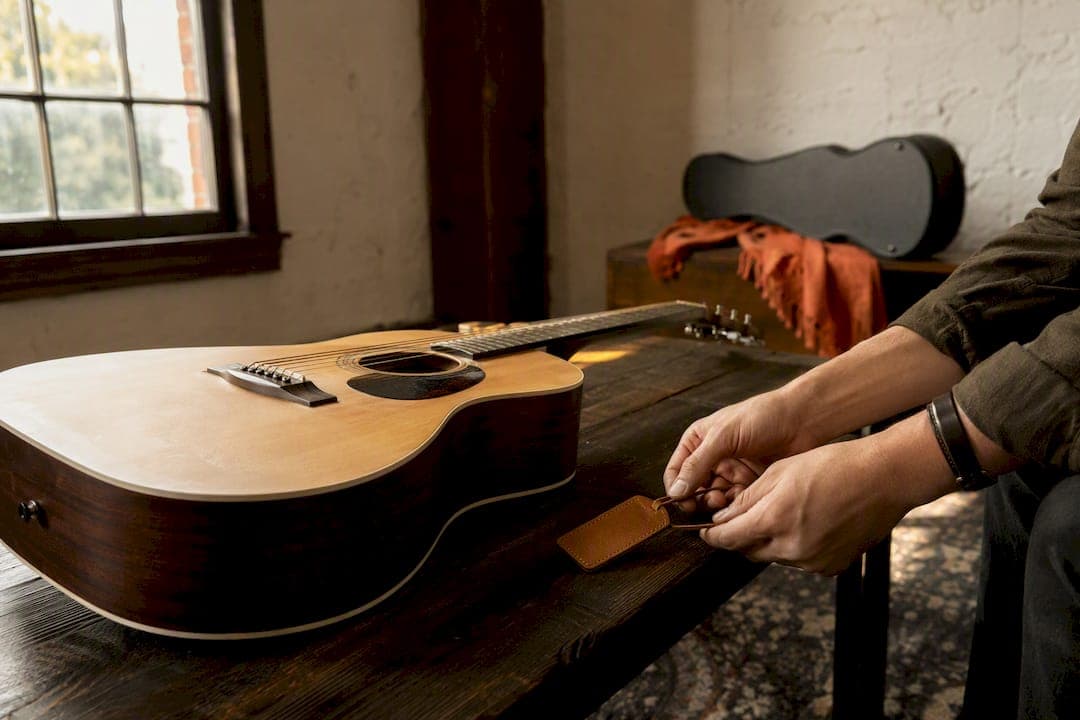
Pick a name by matching it to how the instrument sounds or looks, not by overthinking it: a warm-toned acoustic suits "Honey" or "Amber", while a battered gigging guitar earns something tougher like "Old Faithful" or "Trigger". Fast picks worth borrowing right now: Lucille, Blackie, Copper, Muse, Thunderbird, Runt, Old Faithful and Sparkle. If you're stuck, try the announce test: say the name aloud, then picture yourself introducing it on stage. If it doesn't land in two seconds, it's not the one.
TL;DR:
- Names that sound tough or project well, like Vandal or Reckoning, are best suited for stage-ready electric guitars with attitude.
- Short, hard consonant names such as Lucille or Vortex are more effective for practical, easy-to-shout instrument labelling in live settings.
- Personal history and visible features like wear, finish, or color add authenticity and emotional weight to the chosen name.
- Avoid permanence by using removable labels or custom mugs instead of engraving directly on the instrument to prevent damage and regret.
- Community input and self-testing through the announce test help confirm that a name will feel natural and memorable during actual performances.
Table of Contents
- Quick starter list: 30 ready-to-use instrument nicknames
- Funny and punny name ideas for instruments
- Cool and cinematic names for a stage-ready instrument
- Cute and characterful names for small and student instruments
- Poetic and aesthetic names for classical or vintage instruments
- Matching finish and appearance to a name
- Names for strings, brass, woodwind, percussion and keys
- How to choose a name that actually sticks
- Labelling and marking an instrument safely
- Letting your own story shape the name
- Getting bandmates and your community involved
- How naming trends differ across genres
- Steering clear of trademark and copyright issues
- Why the ritual of naming matters more than the name itself
- Celebrate a newly named instrument without touching the finish
- Sources
Quick starter list: 30 ready-to-use instrument nicknames
You don't need a five-step method to get started tonight. Below are 30 names sorted by the kind of instrument they tend to suit best, each with a one-line reason so you can see why it works before you commit.
For a travel ukulele or small acoustic
- Runt — for the smallest thing in the room that still shows up loud.
- Peanut — an obvious pick for anything pocket-sized, and it never stops being funny.
- Pip — short, easy to say between songs, and doesn't feel babyish once you've gigged with it.
- Nomad — fitting for an instrument that's flown more miles than you have.
- Biscuit — warm, homely, and slightly daft in a good way.
For a well-worn, gigged-up electric guitar 6. Old Faithful — the classic nod to reliability that's earned rather than assumed. 7. Roadie — for the guitar that's survived more van journeys than any person on the tour. 8. Scar — if the finish has taken a few knocks and you'd rather celebrate that than hide it. 9. Ironside — solid, blunt, and suits a Tele that's never once let you down. 10. Warhorse — a bit theatrical, but earns its keep on a battle-scarred body.
For a bright or flashy finish 11. Sparkle — literal, but works precisely because it doesn't try too hard. 12. Comet — good for anything with a metallic or pearl finish that catches stage lights. 13. Neon — suits anything loud in colour as much as loud in tone. 14. Copper — for sunburst and orange-toned finishes with a bit of warmth to them. 15. Firefly — small, bright, slightly unpredictable, just like the sound.
For a jet black or minimalist instrument 16. Phantom — the obvious choice, and still the best one for a black-on-black finish. 17. Midnight — softer than Phantom, better suited to a jazz box or hollow body. 18. Onyx — a touch more formal, good for a classical or orchestral instrument in black lacquer. 19. Shadow — works for anything understated that still commands the room.
For brass and woodwind 20. Brassy — obvious, but that's exactly why it works at a jam night. 21. Foghorn — for a trombone or baritone with real low-end presence. 22. Reedy — self-deprecating enough to get a laugh from a sax section. 23. Chatterbox — fits a clarinet that never seems to shut up in rehearsal.
For keys and synths 24. Ivory — a classic nod to piano heritage, even on instruments with no ivory at all. 25. Ghost — suits a synth with an eerie, ambient patch collection. 26. Muse — works on nearly anything, but especially a keyboard that's inspired a whole album. 27. Wren — a small, delicate name for a compact digital piano.
For percussion 28. Thunder — obvious for a kick drum, but still satisfying to shout across a stage. 29. Rattler — good for a snare with a distinctive buzz. 30. Anvil — for the drum that sounds like it could dent the floor.
Funny and punny name ideas for instruments
Humour works best when the pun is quick to say and doesn't need explaining twice. If you have to pause and unpack the joke, it's not going to survive being shouted across a rehearsal room. The best funny names for musical instruments tend to lean on the instrument's job, its shape, or a well-worn cliché that's been flipped on its head.
For guitars, puns on strings and frets travel well:
- Fretful — for an instrument that's always slightly out of tune.
- Chord Blimey — daft, but it gets a laugh every single time.
- Sir Strums-a-Lot — a mock-noble title for a guitar that's earned its stripes.
- Plank — self-deprecating slang some guitarists already use, worth adopting properly.
- Fender Bender — obviously reserved for a Fender that's taken a few knocks.
Drums invite a slightly different kind of humour, usually built around noise or attitude:
- Ruckus — does exactly what it says.
- Thumper — simple, and works for a kick drum with genuine low-end punch.
- The Snare-cissist — for the drummer who insists on a solo every set.
- Boom Stick — blunt, and slightly ridiculous in the best way.
Brass and woodwind instruments lend themselves to puns on breath and tone:
- Windbag — cheeky, especially for a trumpet player who talks as much as they play.
- Sir Toots-a-Lot — for a trombone with a big, comic presence.
- Squeaky — earns its place on a clarinet that hasn't quite been broken in yet.
- Hornswoggle — nonsense word, but it fits brass instruments unusually well.
Keys and synths tend to work better with wordplay on their sound or their reputation:
- Ivory Tickler — old-fashioned, but still funny for an acoustic piano.
- Synthformer — for a keyboard with more patches than the player has ever used.
- The Diva — for the synth that always seems to need tuning before a gig.
A quick note on tone: puns age fastest when they lean on a meme, a reference, or slang that's tied to a specific moment. A name built on wordplay tends to last; a name built on a trending joke tends to feel dated within a year or two. It's also worth steering clear of puns that punch down at a genre, a nationality, or a person, even in jest. The goal is a laugh in the room, not an explanation later about why it seemed funny at the time.
Cool and cinematic names for a stage-ready instrument
Some instruments don't need warmth or humour. They need a name that sounds good shouted across a stage, and that usually means something short, hard-consonant, and built to project. Think about how a name sounds through a PA system before you commit to it. Multisyllabic, soft-vowelled names tend to disappear in the mix; sharp, one or two-syllable names cut through.
For electric guitars aiming for presence over charm:
- Vandal — blunt and a little dangerous, fits a guitar with real attitude.
- Reckoning — dramatic, works well for a signature instrument used on a big song.
- Wraith — suits anything with a dark or minimalist finish and a cold, cutting tone.
- Vulture — sharp consonants, easy to shout, carries real menace.
- Nomad — works differently here than on a travel uke; on an electric it reads as rootless and restless rather than portable.
For synths and electronic rigs, cinematic names often lean on scale or atmosphere:
- Eclipse — good for a synth with a dark, ambient sound palette.
- Vortex — suits a modular rig that never sounds the same way twice.
- Nova — bright, expansive, and easy to say fast between songs.
- Static — self-explanatory for anything glitchy or noise-based.
For pianos, both acoustic and digital, cinematic naming tends to work through contrast: something grand for an instrument that's actually quite plain, or something stark for a piano with a huge, room-filling tone.
- Requiem — dramatic, but it earns its place on an instrument used for serious, weighty material.
- Obsidian — suits a black lacquer grand or a digital piano with a similarly dark finish.
- Colossus — blunt, but works precisely because it's honest about scale.
The mechanics behind why these work matter more than the words themselves. Hard consonants (K, T, V, X) cut through a mix and a crowd far better than soft ones (S, M, L, N). A name with two syllables or fewer is easier to shout, easier to remember, and easier to fit into a setlist joke or a between-song introduction. That's part of why B.B. King's guitar became simply "Lucille": one syllable, easy to say fast, easy to shout from a stage even decades on.
Cute and characterful names for small and student instruments
Small instruments earn small names, and there's a reason diminutives work so well on them: a name like "Pip" or "Button" matches the physical scale of a piccolo violin or a half-size cello in a way a grand, cinematic name never quite will. Beginners in particular respond well to something affectionate rather than imposing. A first instrument is already intimidating enough without a name that adds pressure.
Good options for a first violin, a small acoustic guitar, or a student clarinet include:
- Button — small, round, and instantly likeable.
- Pip — works across almost any student instrument, string or wind.
- Nugget — playful, and slightly funny without being a joke name.
- Marshmallow — soft and warm, good for a mellow-toned beginner acoustic.
- Freckle — suits an instrument with a slightly imperfect or worn finish, in an endearing way.
- Sprout — leans into the idea of something young and still growing into its sound.
- Tuppence — a nod to something small but valuable, and slightly old-fashioned in a charming way.
One caveat worth thinking through before you commit: if this is a starter instrument you plan to keep for years, an overly childish name can start to feel awkward once you're playing it in a serious ensemble or gigging semi-professionally. "Button" ages fine because it's short and simple enough to say without embarrassment at 30. "Wittle Fiddly-Widdle" does not. The safest cute names are the ones that stay charming rather than tip into baby talk, because you'll be the one saying it out loud in front of other people for years to come.
Poetic and aesthetic names for classical or vintage instruments
Classical and vintage instruments carry weight, and a name drawn from mythology, literature, or musical vocabulary tends to suit that weight better than something playful. Instrument names themselves often come loaded with etymological history: "trumpet" traces back to the Old French trompette, and that kind of linguistic depth is exactly the well to draw from when naming an instrument that feels like it has its own story.
For violins and cellos with a serious tone or a long personal history:
- Elegy — fitting for an instrument mostly played in slower, mournful repertoire.
- Calliope — after the Greek muse of poetry, works well for a violin with a particularly lyrical tone.
- Serenade — simple, but earns its place through sheer musical relevance.
- Solstice — evokes a turning point, good for an instrument tied to a significant life event.
- Persephone — mythological weight, suits a cello with a dark, rich lower register.
For an acoustic piano, especially an inherited or vintage upright:
- Sonata — direct, musical, and instantly recognisable in any language.
- Aria — short, elegant, and works whether the piano is grand or upright.
- Nocturne — fitting for an instrument mostly played in the evening or in quieter settings.
- Amadeus — a nod to Mozart that works particularly well on an instrument with classical repertoire history.
The strongest poetic names usually echo something specific: the repertoire the instrument is mostly used for, the era it was built in, or a personal story tied to how it was acquired. A violin inherited from a grandparent might take a name from a piece they used to play. A vintage upright bought secondhand from a closing music school might earn a name tied to that history rather than something generic. That specificity is what separates a poetic name that feels earned from one that just sounds nice on paper.
Matching finish and appearance to a name
Visible features are the fastest route to a good name, because you don't need to invent anything. You just need to describe what's already there. A name-generator approach that combines colour, material, and finish is exactly how many naming tools work, and it's just as effective done by eye.
| Finish or appearance | Suggested names | Why it fits |
|---|---|---|
| Sunburst | Ember, Copper, Blaze | Warm gradient tones suit fire and glow imagery |
| Jet black | Phantom, Onyx, Midnight | Solid dark colour suits mysterious, minimal names |
| Worn or vintage | Old Faithful, Relic, Scar | Visible wear reads as history rather than damage |
| Cream or white | Ivory, Ghost, Frost | Pale finishes suit clean, quiet-sounding names |
| Metallic or pearl | Comet, Sparkle, Chrome | Reflective finishes suit anything bright and quick |
| Natural wood grain | Maple, Amber, Honey | Material-led names work when the grain is the standout feature |
| Red or wine finish | Ruby, Crimson, Merlot | Rich colour suits names with a similarly deep register |
Wear and tear is worth treating as a feature rather than a flaw. A chipped headstock, a worn strap button groove, or a faded patch where your arm rests for hours a night are all evidence of use, and a name that nods to that history (Scar, Relic, Old Faithful) tends to feel more earned than one plucked from nowhere.
Names for strings, brass, woodwind, percussion and keys
Different instrument families suit different naming instincts, partly because of how they're used in an ensemble and partly because of how their names get shouted, written on a set list, or introduced to an audience.
Strings (violin, viola, cello, double bass, guitar)
- Sonnet — literary and short, works for a violin with a lyrical tone.
- Timber — a nod to the wood itself, easy to say in a rehearsal setting.
- Fiddlesworth — playful but still dignified enough for classical use.
Brass (trumpet, trombone, tuba, French horn)
- Bellow — direct reference to how the sound is produced.
- Goldrush — suits a brass instrument's typical finish and its bold sound.
- Reveille — a military bugle call reference that works especially well for trumpets.
Woodwind (clarinet, flute, saxophone, oboe)
- Whistler — simple and immediately understandable.
- Sax Appeal — a well-worn pun, but it still lands with a saxophone crowd.
- Piper — traditional, short, and easy to say between takes.
Percussion (drums, cajón, congas)
- Thump — blunt and functional, exactly what you want shouted across a stage.
- Tribal — suits hand percussion with a strong ethnic or world-music influence.
- Anvil — already covered above, but worth repeating here as a genuinely strong percussion pick.
Keys (piano, keyboard, synth, organ)
- Chopin's Ghost — playful classical nod, good for an acoustic piano with real history.
- Circuit — fitting for a synth-heavy setup.
- Organist's Friend — tongue-in-cheek, works for a church or session organ.
Pronounceability matters more in ensemble settings than solo ones. If you're in a band or orchestra, other people will need to say your instrument's name too, sometimes quickly, sometimes mid-rehearsal. A name that trips up bandmates every time tends to get quietly dropped within a few weeks.
How to choose a name that actually sticks
Start with the announce test: say the name aloud, then imagine introducing it to an audience or a bandmate. If it feels natural in both contexts, you've likely found it. If it only works on paper, keep looking.
Beyond that first filter, five criteria consistently separate names that stick from names that fade within a month:
- Sound and phonetics. Short, hard-consonant names carry better across a stage than long, soft ones. Say a shortlist of candidates out loud in the room where you'll actually use the instrument, not just in your head.
- Appearance. Colour, finish, and visible wear are the fastest, most honest source of naming ideas, because they're already sitting in front of you.
- Personality fit. A name should feel consistent with how the instrument gets used, whether that's a gigging workhorse or a delicate studio piece.
- Durability. Avoid names tied to a meme, a slang term, or a cultural reference likely to date within a couple of years. A genuinely good instrument name tends to work as well in ten years as it does today.
- Practicality. Shorter names survive better in real use: on a set list, in a group chat, shouted between songs. Anything over three syllables usually gets shortened anyway, so you might as well pick the short version from the start.
Pro Tip: Before committing, write the name on a piece of masking tape and stick it to the case for a week. If you're still saying it naturally by day seven, it's a keeper. If you've quietly stopped using it, try another shortlist entry.
Testing a name properly means using it in the actual contexts it'll live in: on stage between songs, in texts to bandmates, in the case tag you write by hand. A name that only exists in your head has not actually been tested yet.
Labelling and marking an instrument safely
The urge to make a name permanent is understandable, but permanence and instrument care don't mix well. Adhesive labels, engraving tools, and paint pens can all damage varnish, lacquer, or wood grain in ways that are difficult or impossible to reverse. Poor placement of any marking, even a supposedly light one, can also affect resale value on a good instrument.
Safer alternatives exist and work just as well for showing off a new name:
- Removable case tags, which can be swapped out if the name changes or the case is sold separately.
- A personalised mug or similar keepsake bearing the name and a custom illustration, which celebrates the naming without touching the instrument at all.
- Silk-screened or printed removable labels designed for instrument cases rather than the instruments themselves.
- A quick conversation with a luthier or instrument tech before attempting any permanent marking, particularly on a wooden or vintage piece.
The safest rule of thumb is simple: if a marking method can't be undone, don't use it on the instrument itself. Celebrate the name somewhere else instead.
Letting your own story shape the name
The names that last longest usually aren't the cleverest ones. They're the ones tied to something that actually happened. A scratch from a specific gig, a nickname a bandmate gave the instrument without meaning to, a colour that reminds you of where you bought it: these carry a kind of weight that a brainstormed list, however good, can't quite match.
Think about where the instrument came from and what it's already been through. A guitar bought with your first pay cheque might earn a name tied to that job. A violin passed down from a parent or grandparent might take a name from a piece they used to play, or a place they lived. An instrument bought during a difficult year might get a name that marks moving past it, deliberately or otherwise.
This is also where genre, background, and personal taste genuinely matter more than any generic list can account for. A folk musician steeped in family history will likely gravitate toward something rooted and personal. A metal guitarist building a stage persona might want something harder and more theatrical. Neither approach is more valid than the other, and the best name is usually the one that reflects who you actually are when you're playing, not who you think sounds impressive on paper.
If nothing from your own history jumps out immediately, that's fine too. Sometimes the story hasn't happened yet, and the name arrives later, born from a specific gig or a travel mishap rather than a deliberate decision.
Getting bandmates and your community involved
Naming an instrument doesn't have to be a solo decision, and involving other people often produces better results than brainstorming alone. Bandmates who've spent hours in a rehearsal room with your instrument frequently notice something about its sound or appearance that you've stopped seeing, simply because you're too close to it.
A few practical ways to open this up:
- Float a shortlist of three or four names in your band group chat and ask for a quick vote rather than an open-ended brainstorm, which tends to stall.
- Ask bandmates to describe the instrument's sound in one word first, then use those words as naming material.
- Post a photo in a local music community or online forum and ask for gut reactions. Strangers with no attachment to the instrument often spot the obvious name faster than you will.
- Turn it into a between-set bit at a gig: announce a shortlist to the crowd and let them pick. It's a genuinely fun way to name an instrument, and it gives the eventual name a story from the very first time you use it.
Community input works particularly well for humorous names for musical instruments, since jokes tend to land better when tested on an actual audience rather than imagined in isolation. It's less reliable for poetic or personal names, which usually work better coming from you alone. Use the method that suits the tone you're going for.
How naming trends differ across genres
Naming instincts shift noticeably depending on the scene you're playing in, and it's worth knowing the general patterns before picking a direction.
Blues and country players lean toward names with a story and a bit of grit, following in the tradition of instruments like Lucille, Trigger, and Blackie: names that sound like they belong to a person as much as an object. Folk and singer-songwriter circles tend to favour warmth and gentleness, often reaching for nature imagery or diminutives. Metal and hard rock players usually want something harder and more theatrical, closer to the cinematic names covered earlier, built to match a stage persona rather than a personal history.
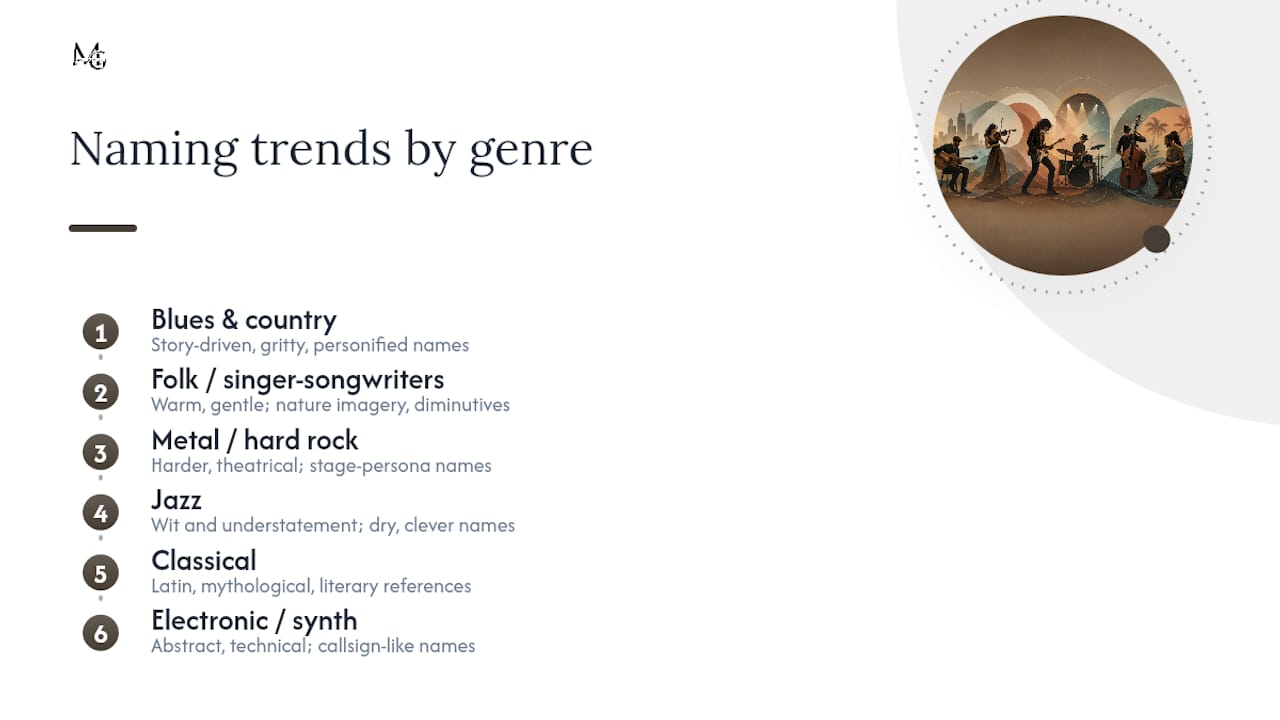
Jazz musicians often go for wit and understatement, favouring a dry, clever name over anything dramatic. Classical players, when they name instruments at all, tend toward Latin, mythological, or literary references that echo the repertoire itself. Electronic and synth-based artists frequently skip warmth altogether in favour of something abstract or technical, treating the instrument more like a tool with a callsign than a companion with a personality.
None of these are rules. They're just patterns worth knowing before you pick a direction, because a name that feels perfectly natural in a folk duo might feel oddly soft in a metal band, and vice versa. Genre is a useful starting filter, not a constraint.
Steering clear of trademark and copyright issues
Most instrument nicknames are entirely personal and never touch a legal issue, because a name used privately or among friends isn't the kind of thing trademark law concerns itself with. Problems tend to arise only when a name gets used publicly and commercially, such as in merchandise, a band name, or branding tied to your music.
A few sensible habits keep this simple. Avoid naming an instrument directly after an existing registered brand, product, or trademarked character if you plan to use that name publicly, in videos, on merchandise, or as part of your artist branding. A private nickname shared only with bandmates carries essentially no risk either way. If you're planning to build any kind of public identity or merchandise around an instrument's name, particularly one that closely echoes an existing brand, it's worth a quick search to check whether that exact name is already trademarked in your territory, and worth consulting a solicitor if there's any doubt once money or public branding is involved.
For the overwhelming majority of players simply naming a guitar or violin for personal use, this is a non-issue. It only becomes relevant the moment a name starts appearing on tickets, T-shirts, or a public artist page.
Why the ritual of naming matters more than the name itself
A friend's cello picked up its name during a delayed flight, after a baggage handler nearly dropped the case on a tarmac in the rain. She started calling it "Survivor" before she'd even unpacked it that night, half as a joke about the near miss, half out of relief. It stuck. Years later, she still introduces it that way before recitals, and the name has become part of how she talks about the instrument's whole history rather than a label bolted on afterwards.
That's the pattern worth paying attention to: the strongest names rarely come from sitting down and deciding to name something. They arrive from an event, a scratch, a joke that got repeated one too many times until it became permanent. Naming after the fact changes how you relate to an instrument in a way that's hard to predict in advance. It stops being simply equipment and starts being something with a shared history, even if that history is only a few months old.
If nothing has happened yet to inspire a name, that's not a problem to solve immediately. Pick a starter name from the lists above, use it for a few weeks, and see whether it survives contact with actual use. Some names get replaced within days. The ones that matter are the ones you're still using without thinking about it a year later.
— Lasse
Celebrate a newly named instrument without touching the finish
Once a name sticks, most players want to mark the moment somehow, but permanent engraving is exactly the kind of decision that's hard to undo and easy to regret. Mugnificentdeals solves that problem entirely differently: instead of risking a finish, you get a personalised ceramic mug featuring a custom illustration of the instrument, its new name, and an inside joke only your bandmates would understand.

Every mug is built around the actual instrument, whether that's a battle-scarred Les Paul called Old Faithful or a student violin called Button, and the illustrations feel sketched and personal rather than mass-produced. It's the same instinct behind the removable case tags and personalised gifts covered earlier: celebrate the name without altering the object itself. For anyone marking a milestone gig, a graduation recital, or simply the day a nickname finally landed, browsing the personalised music mugs collection is a good place to start choosing a design that matches the instrument's new identity.
Sources
A few resources are worth bookmarking if the naming bug has properly caught you. Johnson String Instrument's guide to naming your instrument offers a grounded, no-pressure take on why naming is entirely optional and personal. For quick brainstorming, the Musical Instrument Name Generator lets you input colour, material, and tone to generate fresh options in seconds. If etymology interests you, Babbel's breakdown of instrument names and their origins is genuinely fascinating and a great source for poetic naming ideas. For scale, NamesCastle's list of 500+ instrument names is a solid brainstorming dump, and Wikipedia's overview of musical instrument families is a handy reference if you want to understand where your instrument sits within its broader family before naming it.
- Naming Your Instrument | Johnson String Instrument
- Musical instrument names and their etymologies — Babbel