
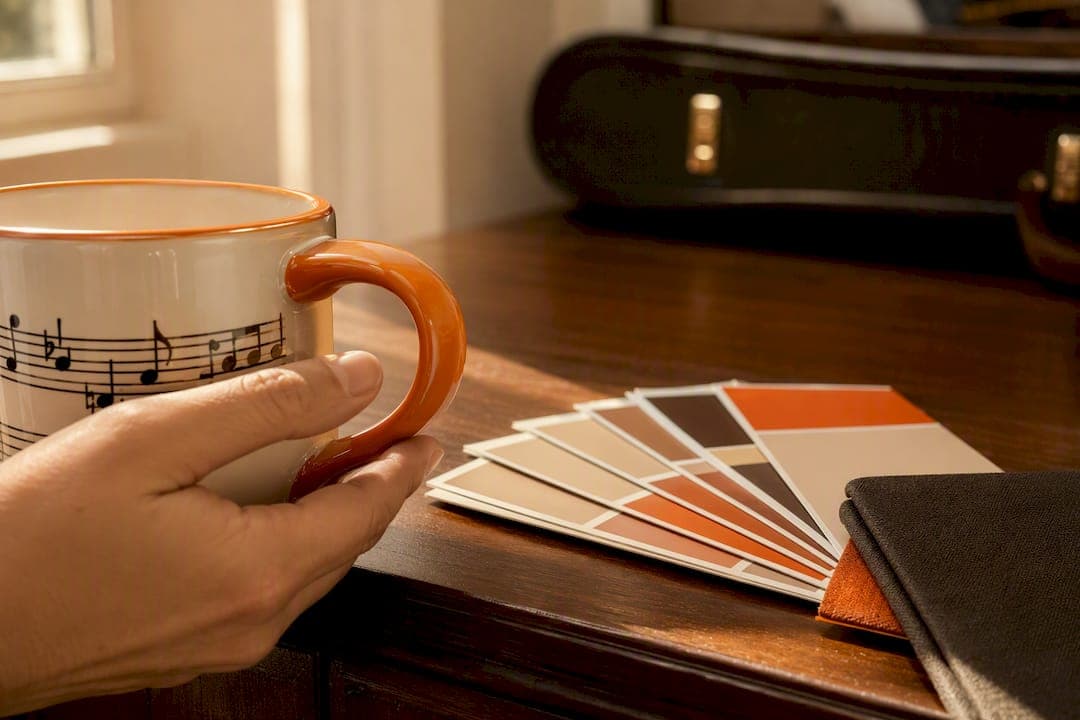
The accent on a personalised mug is the deliberate splash of colour, usually on the handle, interior, or rim, that turns a plain white shape into something designed. For most gift buyers, a two-tone ceramic mug with a tested printed finish is the safest, most durable choice. Before ordering, check the style options, character limits, and proof policy so your text or artwork actually fits.
TL;DR:
- Two-tone handle and interior accents are most common and frame exterior artwork without competing with it, suitable for confident and bold gifts.
- Short names and simple, high-contrast colours yield clearer, more legible designs, especially when paired with minimal line art for music-themed mugs.
- Printed accents are dishwasher safe and consistent for bulk orders, while hand-painted or reactive glaze finishes offer unique textures but may require gentle handling.
- Larger mug sizes like 11oz and 15oz offer better space for text and artwork, with boxed sets enhancing the presentation for special occasions.
- Always review layout, character limits, and colour contrast carefully before approving a proof to prevent design mistakes and ensure the accent complements the artwork.
Table of Contents
- What are the main accent styles on personalised mugs?
- How do you design text and artwork around a coloured accent?
- Printed, hand-painted, or reactive glaze: which lasts longest?
- What size and set should you choose for the recipient?
- What does a personalised accent mug typically cost, and how long does it take?
- How do you order a personalised mug without layout mistakes?
- What colours and two-tone palettes are usually available?
- How do you look after a mug's coloured accent and printed design?
- Why coloured accents matter more on niche, music-themed mugs
- Design your own accent mug with Mugnificentdeals
- Sources
- FAQ
What are the main accent styles on personalised mugs?
An accent is any deliberate colour break against a mug's base tone, and where it sits changes how loud or subtle the design feels. Understanding the standard formats helps you choose one that suits the recipient rather than just picking whatever appears first on a product page.
- Two-tone handle and interior: the whole handle and inner glaze share one bold colour while the outside stays white or cream. This is the most common commercial format and the one you will see most on personalised music mugs, because it frames the exterior artwork without competing with it.
- Dipped interiors: only the inside is coloured, often achieved by dipping the bisque piece into a mixed glaze before firing, a technique described in detail on Ceramic Arts Network. It is subtler, revealed only when the drinker looks in or takes a sip.
- Rim accents: a painted or glazed line around the lip, popular for a understated finish that still photographs well for gift unboxing.
- Brush or splash decoration: hand-applied streaks or spatters, giving each piece a slightly different pattern.
- Metallic trims: gold or silver rim and handle detailing, generally reserved for premium or anniversary pieces because metallic glazes cost more to fire correctly.
Bolder accents like a full handle-and-interior colour suit confident, expressive gifts. Subtler rim or dipped accents suit formal or professional recipients, such as a music teacher's desk mug.
How do you design text and artwork around a coloured accent?
Getting the layout right matters more than picking a pretty colour, because a mismatched accent can swallow a name or a caption entirely. Standard personalisation on a music-themed mug typically includes a name or short text, a photo, a small logo, or a brief message, most sitting within a character limit somewhere between 20 and 40 characters for a single line of text.
- Choose the print area first. If the handle and interior are coloured, your artwork and text stay on the white exterior panel, usually a rectangle roughly 3 inches high by 4 inches wide on a standard mug.
- Shorten long names before you design around them. A long name or nickname often needs a second line, a smaller point size, or a curved baseline rather than being crammed onto one row.
- Pick print colour by contrast, not preference. Dark navy or black text reads clearly against white or pastel accents; white or gold text works better against deep reds, forest greens, or black accents.
- Match the font weight to the artwork. A delicate violin sketch pairs better with a light serif or hand-lettered script than a heavy block font, which tends to overwhelm fine line art.
For music-themed designs specifically, simple single-colour instrument line art (a treble clef, a guitar outline, a piano keyboard strip) paired with a short caption or the recipient's name tends to read cleanly at mug scale, where a detailed illustration can blur.
Pro Tip: If you're stuck for wording, a short, specific line beats a generic one every time. "Plays first violin, drinks second coffee" says more than "World's Best Musician" ever will.
Printed, hand-painted, or reactive glaze: which lasts longest?
Production method decides both how the accent looks and how it survives the dishwasher. Printed (decal) mugs use a design applied under a clear glaze layer, producing flat, perfectly repeatable results, which is why CeraBien's buying guide notes decal methods suit anyone ordering several identical pieces. Hand-painted mugs, by contrast, carry visible brushstroke texture and small variations between units, giving each one a genuinely one-off character.
Reactive glazes sit somewhere between the two: applied by hand, but fired to produce unpredictable colour blends rather than a flat block. A tutorial from SIO-2 recommends following the glaze manufacturer's own firing guidelines closely, since underwired or overtired glaze affects both colour and durability.
- Printed accents: dishwasher and microwave safe in most cases, consistent across a bulk order.
- Hand-painted or reactive glaze accents: often dishwasher safe once properly fired, though some sellers still advise hand washing to protect fine detail.
- Thermal shock, caused by moving a hot mug straight into cold water, can cause fine glaze cracking known as crazing, according to Soul Ceramics.
A quick reality check: if you're buying six or more mugs for a school orchestra or a corporate gift run, printed accents give you visual consistency that hand-painted batches simply can't guarantee.
What size and set should you choose for the recipient?
Size drives both practicality and how the accent reads, since a larger surface gives artwork room to breathe while a smaller cup concentrates the colour more intensely.
- 11oz: the common desk mug size, well-suited for everyday coffee or tea, offering good space for text and small instrument sketches to print clearly.
- 15oz: a bigger vessel suited to tea drinkers, students pulling long study sessions, or anyone who resents refilling their cup twice before lunch.
- Espresso-style cups: best kept plain or with a minimal rim accent, since there is little room for text at that scale.
For presentation, a boxed set or matching coaster lifts a mug from "nice cup" to a considered gift, particularly for teacher gifts or retirement presents where unboxing matters. Bold two-tone accents in a section colour (school or orchestra branding, for instance) suit corporate or ensemble gifts, while a softer dipped interior or rim accent tends to feel more personal for a one-to-one keepsake.
What does a personalised accent mug typically cost, and how long does it take?
Prices for a personalised two-tone ceramic mug generally sit in a mid-range gift bracket, with common add-ons like a matching coaster, gift box, or gift wrap pushing the total up modestly. Exact current pricing for Mugnificentdeals' own ranges is listed on the site rather than fixed here, since product lines and options change.
- Standard production usually takes several working days before dispatch, covering design proofing, printing, and firing or curing time.
- Rush fulfilment is often available for an extra fee where deadlines are tight, useful for last-minute birthdays or recitals.
- A proof stage, where you approve a digital mock-up before printing, adds a short delay but prevents a costly reprint over a misspelled name.
- Character limits directly affect turnaround, since text that overflows the design template usually triggers a manual review or a request to shorten it.
Choose a tracked delivery option whenever the mug is a gift rather than a personal purchase. A untracked parcel arriving late, or not at all, undoes all the thought that went into the design.
How do you order a personalised mug without layout mistakes?
A short checklist prevents the two most common errors: text that doesn't fit and colours that clash once printed.
- Pick the accent style and size before designing anything. A rim accent, a full handle-and-interior colour, and a dipped interior all use different print templates, so choosing late means redoing your layout.
- Upload your photo or enter your text, then check the mock-up against the accent colour, not just against a white background.
- Review the proof carefully. Check spelling, character counts, and whether long names have wrapped sensibly onto a second line.
- Approve the final artwork only once you're satisfied, since most sellers won't reprint free of charge after approval.
- Choose gift wrapping, a coaster, and your delivery speed, then place the order.
Following this order, style first, layout second, proof third, stops the most common mistake: designing beautiful artwork that turns out illegible against a navy handle you chose as an afterthought.
What colours and two-tone palettes are usually available?
Most sellers work from a fixed palette rather than offering unlimited custom colour matching, largely because glaze colours behave differently at firing temperature and only a tested set gives consistent results. Commercial two-tone product listings, including the range shown by Photobubble, typically list around six core options: red, blue, black, pink, green, and yellow.
Red and black accents tend to read as bold and confident, suited to a drummer or a rock guitarist. Blue and green lean calmer, a natural fit for a piano teacher or a classical musician. Pink is popular for younger recipients or playful gift orders, while yellow adds contrast without the heaviness of a darker tone.
Colour choice isn't purely decorative, either. Research summarised by Cheralle suggests mug colour can subtly influence perceived taste and mood, with brands often pairing cobalt blue with dark roast coffee and softer pastels with milkier drinks. If you don't know the recipient's exact preference, a safer neutral like navy or black rarely clashes with anything they already own. If you know they've got a bold personality, a red or bright pink handle says so before they've even read the text.
Metallic trims occasionally appear as a premium option alongside the standard six, usually priced higher because gold and silver glazes need more careful firing control. Ask about availability before assuming every seller offers them.
How do you look after a mug's coloured accent and printed design?
Coloured accents and printed designs both last considerably longer with a few simple habits, most of which cost nothing beyond a moment's patience.
Hand washing is the safest default for hand-painted or reactive-glaze pieces, even when a listing states they're dishwasher safe, because repeated hot cycles gradually dull fine brushwork faster than a printed decal. Printed two-tone mugs generally tolerate the dishwasher well, but stacking them tightly against other crockery risks chipping the rim, which is usually where an accent first shows wear.
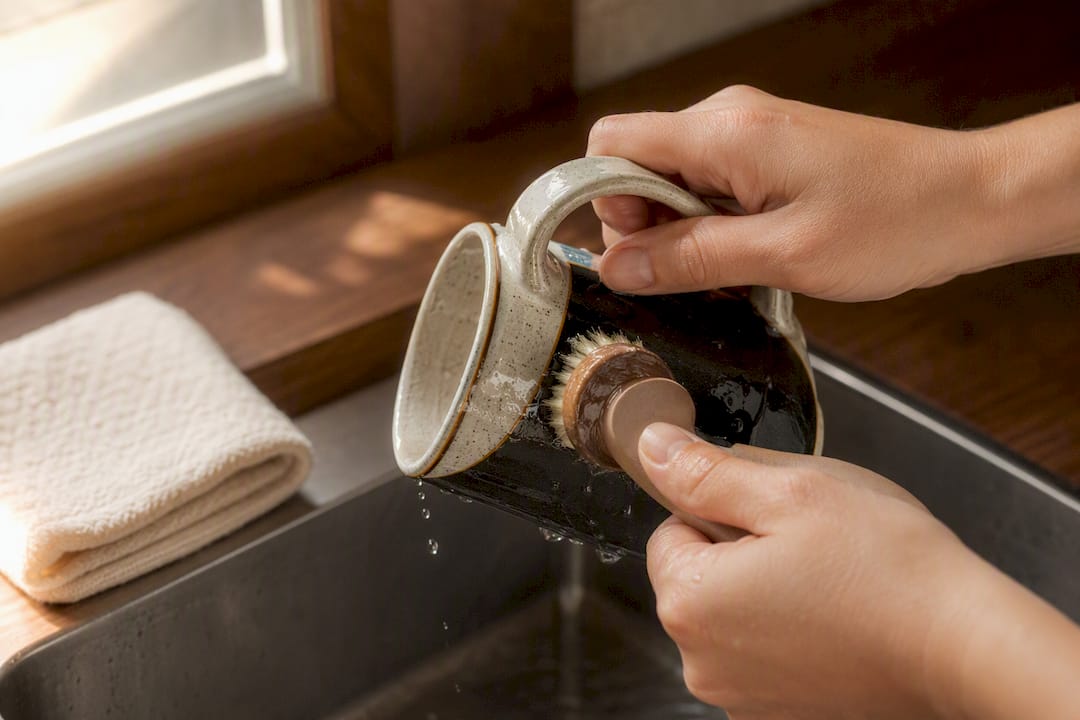
The single most useful habit is temperature management. Letting a mug cool before rinsing it in cold water reduces the risk of crazing, the fine network of surface cracks that develops when hot glaze meets a sudden cold shock, as Soul Ceramics explains. Once crazing sets in, it's permanent and tends to trap tea and coffee staining along the cracks.
A few more habits worth adopting:
- Avoid abrasive sponges or scouring pads on printed text, since repeated scrubbing wears the surface layer faster than normal washing.
- Skip the microwave for hand-painted or metallic-trim mugs unless the listing explicitly confirms it's microwave safe.
- Store mugs upright rather than stacked handle-to-handle, which reduces chip risk on accent rims.
Treat a personalised mug the way you'd treat any well-made ceramic: gentle heat changes, a soft sponge, and it should hold its colour and crispness for years of daily use.
Why coloured accents matter more on niche, music-themed mugs
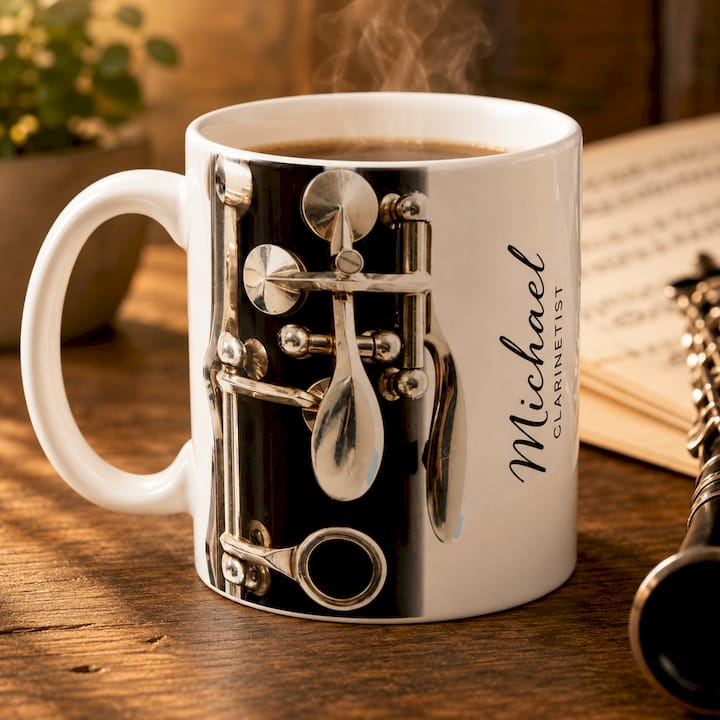
A plain white mug with a name on it reads as an afterthought. A two-tone mug with a considered accent colour, paired with a simple instrument sketch or a well-chosen music line, reads as something someone actually thought about. That distinction is exactly where niche personalisation earns its keep over generic gift-shop printing.
The artwork is kept minimal, a clean clef, a line-drawn guitar, so it doesn't fight with the accent colour for attention. The colour does the visual heavy lifting; the line art does the storytelling. Buyers should expect that pairing to be handled with the same care as the printing itself, not treated as decoration bolted on afterwards.
— Lasse
Design your own accent mug with Mugnificentdeals
This brand is a specialist route to a personalised music mug when generic gift shops only offer bland templates dressed up as customisation. Every design starts from music-focused artwork, instrument sketches, composer references, or a music-in-joke, built to pair properly with a two-tone accent rather than fight it.
Browse the full personalised music mugs collection to see current accent colours and styles, or head straight to the instrument personalised sketch mugs if a hand-drawn violin, guitar, or piano is what you're picturing. Prefer something for a music history buff? The Composer Music history Mugs range covers that ground too. Character limits and mock-up guidance are covered in the brand's own custom mug design guide, so you'll know exactly how your text and artwork will sit before you approve anything. Pick your accent colour, upload your design or text, and get a proof back before it goes anywhere near a kiln.
Sources
- How to make color-blocked illustrations with underglaze — Ceramic Arts Network
- Decorate your mug with ceramic glazes — SIO-2 (GB blog)
- How to choose the perfect handmade ceramic coffee mug | CeraBien
- Crazing and pottery glaze care — Soul Ceramics
FAQ
What should you write on a personalised mug?
Short and specific always beats generic. A name, a nickname, an instrument in-joke, or a line like "plays first violin, drinks second coffee" works better than a stock phrase, and the inside joke ideas for mugs guide has ready-to-copy examples if you're stuck.
What is an accent mug?
An accent mug is a two-tone ceramic mug where the handle, interior, or rim carries a colour different from the main body, often paired with printed or hand-painted personalisation. The colour break is deliberate, designed to frame the artwork or text rather than compete with it.
Does a permanent marker stay on ceramic mugs?
Marker ink can work as a temporary DIY option, but it isn't durable: it fades and wears off with washing and normal handling far faster than a professionally printed or fired design. For anything meant to last, a proper printed decal or hand-painted glaze finish, fired at the correct temperature, holds up considerably better over daily use.
What are some creative ideas for personalising a mug?
Popular options include a minimal instrument line sketch paired with a name, a short music quote, a composer's name for a classical fan, or a photo mug for a sentimental gift. Pairing any of these with a bold or subtle accent colour, chosen to suit the recipient's personality, is what separates a considered gift from a generic one.
How much does a personalised accent mug from Mugnificentdeals cost?
Current prices for Mugnificentdeals' personalised music mugs are listed directly on the product collection page, since pricing varies by design and options chosen. Checking there gives you the exact figure for the specific mug and accent style you want.